Home Blog Page 79

Thrills and chills: North America’s most spectacular winter destinations

0

You know it’s winter in North America when ads promoting the Caribbean, Mexico and Hawaii start appearing in droves in newspapers and online. The message: winter is something you should flee.

Counterpoint: those balmy destinations are great year-round. The places that hit peak beauty at the chilliest times of year, on the other hand, are at their best for a short length of time. So grab your parka, embrace the chill and be one of the few to see these rare moments of winter wonder.

Snowshoe through Bryce Canyon National Park, Utah

Towering red rock hoodoos melting away into rolling badlands under blue jay skies: Bryce Canyon is a stunner at any time of year, but a dusting of snow turns it into a crystalline fairyland. The other benefit of a winter visit: solitude. The height of summer sees 15 times the number of visitors that come during the snowy months. With fresh snow, Bryce Canyon becomes one of the premier snowshoeing destinations in the US. If you don’t have your own, join one of the ranger-guided snowshoe walks where a pair is provided free of charge.

These other US National Parks are pretty stunning too.

Bubbles trapped in the frozen water of Abraham Lake, Canada
Bubbles trapped in the frozen depths of Abraham Lake, Canada

Admire the bubbles at Abraham Lake, Alberta

If Banff and Jasper National Parks don’t fully satisfy your craving for winter beauty, just outside the parks sits Abraham Lake with a peculiar claim to fame: beautiful bubbles. When the lake freezes over, methane released from decaying matter on the lakebed becomes trapped in the ice, creating a remarkable effect that draws photographers from around the world. To see the beautiful bubbles in person, timing is everything. Go after the lake has fully frozen and is safe to skate on, but while the ice is still clear enough to see through – usually late December into January. And bundle up – this is one chilly adventure.

Find the perfect place to stay in the region.

The last light of day creating a 'firefall' effect at Horsetail Falls, Yosemite National Park
The ‘firefall’ effect at Horsetail Falls, Yosemite National Park, only occurs in winter 

Catch a show at Horsetail Falls, Yosemite National Park

For most of the year, wispy Horsetail Falls is one of the least remarkable waterfalls in Yosemite Valley, but for about two weeks in mid- to late February, it’s the star of the show. At sunset, when the winter light is just right, Horsetail Falls lights up like a stream of fire flowing off El Capitan, reminiscent of the long-gone tradition of the Yosemite Firefall when burning embers from a bonfire were pushed over the edge of Glacier Point for the enjoyment of visitors below. This natural firefall is popular with photographers, so you now need to apply for a permit from the Ansel Adams Gallery to park along the key stretch of Northside Drive near El Capitan (you can also walk or take the free shuttle, no permit required). At the coldest times of winter, also watch for frazil ice: frozen mist crystals from Yosemite Falls that wash down the creek making a frozen slurry that flows like white lava.

Never been to Yosemite? We’ve got you covered.

The Northern Lights in the sky above a van parked near Fairbanks, Alaska
Fairbanks, Alaska, is a good place to witness the Northern Lights 

Experience the lights in Fairbanks, Alaska

Winter is the season for the northern hemisphere’s most spectacular light show: the aurora borealis, aka the Northern Lights, and Fairbanks has everything you need: most importantly, an international airport really far north. The Northern Lights won’t always come to you – it can take some patience, a little luck and some stalking. For the best viewing, head away from the lights of town. Popular viewing spots include Creamer’s Field, a bird sanctuary on the north of side of Fairbanks, and along Chena Hot Springs Road. For a more adventurous approach, guided tours leave from Fairbanks taking you north along the famous Dalton Highway across the Arctic Circle to Coldfoot and Gates of the Arctic National Park and Preserve.

Chena Hot Springs is worth a trip.

A wintry scene near Old Faithful in Yellowstone National Park
Yellowstone National Park is just as magical as ever in winter 

Wander with wildlife in Yellowstone National Park, Wyoming

With the exception of a short stretch of road to Mammoth Hot Springs, Yellowstone National Park shuts down to car traffic every year in early November – but that doesn’t mean you can’t go. Old Faithful Snow Lodge and Mammoth Hot Springs Hotel remain open all year, and once enough snow accumulates (usually by mid-December), roads open to snowmobiles and snow coaches. In winter, Yellowstone’s famed geysers and other geothermal features make the snow-blanketed landscape steamy and mysterious. For wildlife lovers, look for bison keeping warm near steaming hot springs, migrating herds of elk, foxes donning their winter coats, and the always elusive wolf. Free, ranger-led snowshoe walks are available, and local guides offer a range of skiing, snowshoeing and snowmobiling tours throughout the cold season.

See the best of winter wildlife in Yellowstone

A stone lying on the Racetrack Playa, Death Valley National Park
One of the mysterious stones of the Racetrack Playa, Death Valley National Park 

Experience the weird at Racetrack Playa, Death Valley National Park

Until quite recently, the ‘sailing stones’ of Racetrack Playa were a long-standing mystery of Death Valley National Park. Any traveler who makes the long, bumpy trek to the flat playa will see that numerous large rocks have, over time, carved clear, meandering trails across the desert floor. How do they move? Since the 1940s, dozens of theories piled up until researchers finally cracked the case in 2014. The culprit: winter. Thin sheets of ice that form on the playa floor melt in the morning sun, and wind pushes the floating ice against the rock, pushing them along at up to five meters per minute. The Racetrack can be visited at other times of year, but winter is one of the most pleasant times to visit what is often the hottest spot in the US.

The US is full of strange and wonderful places

A woman ice-climbing at Ouray, Colorado
Test your nerve with an ice climb at Ouray, Colorado 

Ice climb in Ouray Ice Park, Colorado

What do you get when you combine an abundant source of spring water with 7500 feet of irrigation pipe, over 100 shower heads, and a cold, shady gorge in the Rockies? You get the world’s first public ice climbing park with over 200 climbs, and it’s all free. Gear can be rented from several nearby outfitters, and multiple local services are permitted to provide training and guide services for all levels. At the annual Ouray Ice Festival in January, you can watch the best ice climbers in the world compete.

Try these other Colorado adventures while you’re at it

A woman standing amid giant trees in snow-covered forest, Sequoia National Park, California, USA
Winter is a great time to be dumbstruck by the giants of Sequoia National Park 

Contemplate in Sequoia National Park, California

Few things on Earth will alter your perspective more than standing next to a giant sequoia. Even better, stand next to a giant sequoia in the snow with no one around to interrupt your thoughts. An adult blue whale, the largest animal, can weigh 190 tonnes; the General Sherman tree in Sequoia National Park is estimated to weigh 2100 tonnes, and it’s a relative youngster at around 2000 years old. At the Giant Forest and Grant Grove you can join free ranger-led snowshoe hikes, or you can head out on your own on many of the park’s trails. If the kids aren’t up for a long trek in the snow to see more trees, Wolverton Meadow has a winter snow-play area, and you can warm up with a hot cocoa at the Wuksachi Lodge.

Californias has so much to do in the winter

A flock of snow geese take flight in Bosque del Apache National Wildlife Refuge, New Mexico
Winter mornings are noisy affairs in Bosque del Apache National Wildlife Refuge, New Mexico 

Go birding in Bosque del Apache National Wildlife Refuge, New Mexico

People aren’t the only travelers that flee the cold of winter. Every winter, hundreds of thousands of migratory birds including snow geese and sandhill cranes flock to the marshes and grasslands of Bosque del Apache National Wildlife Refuge south of Socorro, New Mexico, one of the most dramatic birding destinations in North America. Explore the web of trails on foot, or drive the 12-mile auto tour loop to see hawks, eagles, ospreys and more. Come at sunrise to see huge flocks of geese taking off in search of food, and bring your binoculars and your zoom lens. The peak season is December and January, but you can always check the park’s online bird tracker to see the latest avian arrivals.
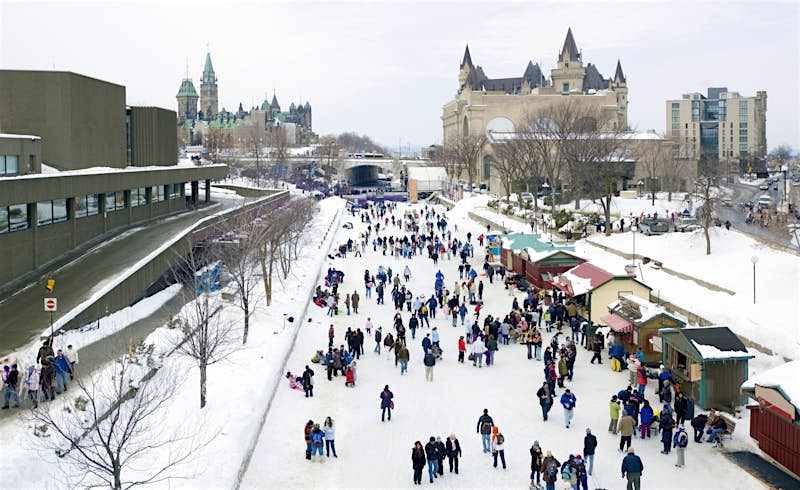
Skaters on Rideau Canal, Ottawa
Get your skates on to enjoy Ottawa’s historic Rideau Canal

Ice skate the Rideau Canal, Ottawa

Ottawa’s historic Rideau Canal – one of Canada’s Unesco World Heritage Sites – is the oldest continuously operated canal system in North America. In the winter, the boats disappear, the canal freezes over and it transforms into the world’s largest ice rink. Lace up your skates and explore the 7.8 km of glassy ice that runs from downtown Ottawa to Dow’s Lake. There’s no need to make this a marathon outing; skating the canal can be as leisurely as you want to make it. Heated rest stops dot the skateway, skates can be rented at numerous spots, and you can warm up with freshly fried beavertails from vendors along the route (donut-like slabs of dough – no beavers are harmed in the process). But don’t dawdle too long – the skating season is only 50 days long on average.

Spend a perfect 24 hours in Ottawa.

Frozen Minnehaha Falls
The Minnehaha Falls become an elaborate ice sculpture in the harsh Minnesota winter 

Minnehaha Falls, Minneapolis, Minnesota

Not all winter wonders require a journey out into the frozen middle of nowhere; a few can be found within easy reach of big-city comforts. Minnehaha Falls, made famous by Longfellow’s poem The Song of Hiawatha, can be easily enjoyed within the city limits of Minneapolis. In the cold winters of Minnesota, the 53-foot waterfall freezes solid, forming a dramatic curtain of ice. Enjoy the frozen falls from a safe distance at the open viewing areas – the City of Minneapolis issues dozens of citations every year for people that venture down into the closed area around the base of the falls.

Why I live in both Madrid and Barcelona – and which city I prefer

0

In Spain, the Madrid vs Barcelona debate is serious business. Which is a better place to live or to visit? They both have their pros and cons – Barcelona has its famous Modernista architecture and miles upon miles of beaches. Madrid, on the other hand, is the pretty-yet-gritty capital city: world-class museums, restaurants galore, and so much nightlife that occasionally going to work on less than an hour of sleep is a point of pride for locals.

These days, I’m living in both, so I have a horse in both races. As a freelance writer, I don’t really have to be anywhere in particular, so I’m more or less free to be where I love.

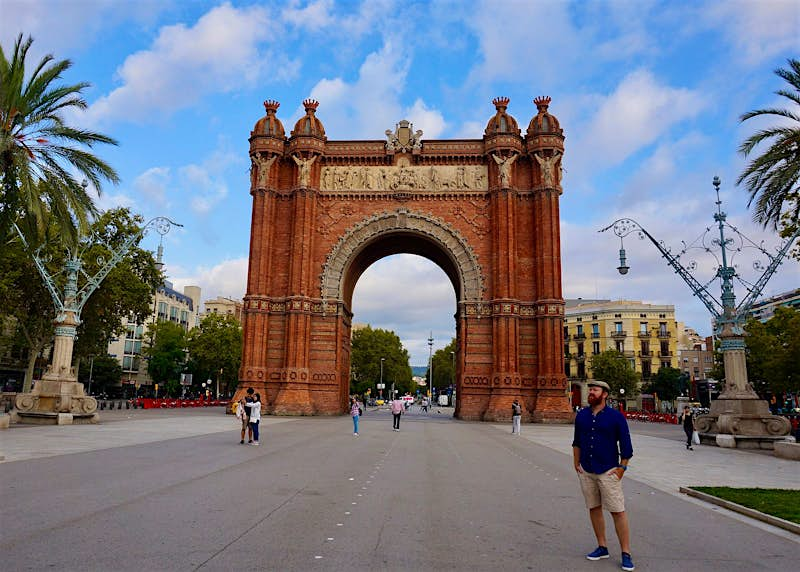
Writer Daniel poses in front of Barcelona's Arc de Triomf, a huge freestanding red-brick arch; he wears beige shorts, a blue shirt and a flat cap.
Daniel at Barcelona’s Arc de Triomf 

And for most of my adult life, that’s been Madrid. But when my girlfriend suddenly got a job in Barcelona last year, we decided to pick up and move. Sort of.

Actually, I kept my flat in Madrid. To be honest, I was half expecting the charm of the capital to wear off after a couple of months of beachside living, but it didn’t. So now, I’m making it official. I live in two cities, and love them both.

Madrid vs Barcelona: which is better?

Really, it’s hard to say that one is better than the other, because in a lot of ways they’re different. Barcelona has a noticeable French influence seen in its Catalan Modernist architecture, and of course its own language and regional independence movement. The Mediterranean climate means it’s not too hot or too cold, and then there are the beaches. All those long golden beaches.

Madrid, on the other hand, is the centre of Spain: usually either too hot or too cold, it’s less stunning architecturally and much less tourist-focused. And it’s probably better not to talk about our version of the beach. Just go to Parque Retiro to relax and cool off in the shade or have a nice walk by the Manzanares River. Maybe try to make friends with someone who lives near a swimming pool.

Having said that, Madrid has a strange sort of hold on many people – I’m far from being the only one who came for a week and found myself still there a decade later.

Daniel sits at an outdoor table with a pint of beer on it, wearing a hoodie and looking to the side; the grey stone wall behind him is covered with graffiti.
Daniel out for a pint in Madrid 

Food in Madrid and Barcelona

One thing you can say about nearly anywhere in Spain: the food’s great. And Madrid and Barcelona are no exceptions. From the typical taverns to newer gastropubs and international cuisine from around the world, there are thousands of restaurants and bars in each city.

Thinking about it, though, Madrid’s star dishes don’t seem as stellar when compared to Barcelona’s. In the capital, we’ve got cocido madrileño (a meaty chickpea soup) and callos a la madrileña (a thick stew made of tripe and other cow parts). Try local classics like Casa Jacinto for the cocido and Casa Toni for callos.

In any case, dishes like those are not nearly as glamorous as some of the Catalan specialities you can find in Barcelona: bomba catalana (a potato croquette stuffed with ground beef) at La Cova Fumada or esqueixada at Can Ramonet – also known as Catalan ceviche, it’s a cold dish made of marinated salt cod.

There’s no reason to stop at local cuisine, though: Spain has many other regional cuisines, and vibrant immigrant communities mean you can find restaurants serving typical dishes from nearly anywhere in the world.

People in boats by the Monument to Alfonso XII in Madrid's Parque del Buen Retiro
Madrid’s Parque del Buen Retiro is the perfect place to relax 

Travelling from Madrid and Barcelona

One thing I didn’t appreciate enough when I was living in Madrid full-time is that it’s just so well-connected to the rest of Spain and Europe. As the major hub for Iberia airlines as well as the AVE high-speed train network, Madrid feels close to almost everywhere.

On the other hand, Barcelona is close to France, which means you can take a short flight and spend the weekend in Bordeaux for some wine culture or Marseille to soak up the grit and grandeur of the famously multicultural port city. The beaches and nature of Mallorca and Menorca aren’t far either, nor is the night life in Ibiza. But all in all, being in Barcelona means it’s a bit harder to travel around Spain.

If you want to take a day trip from Madrid, you’ll find it’s close to towns like Toledo, which is famous for its mix of Gothic and Mudéjar architecture, and Segovia with its massive Roman aqueduct and Alcázar fortress.

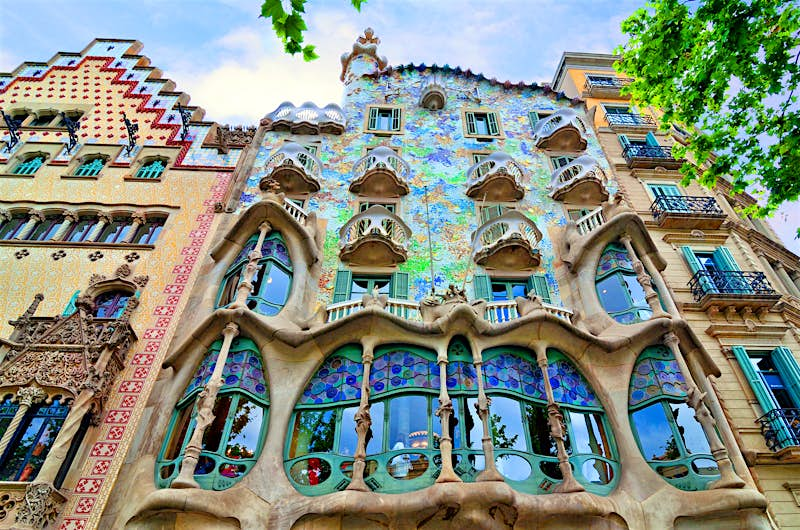
A low-level view of the whimsical facade of Casa Batlló in Barcelona; it is sprinkled with bits of blue, mauve and green tiles and studded with wave-shaped window frames and balconies, rising to an uneven roof with a solitary tower.
Barcelona is full of crowd-pleasing buildings like Casa Batlló 

Barcelona is tourist heaven… Madrid, not so much

When friends have come to visit me in Madrid, it’s not always clear what I should show them. It’s a great city to live in, but after you’ve seen Museo del Prado, Reina Sofía and Plaza Mayor, there aren’t loads of big-name attractions left. Because Madrid’s not about tourism, and that’s one of the reasons I love it. Instead, it’s about the lazy Sunday afternoons having vermouth in La Latina; the nightlife in Malasaña; the taverns and tapas and terrazas.

Barcelona, on the other hand, is tourist paradise. The beaches, the bike tours, the whole Barri Gòtic neighbourhood are all set up for the enjoyment of tourists. (Fun fact: much of Gótico was actually built in the early 20th century, as a tourist attraction for visitors to the 1929 International Expo). And then there’s Gaudí and his world-famous architecture: monuments like the perennially unfinished La Sagrada Familia, Casa Batlló, and Parc Güell attract long lines of visitors nearly every day of the year.

In Barcelona, prices are higher – you’ll be charged for every tapa. But in Madrid, the tapas are free with drinks, and the prices are more reasonable. Spending 6 euros for breakfast in Madrid used to seem like the height of luxurious waste. Not any more. In some areas of Barcelona you can barely get an orange juice for that much.

And there’s a bigger downside which is Barcelona’s overtourism problem. Cruise ships the size of stadiums pull in and out of the port several times a day. And recently, things have reached a point where neighbourhoods have protested against rising rents and you can see ‘Tourists Go Home’ on posters and graffiti around town.

Looking down over Madrid's Gran Vía, which is full of tall handsome buildings including one in the foreground with a gilded cupola; beyond, the Madrid skyline stretches into the distance.
Madrid’s iconic Gran Vía 

So which Spanish city has my heart?

I’ve thought about it a lot. And while Barcelona might seem to be the city with more going for it, I still love Madrid. After all, I spent most of my adult life wandering through the neighbourhoods of the capital. You can’t beat things like watching the moon rise over the ocean here in Barcelona. But in the end, Madrid has my heart.

Iceland’s WOW Air to relaunch next month with a difference

0

Icelandic budget airline WOW Air ceased operations in March 2019 when it went bankrupt but it’s staging a comeback in October thanks to a major investment from an American company.

WOW Air plans to relaunch in October. Image by Yuriko Nakao/Getty

Before it collapsed in March, WOW Air’s purple jets delivered more than one-fourth of all international visitors to Iceland thanks to low-cost flights for as little as US$49. When it ceased operations in March and stranded thousands of customers in the process, the rugged island nation suffered a notable drop in tourist numbers, which had a negative effect on the economy. Former WOW Air CEO Skúli Mogensen said that time ran out before the airline was able to find funding to keep them operational. But now WOW Air is coming back into the picture after American company USAerospace Associates injected $85 million into the business, according to Visir.

Introducing Iceland

Introducing Iceland

Start exploring Iceland with Lonely Planet’s video guide to getting around, when to go and the top things to do while you’re there.

USAerospace Associates’ Chairman, Michele Ballarin made the announcement at a press conference in Iceland last week, revealing that while the name remains the same, there there are some changes underfoot with the new ownership. For a start, they’re taking things slowly by relaunching with just two planes in October, though there is the potential to increase that number to more than 10 aircraft by summer 2020. Operations will be based at Dulles International Airport in Washington DC this time with facilities in Reykjavík and nearby Keflavik International Airport.

shutterstockRF_316413347.jpg
Iceland is suffering a pronounced drop in tourists. Image by Dennis van de 

The company is also aiming to revamp the passenger experience with perks such as airport lounges and in-flight meals created by a Michelin-starred chef, suggesting that WOW Air may not be relaunching with the low-cost flights it was renowned for.

WOW Air hasn’t made any official announcements from its website yet, which expired earlier this summer.

The ‘Place of Elephants’: why Gonarezhou National Park is Zimbabwe’s rising star

0
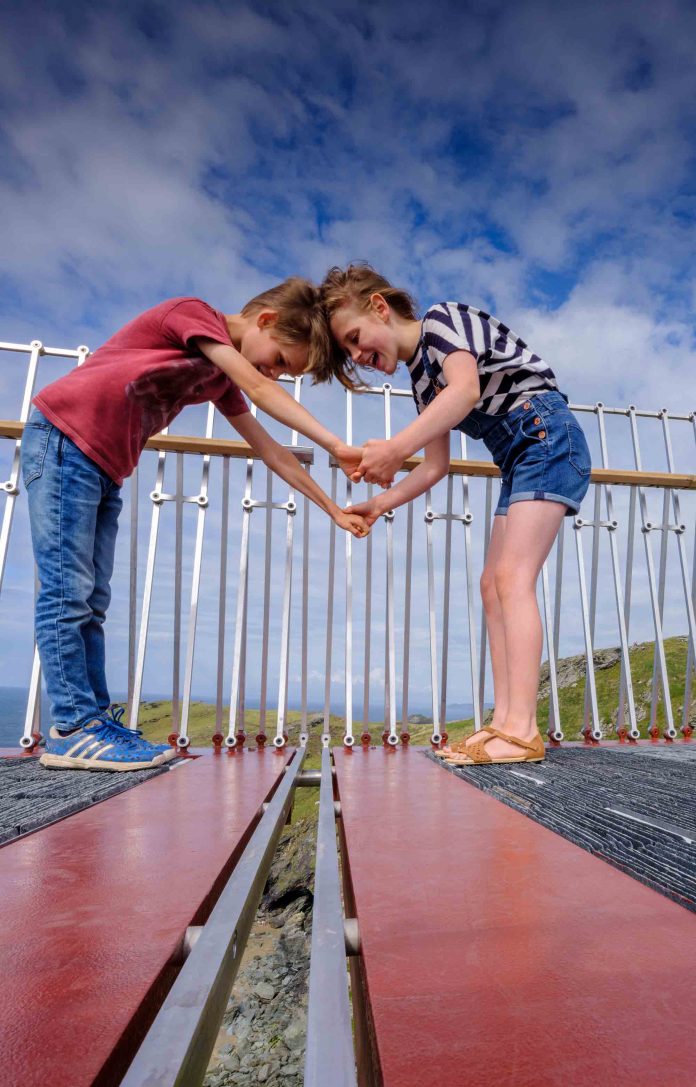
Tintagel, UK. 5, August, 2019. Tintagel Castle ahead of the opening of the new bridge due to open this week.

Zimbabwe defies expectations and preconceptions. Travellers who come here despite its political and economic woes discover a remarkable, resilient and safe country with spectacular landscapes, myriad wildlife, cool camps and lodges, and top-class safari guides.

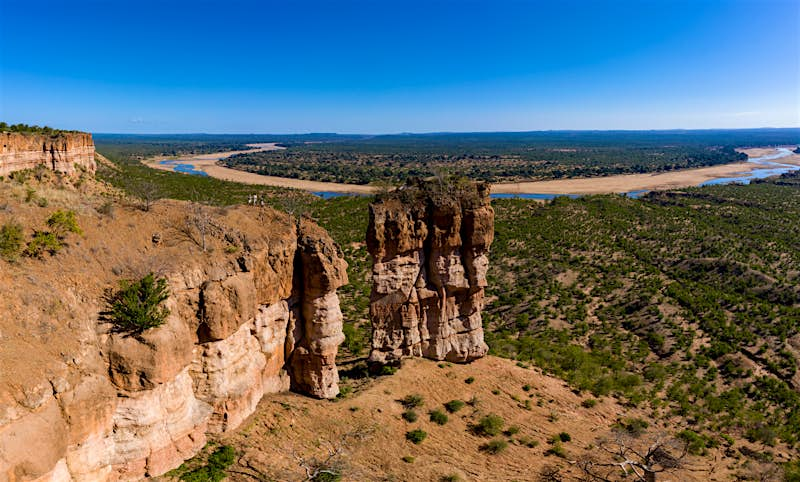
A group of three people stand on the slope between the two-stepped Chilojo Cliffs; in the distance is a huge horseshoe bend in the Runde River.
A guided group of hikers on the flanks of Chilojo Cliffs are dwarfed by the surroundings and the distant bend in the Runde River

Its star attraction is the dramatic, bone-drenching Victoria Falls, the largest curtain of falling water in the world. Others include Hwange, the country’s largest national park, renowned for its huge herds of elephants. Magical Mana Pools National Park, a Unesco site on the banks of the Zambezi, offers camping, canoeing and walking. And Lake Kariba, a vast inland sea, has unforgettable sunrises with wildlife-rich Matusadona National Park on its shores.

Few visitors, however, make the journey to Gonarezhou. In the south-eastern corner of the country and an eight-hour drive or 90-minute flight from Harare, this remote national park hasn’t yet made it onto the travellers’ radar. But it soon will.  With an incredible story of regeneration, conservation and hope for local communities, Gonarezhou is Zimbabwe’s rising star.

Three elephants cavort in the shallows of the Runde River, with the Chilojo Cliffs in the background.
With 11,000 elephants and staggering landscapes, the 5035-sq-km Gonarezhou National Park has huge tourism potential 

The ‘Place of Elephants’

Gonarezhou means ‘The Place of Elephants’, an apt name for a reserve that’s home to almost 11,000 pachyderms. Spanning 5035 sq km, the second largest national park in Zimbabwe is one of Africa’s last great wildernesses, raw and unfettered, a place of space and big skies, of ever-changing landscapes.

Crocs and hippos wallow in the sweeping Save and Runde sand rivers. The floodplains and forests of mopane, mahogany and giant baobabs are home to over 150 mammal species from prancing impala, wildebeest, warthogs and zebra to graceful giraffe, eland, buffalo and huge herds of elephants. Predators include lions, spotted and even brown hyena, and a staggering 12 packs of rare African wild dogs. Among its 400 bird species are majestic African fish eagles, spoon-bills and Pel’s fishing-owls, with the lily-strewn Tembwehata Pan and nearby Machaniwa Pan both classed as Important Birding Areas.

And at the heart of Gonarezhou stand the dramatic Chilojo Cliffs, almost 200m high and 16km long, in sandstone tiers of cream, pink and terracotta that glow gold at sunset.


Troubled past

Gonarezhou has a troubled history. In 1968, the Shangaan people living in the reserve were moved out to allow tsetse fly control; animals in the affected areas were culled. Gazetted as a national park in 1975, Gonarezhou soon became embroiled in civil wars, both Zimbabwe’s and Mozambique’s, with which it shares a border. During the conflicts, wildlife was caught in the crossfire.

With Zimbabwe’s independence in 1980, the Shangaan wanted to return to their homeland but were refused as the government focused on conserving the park. Many went back regardless, including people from Mahenye village that borders the Park’s northern boundary. Poaching was rife and battles with rangers frequent and fierce.

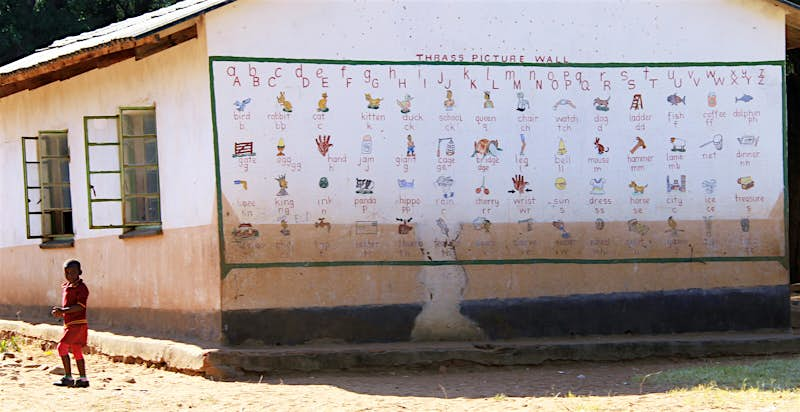
A young child stands next to a single-room school with two windows; painted on the end exterior wall is the alphabet and images for each letter
The Mahenye village school, funded by the proceeds of the Campfire concept © Will Whitford

Communities and Campfire

Out of this chaos, the concept of Campfire was born (Communal Area Management Programme for Indigenous Resources). Clive Stockil, a missionary’s son born and bred in Mahenye, and regarded as an honorary Shangaan, realised if communities owned the wildlife on communal lands and benefited from it, they would protect it. Following tense negotiations, limited hunting safaris were eventually allowed outside the park with an annual quota of two elephants: the meat and money went to the community.

By 1983, the first school was built in Mahenye from the proceeds, and poaching dropped dramatically from one of the highest to one of the lowest rates in the country. Campfire became a blueprint for community partnerships in wildlife regions across Africa, and Clive became a renowned conservationist.

Today, after the troubles of the past, the people of Mahenye are settled there. Home to 6000 Shangaan living in traditional homesteads of mud and thatch huts with cattle kraalls, grain stores and chicken pens on stilts, the village now has a clinic, schools, boreholes and grinding mills provided through the Campfire initiative. And although it’s early days, they’re taking steps to create the new Jamanda Conservancy, having recently relinquished 121 sq km of their land abutting Gonarezhou for wildlife conservation and photographic safaris.

A group of 13 giraffe standing side-by-side in long grasses and backed by acacia trees; the light is golden with a blue sky above.
A tower of giraffes in Gonarezhou, a park where wildlife is once again on the rise 

Gonarezhou’s new beginnings

During Mugabe’s disastrous economic management, the beleaguered national park struggled again with no resources to protect wildlife. In 2007, Zimbabwe Parks and Wildlife Management Authority (ZPWMA) invited Frankfurt Zoological Society (FZS) to help restore the Park, with FZS initially supporting anti-poaching patrols, better training and improved infrastructure.

Ten years on, FZS and ZPWMA strengthened their partnership by forming the new Gonarezhou Conservation Trust (GCT) to manage the Park for 20 years: the Trust is transforming Gonarezhou into the thriving park it is today.

With wildlife populations booming, elephants, buffalo, lions and leopards make regular appearances. The only thing that’s missing is rhinos, poached to local extinction in the 1990s. Next year, however, all being well, GCT hopes to reintroduce rare black rhinos in a new conservation initiative to make Gonarezhou a Big Five (lion, leopard, rhino, elephant and buffalo) destination.

For all their success, however, conservation won’t work without communities on board. Villages that border the park live with elephants sometimes raiding their crops or lions killing their livestock. GCT is now closely involved with villagers through regular meetings to discuss such challenges. And through an education programme and workshops run by GCT’s Chilojo Club, people are learning about better protecting their crops and animals, about understanding animal behaviour and about conservation.

However, the greatest opportunity conservation brings is employment. GCT has opened a training centre for local people, a first for the area, and itself employs nearly 250 staff, 85% of them local.

Such opportunities are only likely to rise as Gonarezhou makes its rightful mark on the traveller’s radar and more visitors come to explore its wild, raw beauty.

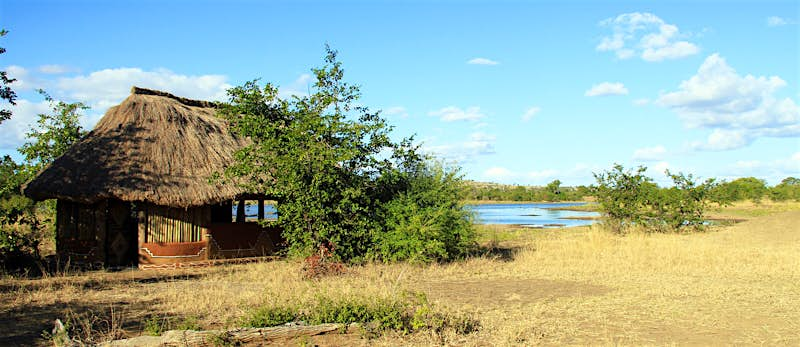
A thatched-roof, open-sided accommodation structure on the banks of a river; some trees shade the building.
One of the bedrooms at the new managas camps, which are run by local women 

Where to stay 

Don’t expect masses of lodges and camps – what’s special about Gonarezhou is that it’s still a rare unspoilt wilderness.

The park runs campsites for self-drivers, from fabulous wild camping areas like Director’s near Chilojo Cliffs, where the only facility is a long-drop loo, to en suite tents complete with kitchens at Chipinda Pools. Unique manangas are a new style of camp with a light footprint, built and run by local women and replicating traditional homes, with a communal kitchen and dining area. Choose Masasani Mananga for daily sightings of elephants and antelopes coming to drink at the dam.

Beautiful Gonarezhou Bush Camp, a more upmarket camp, offers excellent private guiding with Ant Kaschula and five comfortable en suite tents overlooking Chilojo Cliffs and the river.

The closest lodge is Clive Stockil’s luxury Chilo Gorge on Mahenye’s communal lands. High on a cliff looking down into a spectacular gorge and the Save River, staff are predominantly local and the community receives lease fees and a percentage of its income.

Turkey’s treasures: 7 incredible ancient sites

0
Backpacker Index: 137 global destinations for 2019 (Totals below are recalculated by exchange rate and re-ranked daily) Cheapest to most expensive 1. $18.21 Hanoi, Viet Nam 2. $19.36 Vientiane, Laos 3. $19.38 Saigon (Ho Chi Minh City), Viet Nam 4. $20.05 Yangon, Myanmar 5. $20.43 Granada (Nicaragua), Nicaragua 6. $20.92 Pokhara, Nepal 7. $21.11 Hoi An, Viet Nam 8. $21.12 Chiang Mai, Thailand 9. $21.90 Quito, Ecuador 10. $22.23 Phnom Penh, Cambodia 11. $23.02 Delhi, India 12. $24.13 Kathmandu, Nepal 13. $24.68 Jakarta, Indonesia 14. $24.92 Zanzibar City, Tanzania 15. $24.94 Manila, Philippines 16. $25.56 Luang Prabang, Laos 17. $25.89 Colombo, Sri Lanka 18. $26.00 Siem Reap, Cambodia 19. $26.12 Goa, India 20. $26.25 La Paz, Bolivia 21. $27.65 Bangkok, Thailand 22. $27.76 Bucharest, Romania 23. $27.81 Kuta, Bali, Indonesia 24. $28.67 Cartagena, Colombia 25. $28.83 Marrakech, Morocco 26. $29.38 Cancun, Mexico 27. $29.58 Sofia, Bulgaria 28. $29.65 Arusha, Tanzania 29. $30.23 Belgrade, Serbia 30. $30.70 Cusco, Peru 31. $30.79 Xian, China 32. $31.12 Istanbul, Turkey 33. $31.17 Kiev, Ukraine 34. $31.37 Krakow, Poland 35. $31.45 Taipei, Taiwan 36. $31.62 Mexico City, Mexico 37. $31.65 San Jose, Costa Rica 38. $32.24 Santa Ana, El Salvador 39. $32.61 Sarajevo, Bosnia and Herzegovina 40. $32.67 Fez, Morocco 41. $32.97 Mumbai, India 42. $33.67 Budapest, Hungary 43. $33.87 Buenos Aires, Argentina 44. $34.01 Dakar, Senegal 45. $34.38 Phuket, Thailand 46. $34.57 Lima, Peru 47. $34.59 Santiago, Chile 48. $35.43 Boracay Island, Philippines 49. $36.71 Antigua, Guatemala 50. $36.80 Beirut, Lebanon 51. $37.27 Riga, Latvia 52. $37.44 Vilnius, Lithuania 53. $37.58 Warsaw, Poland 54. $37.80 Montevideo, Uruguay 55. $37.91 Cairo, Egypt 56. $38.04 Kuala Lumpur, Malaysia 57. $38.22 Bratislava, Slovakia 58. $39.70 Zagreb, Croatia 59. $39.95 Beijing, China 60. $41.10 Panama City, Panama 61. $41.13 Shanghai, China 62. $41.28 Cesky Krumlov, Czechia 63. $43.32 Rio de Janeiro, Brazil 64. $43.80 Amman, Jordan 65. $45.28 Split, Croatia 66. $45.53 Saint Petersburg, Russia 67. $45.78 Cape Town, South Africa 68. $46.93 Santorini, Greece 69. $47.08 Roatán Island, Honduras 70. $47.18 Prague, Czechia 71. $49.32 Tallinn, Estonia 72. $49.43 Tenerife, Spain 73. $49.48 Seoul, South Korea 74. $50.93 Nairobi, Kenya 75. $51.24 Ljubljana, Slovenia 76. $52.64 Moscow, Russia 77. $54.18 San Pedro (Ambergris Caye), Belize 78. $55.23 Lisbon, Portugal 79. $56.14 Valletta, Malta 80. $56.44 Singapore, Singapore 81. $59.32 Naples, Italy 82. $60.11 Ibiza, Spain 83. $61.06 Cairns, Australia 84. $61.84 Hong Kong, Hong Kong 85. $62.15 Madrid, Spain 86. $62.50 Athens, Greece 87. $63.60 Dubai, United Arab Emirates 88. $64.85 Montreal, Canada 89. $65.43 Macau, Macao 90. $65.92 Auckland, New Zealand 91. $66.14 Nice, France 92. $68.41 Berlin, Germany 93. $69.86 Dubrovnik, Croatia 94. $69.94 Bruges, Belgium 95. $70.66 Brisbane, Australia 96. $71.01 Milan, Italy 97. $71.60 New Orleans, United States 98. $73.35 Tokyo, Japan 99. $73.38 Melbourne, Australia 100. $73.40 Miami Beach, United States 101. $74.28 Hamburg, Germany 102. $74.34 Barcelona, Spain 103. $74.51 Sydney, Australia 104. $74.99 Rome, Italy 105. $75.29 Edinburgh, United Kingdom 106. $75.91 Luxembourg City, Luxembourg 107. $76.40 Abu Dhabi, United Arab Emirates 108. $76.65 Dublin, Ireland 109. $77.63 Queenstown, New Zealand 110. $77.73 Florence, Italy 111. $78.70 Vienna, Austria 112. $79.50 Washington D.C., United States 113. $80.43 Munich, Germany 114. $82.64 Los Angeles, United States 115. $83.28 Vancouver, Canada 116. $83.30 Brussels, Belgium 117. $83.30 Salzburg, Austria 118. $83.32 Helsinki, Finland 119. $83.78 Toronto, Canada 120. $87.10 Paris, France 121. $87.60 Honolulu, United States 122. $88.56 Tel Aviv, Israel 123. $88.90 Las Vegas, United States 124. $90.04 Bergen, Norway 125. $90.63 Amsterdam, Netherlands 126. $90.95 Stockholm, Sweden 127. $91.55 Reykjavik, Iceland 128. $93.20 Oslo, Norway 129. $93.65 London, United Kingdom 130. $93.90 Copenhagen, Denmark 131. $95.41 Interlaken, Switzerland 132. $98.50 Chicago, United States 133. $103.99 Boston, United States 134. $108.70 San Francisco, United States 135. $113.00 New York City, United States 136. $114.09 Venice, Italy 137. $124.55 Zurich, Switzerland *Note: In late 2018 we removed Caracas from the list because its currency is far too unstable to rely on.

From classical cities scattered along the coast to archaeological sites that date back to the earliest periods of human history, Turkey‘s fertile plains, high steppe and rugged mountains have witnessed every stage on the human journey. Even if you’re planning a beach break, don’t miss brushing up on some of this remarkable heritage while you’re there. Here are Turkey’s best ancient sites.

The huge heads of two stone statues on a mountaintop; the ruins of the statues' bodies lie behind them; the heads wear conical helmets and appear to be staring, creating an eerie effect.
The famous disembodied heads at Nemrut Dağı 

Göbekli Tepe: a Neolithic temple

Come to this small hilltop pit of ringed megaliths to witness our earliest cultural beginning. Göbekli Tepe’s anthropomorphic T-pillars, decorated with carved vultures and foxes, were raised around 12,000 years ago in the pre-pottery Neolithic era when humans were still hunter-gatherers. Now recognised as the world’s earliest site of worship, and Turkey’s newest Unesco World Heritage Site, Göbekli Tepe’s discovery turned on its head the accepted theory that religion followed the invention of agriculture and settled villages.

Göbekli Tepe is 11km northeast of Şanlıurfa. Visit Şanlıurfa Archaeology Museum before heading to Göbekli Tepe to help you understand the site.


A gateway in a stone wall, flanked on either side by well-preserved stone statues staring ahead.
One of the remarkably preserved gates at Hattuşa 

Hattuşa: Anatolia’s Bronze Age empire

The Hittites were Anatolia’s ancient superpower. In the 13th-century BC they took on the might of Egypt’s Ramses II in the Battle of Kadesh, resulting in the world’s first peace treaty. Today, the remains of Hattuşa, the Hittite capital, sprawl across a hillside rimmed by the remnants of some of the grandest defensive ramparts ever built in the ancient world. For the best views, walk through the gabled tunnel of the postern gate, and then up the monumental stairway cut into the massive manmade mound to the Sphinx Gate at the top. From here a panorama of the upper city’s ruined grand palaces and temples, now reduced to scattered stone outlines, stretches down the hill.

Hattuşa is in the village of Boğazkale, 200km east of Ankara and 220km north of Cappadocia’s villages. With your own transport you can visit as a day excursion from Ankara, while tour companies in Cappadocia offer private day trips. For a less rushed experience, stay in Boğazkale and explore the surrounding ancient sites of Yazılıkaya and Alacahöyük.

Looking down over the remains of the stone semicircular theatre at Troy; there are trees and a verdant valley beyond.
The remains of the theatre at Troy 

Troy: the city behind the Homeric legend

Wrapped up in myth, the site now claimed as Troy is several settlements built on top of each other, dating from the early Bronze Age (Troy I) to the Graeco-Roman period (Troy VIII-IX). Its peak, though, came during the late Bronze Age (Troy VI) when this city-state rose in power thanks to its position of control over the Dardanelles. Thanks to Homer’s Iliad, with its escapades of Achilles and co, Troy is one of Turkey’s most famous ancient highlights, though walking through its jumbled layers of ruins can be underwhelming and confusing. Make sure to visit the new Troy Museum to help make sense of the site.

Troy is 29km southwest along the coast from Çanakkale. Many visitors arrive on an exceedingly long day tour from İstanbul. Overnight in Çanakkale instead for a more leisurely approach.

Introducing Turkey

Perge: the rise of the coastal city-states

Turkey’s Aegean and Mediterranean coastline is scattered with the ruins of small city-state confederations, such as Lycia, Lydia and Pisidia, which rose in prominence during the Iron Age. According to lore, Perge, in ancient Pamphylia, was founded by refugees escaping the Trojan War, kick-starting this city’s ascent. The vast ruins, mostly dating from Perge’s later Hellenistic and Roman eras, include two nymphaeums (monuments dedicated to nymphs), a baths complex and a commanding Hellenistic gate marking the beginning of a long colonnaded street. Climb up to the acropolis to capture photos of the dramatic sweep of the street below.

Perge sits 16km northeast of Antalya city centre. You can take Antalya’s AntRay tram nearly all the way to the ruins. Get off at Aksu tram stop and walk 2km to the site entrance.

Looking over stone remains that include walls, columns and doorways; there is a green, tree-dappled hillside beyond.
The ruins of Patara are one of the notable landmarks of Lycian civilisation 

Patara: coastal cities of the classical age

Many of the Aegean and Mediterranean city-states were swept up into the great Persian and Hellenistic empires that vied for control over Anatolia. Lycia’s fierce independence, though, gained them a level of autonomy over their own affairs. Ancient Lycia stretched roughly from Dalyan to Antalya, and even after Romans stomped over to stake their claim, this contrarian confederation of 23 cities still self-governed. Head to Patara (better known today for being home to Turkey’s longest stretch of beach) where the Lycian ruins of the ancient city ramble all the way down to the sand.

Patara’s ruins trail for 1.5km between the beach and the little village of Gelemiş, 16km northwest of Kalkan. You can easily visit from either Kalkan or Kaş, but Gelemiş itself has relaxed family-run guesthouse options.

Looking up at the ornate, pillared façade of the Library of Celsus at Ephesus.
The façade of the Library of Celsus at Ephesus 

Ephesus: Asia Minor’s glorious Roman era

There are few first-time Turkey visitors who don’t include Ephesus on their itinerary: this is one of the world’s best-preserved classical-era cities. Although Ephesus has a history that stretches much further back in time, it’s the monuments and civic buildings raised when it was capital of Rome’s Asia Minor province that have made this one of the country’s most popular tourist sites. Walk along the marble slabs of the Curetes Way, between the ornate, pillared façade of the Library of Celsus and the 1400-seat Odeon, and past the brothel and fresco-decorated terraced houses, to get a glimpse of day-to-day life in the ancient Mediterranean world.

Ephesus is an easy, flat 3km stroll from the easygoing small town of Selçuk, which is the best base for a visit.

Nemrut Dağı (Mt Nemrut): Rome’s borderland

While the coastal cities under Rome were buzzing, out on the edges of the empire in the mountains of southeast Turkey, an obscure little kingdom sat in the buffer zone between Roman rule and the might of the Parthian Empire to the east. The Commagene Kingdom’s most famous king was Antiochus I, who in his 32-year reign managed the tight-rope task of keeping relations friendly with his bigger neighbours on both sides. Not known for his lack of ego, Antiochus built a monumental burial mound as tribute to himself atop Nemrut Dağı (Mt Nemrut) and called it the ‘throne of the gods’. The statues and toppled heads of Antiochus surrounded by his godly mates on the summit are one of Turkey’s eeriest ancient sites.

Nemrut Dağı (Mt Nemrut) sits within Nemrut Dağı National Park. The summit is 54km northeast of Kahta. Independent travellers generally use Kahta, Adıyaman or the scatter of pensions and hotels in the village of Karadut (on the mountain itself) as their base.


How to get your kids to love the outdoors

0

Baby’s first smile, roll, words, and steps are milestones of child development. It’s easy for parents to find expert advice on the best time for swim lessons, to pedal a trike, and ride a bike. But when should you expose your children to outdoor adventures?

A mother and her daughter, both in denim overalls, explore a river while standing on rocks. The daughter is looking into the green woods with binoculars; kids outdoor adventures
There’s something exciting to do outdoors at every age 

Erin Kirkland, journalist and founder of the Alaska family travel site AKontheGO, suggests starting where you are, literally and figuratively: ‘The goal is success for the entire family,’ she says ‘and to get there, you’ll need to begin at the beginning, with your youngest and/or most inexperienced family member.’

While each child develops differently, we’ve come up with suggestions for the right age to take kids on various adventures.

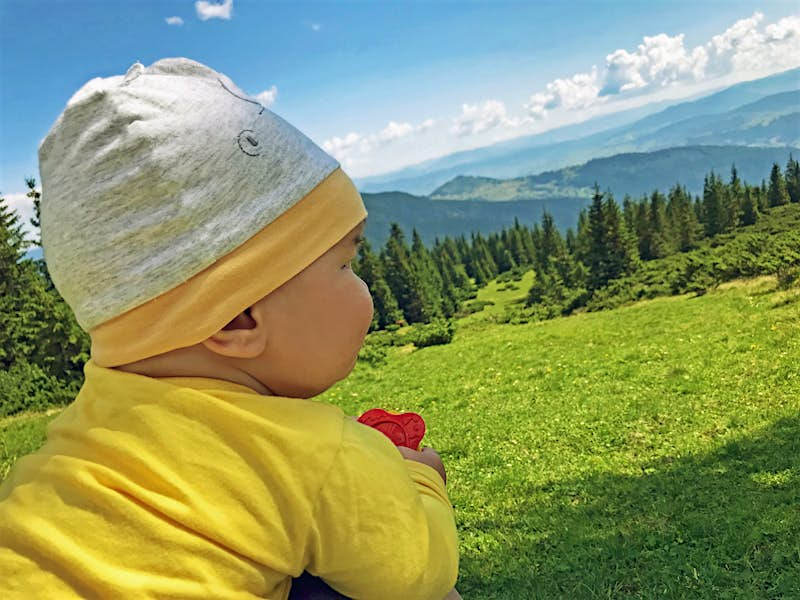
A very young baby wears bright yellow pajamas and a knit hat as he looks out on a mountain vista; kids outdoors adventures
Provided you have the right clothes, there’s no reason even very young babies can’t enjoy the outdoors 

Newborns

If you’re a parent who has enjoyed outdoor adventures before kids, there’s no reason not to take your child along and introduce them to the outdoors right away. Remember, a newborn is still developing their immune system for the first few months, so parents should be careful in exposing babies to crowded public spaces, but that doesn’t mean your child cannot go outside.

Ensure the baby is dressed appropriately for the weather (think Goldilocks — not too hot and not too cold), limit exposure to the sun, and use sunscreen once the baby is older than 6 months (younger than that use hats, clothing, and shade to block the sun.

It’s also easier than you may think to go camping with infants. Before they start crawling, parents don’t have to worry about babies getting into dangerous areas around the campsite (i.e., a fire). This is a great time to try some low-key overnight camping at a state park close to home in case you need to run back to the house for emergencies. But it’s probably not the best idea to camp out in the dead of winter or heat of the summer.

A toddler bebops down a trail with an oversized backpack on; kids outdoor activities
Between 6 and 12 months, children get much more mobile 

Infants (6 – 12 months)

Outdoor activities for infants include hiking, camping, and swim lessons. Of course, a 6-month-old isn’t going to ramble down the trail, but ‘hikes’ with a stroller (regular or jogger) can be great exercise and self-care for Moms and Dads.

Between 6-12 months it gets more challenging to camp with a growing baby – they need to crawl around and move, and anything they pick up (sticks, mud, bugs) goes straight into their mouths. Parents need vigilance to ensure their child’s safety. If you want to continue the camping experience at this age, perhaps stick to a tent in the basement or backyard.

Also, around 6 months of age is a great time to start introducing your little one to the water during swim lessons. Fear and separation anxiety start to develop around 8-9 months, so introducing the child to the water beforehand will make it easier to continue those lessons through this period.

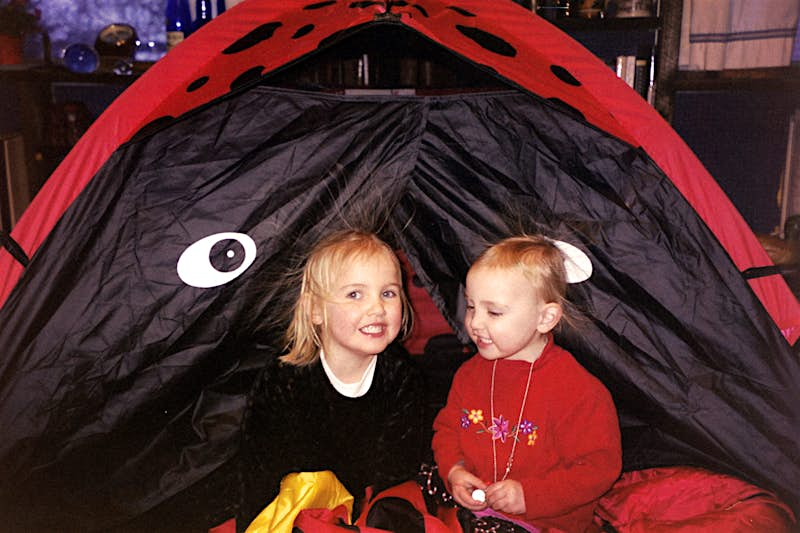
Two young girls play in a tent made to look like a ladybug, as their hair stands on end from the static; kids outdoor adventures
Author Dave Parfitt’s kids loved setting up a tent in the living room – and the static it produced 

Toddlers (2-3 years old)

At 2-3 years old, toddlers do not have the strength or patience to complete a 3-mile hike, but they always enjoy spending time with their family outdoors. Plus, getting the chance to study insects, flowers, or a stream for minutes at a time is a sure winner. Toddlers love to be outdoors, and most will be thrilled to sleep under the stars.

For a toddler’s first camping experience start with a simple overnight close to home. Get a good tent to protect everyone from wind, rain, and cold, and be sure to stick to your toddler’s schedule. The first campout is probably not the time to keep the kid active all day without a nap, and your campsite neighbors will also appreciate not hearing junior’s meltdown.

For watersports, this is a great time for short canoe or kayak rides with your toddler in the center compartment of the boat. Don’t stay too long on the water (20-30 minutes will suffice), and always have young children wear a properly fitted life jacket. At this age, remember, it’s not the destination that matters, it’s building a comfort level with the outdoors and an expectation for going on these adventures.

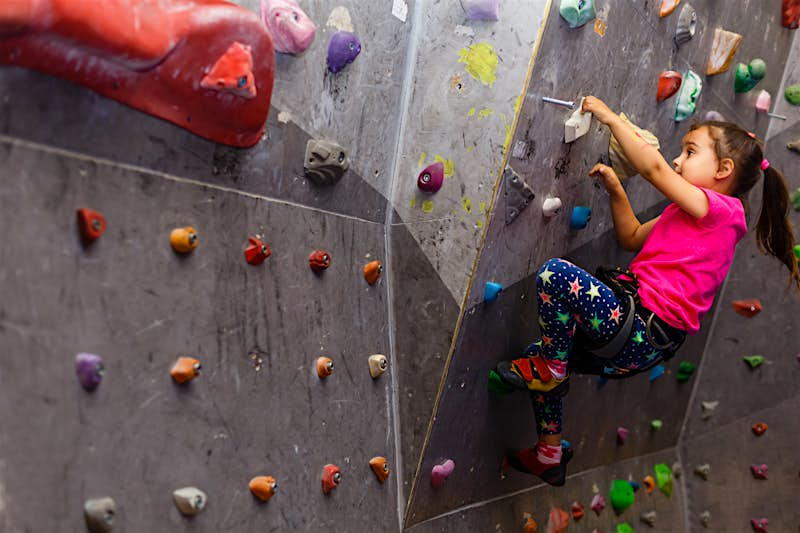
A young girl climbs on a bouldering wall in a climbing gym; kids outdoor adventures
Even preschoolers will probably have the skills they need for some light bouldering at a climbing gym 

Preschoolers (3-5 years old)

After unrolling sleeping bags in the living room, setting up a tent in the backyard, and perhaps an overnight at a park close to home, your preschooler is now ready for a longer camping trip. If your child has some experience, head to a state park for a long weekend. Intentionally choose a destination with features of interest to children, perhaps a lakefront beach, waterfall, or gorge to explore.

Speaking of scrambling up gorges and rocks, 4-5 years old is a great age to start rock climbing. Preschoolers are usually old enough to use problem solving skills to get through a bouldering route, and most climbing gyms have a minimum age of 5 for children to start climbing walls.

On the water, a preschooler can move from the center of a canoe to sitting in the bow (a canoe offers more stability than a kayak for young children who can’t sit still). Offer them a paddle, teach a basic forward canoe stroke, and get them involved. They may not last long or provide much propulsion, but your child will grow confidence in assisting with the adventure.

When planning outdoor adventures with children, Erin Kirkland reminds parents to ditch the agenda. ‘I find in my family-based classes and events that kids crave unscheduled, unscripted time in the outdoors,’ she says. ‘Find a location, create a base camp, and encourage free play. It might take kids a bit of time to figure out what that means, but once they start digging in the dirt, climbing trees, or wading in a pond, you’ll be amazed.’

A man and a girl paddle a canoe through a lake with mountains rising in the background; kids outdoor adventures
Once they reach school age, you’ve established a foundation and it’s time to listen to what your kids want to do 

School-age (6-12 years old)

School-age children are developing and expressing their own interests. During their first five years, you’ve introduced them to different outdoor adventures and built a strong foundation. Now it’s time to listen to your children’s interests.

Think intentionally about what appeals to your child: if your child has demonstrated a keen interest in hiking and camping, perhaps it’s time for a backpacking trip. Children who love their time in the water are certainly ready to paddle along with you in the bow of a kayak or canoe. Perhaps a canoe camping trip would be more their speed.

If they’ve enjoyed climbing activities like bouldering in a climbing gym, get that kid in a harness and up on a real rock or on a rope-based obstacle course. For your young explorer, guided cave tours are an absolute blast — just be on the lookout for signs of claustrophobia.

Or perhaps your child would prefer something more introspective. Going to interpretive hiking trails with stations and activities or stopping to pick wild raspberries or search for crayfish are perfect outdoor adventures for some kids.

It’s important to involve your children in the planning process to find an outdoor adventure where they are truly invested. Listen to your kids, give them choice and control over their activities, and you’ve done all you can do to set them up.

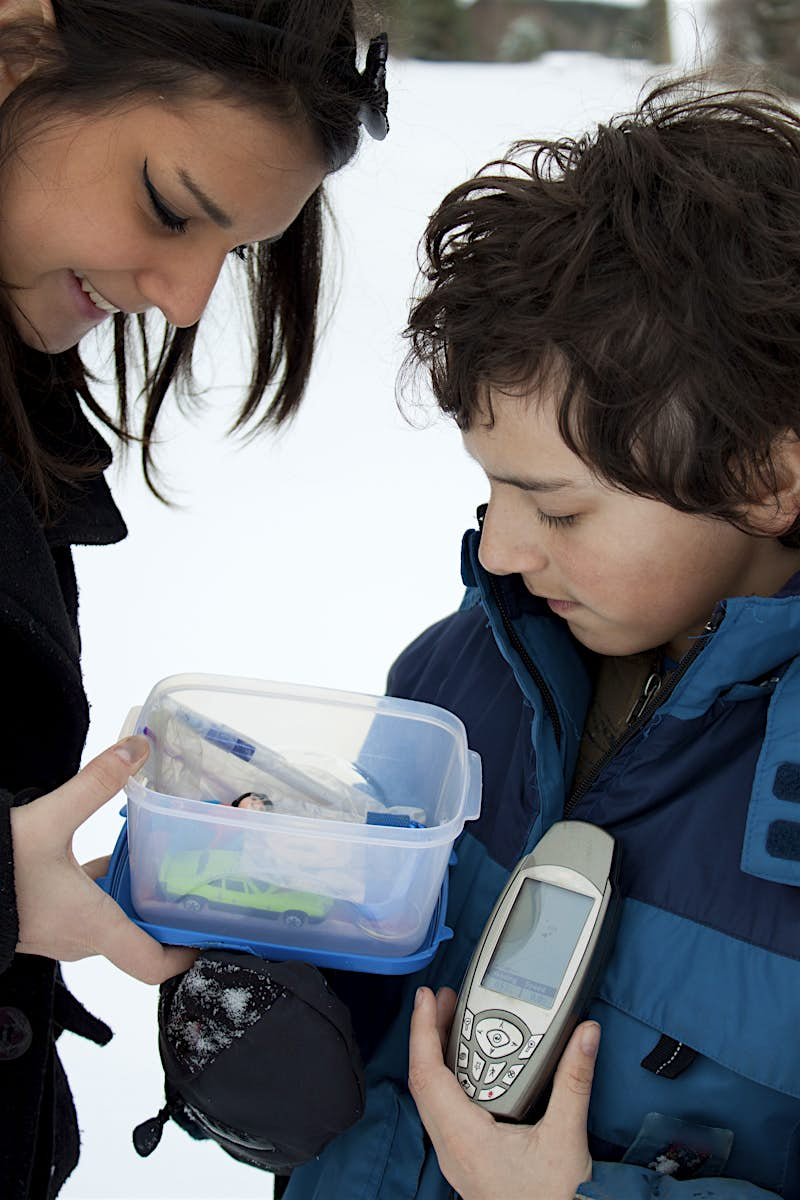
A boy and a girl open a geocache with lots of items inside in a snowy landscape. The boy holds a hand-held GPS device; Kids outdoor adventures
Geocaching is the perfect activity to keep older kids interested in exploring the outdoors 

Teenagers (13-18 years old)

The teenage years might be known for attitude, eye rolls, and mood swings, but that doesn’t mean outdoor adventures have to end.

Geocaching can pique this age group’s enthusiasm for hiking. Erin Gifford, family travel writer and founder of Kidventurous, discovered geocaching during a family trip to Michigan. ‘We spotted a family that was clearly hunting around for something,’ she said. ‘Looking under rocks, in trees, around park signs, all while staring into a phone, looking for answers. They let us know they were geocaching and that their boys loved it, that it got them interested in hiking. We downloaded the geocaching app on the spot and my kids were hooked, especially my 10- and 14-year-olds.’

On camping trips, give teens their own tent so they have the privacy they need, and with body image concerns top-of-mind, go easy on them when they want to bring extra hair care products, acne scrub, and/or face wash. Similar to the school age years, after a foundation of outdoor adventures, parents should have a good sense of what appeals most to their child. Get teens involved in the planning process. Try for unique destinations such as camping in a covered wagon, a yurt, or glamping.

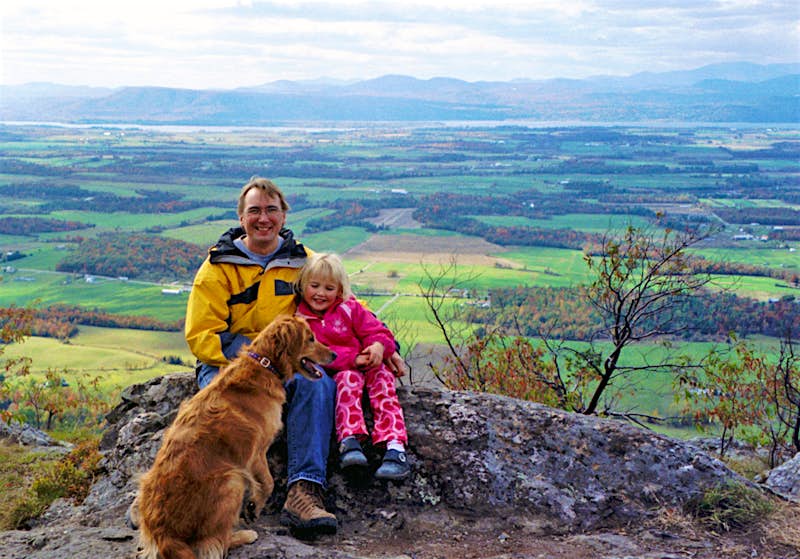
A man and a young girl sit on an overlook on a mountain in Vermont; kids outdoor adventures
Family trips to Snake Mountain in Vermont were bonding experiences for author Dave Parfitt and his children 

Outdoor adventures at any age

Preparing kids for a lifetime of outdoor adventures is not so different than preparing kids for an independent life. As a parent, keep your expectations realistic and be flexible — outdoor adventures with kids are certainly different than when you hiked and camped solo.

‘Just go,’ says travel writer and outdoor trade consultant Chez Chesak. ‘Don’t overthink it. Don’t worry if your child is the ‘right age’ or not because any age is the right age. Granted, you have to take more into consideration when taking a toddler out camping or on a hike versus a teen. But the key, really, is to just get them out there, into the wilderness.

‘Allow them (and you as a parent) to make mistakes, sometimes stumble, figure things out, and get back up again. That is how they will learn to be comfortable in the outdoors and ultimately fall in love with being outside.’

9 TSA rules you might be breaking

0

With the Transportation Security Administration’s restrictions around the boarding process constantly shifting (see: those Star Wars-themed Coca-Cola bottles that had Disney-goers in an uproar), even the most jaded frequent flier can be caught unaware. Here are some scenarios you should have on your radar before your next departure.

1. You went on a spice-buying spree and packed your finds in your carry-on

For the past year, the TSA has required additional screening for any powder-based substances greater than 350 ml (or about how much would fit in a soda can). They don’t have to be packed in your checked luggage, but you will need to allow time for additional screening—and depending on how savvy your airport staff is, that could take a while. A 16-ounce bag of sea salt, for example, proved problematic for one of our writers returning from Sicily, triggering the scanners and stumping the agents at every port of call. To alleviate the hassle, pull them out with your electronics at security or consider stashing them in your checked baggage.

2. You stopped at the dispensary to refill your prescription, and now you’re carrying too much medical marijuana

marijuana disposal bin at airport.jpg
The airport in Aspen, Colorado, has marijuana disposal bins in case you forgot to take your stash out of your bag. Image: Robert Alexander/Getty Images

Speaking of stashes: Medical marijuana is legal in 33 states, plus D.C., Guam, Puerto Rico, and the US Virgin Islands, but that doesn’t mean it’s cleared to fly cross-country. Because the plant remains illegal under federal law, only FDA-approved goods or those that contain no more than 0.3% THC when weighed dry are allowed, either in carry-on or checked bags. (The rules apply to some CBD products as well, so tread carefully.) Though the TSA screens for security, not specifically for drugs, if an officer sees that you’re holding, they’ll call in the authorities. To avoid the issue altogether, some airports have installed cannabis disposal bins – look for them in locations like Las Vegas, Toronto, and Aspen, Colorado.

3. Your liquids are out of sight, out of mind

Sure, you remembered to take out your toiletries and empty your water bottle, but what about your roll-on deodorant, heating pad, or glow sticks? The former and the latter are fine in your carry-on as long as they’re less than 3.4 ounces or 100 milliliters, but gel-based items like heating pads and candles have to go in your checked bags. (As with any liquids, gel ice packs are fine as long as they’re completely frozen – if they’re at all melted or slushy, they have to meet the 3-1-1 requirement, unless they’re medically necessary.) On the off chance you’re transporting a Magic 8 ball, stick with your checked baggage there too. As the TSA’s reference page puts it, “For Carry-on bags: We asked the Magic 8 Ball and it told us…Outlook not so good! For Checked bags: We asked the Magic 8 Ball and it told us…It is certain!”

4. You snapped a picture of something you shouldn’t have 

paparazzi shot.jpg
It’s not illegal to take pics or video at security checkpoints if you don’t interfere with the screening process or reveal sensitive information. Image: fotografstockholm/Getty Images

Shooting photo or video isn’t completely verboten at security checkpoints, but the regulations around it are pretty hazy. The TSA says that you’re fine as long as you don’t reveal sensitive information, shoot equipment monitors that aren’t in public view, or interfere with the screening process in any way—including but “not limited to holding a recording device up to the face of a TSA officer so that the officer is unable to see or move, refusing to assume the proper stance during screening, blocking the movement of others through the checkpoint or refusing to submit a recording device for screening.” It’s easy to see how an innocent action could be interpreted as interference, so you’re probably better off skipping the snapshots, just to be on the safe side.

5. You’ve lost a loved one, and you’re traveling with their ashes

Going “Code Grandma,” or simply taking a loved one to their final resting place? Some airlines might ban cremated remains from checked bags, but somewhat shockingly, the TSA as a whole has no issue with passengers bringing cremated remains on board, as long as they’re transported in a vessel that allows the scanners to see what’s inside. (Wood and plastic are fine, metals like tin or stainless steel, not so much.) If the officers can’t make out what’s in the container, it won’t be allowed. Per the site, “Out of respect for the deceased, TSA officers will not open a container, even if requested by the passenger.”

6. You’re heading for the big game, or Comic-Con, or a killer Halloween party – and you’ve dressed up to get in the mood

KISS at Heathrow 1980.jpg
If you’re not KISS, you shouldn’t even try to get through airport security with your face painted. And even if you are KISS, you might want to reconsider—things have changed since 1980. Image: Kent Gavin/Daily Mirror/Mirrorpix/Getty Images

Though it’s not strictly prohibited, dressing in costume, painting your face, or altering your appearance in any significant fashion could result in additional screening. TSA agents need to be able to identify you to wave you through the checkpoints, so save the makeup or the mask for a quick restroom change after you’ve cleared security or once you’ve landed at your destination.

7. Your smart luggage was grabbed for the dreaded gate check, and you forgot to pop out the battery

Most rechargeable and non-rechargeable batteries – lithium, cell phone, laptop, and external batteries, plus power banks and portable rechargers – are fine in the cabin, but they become a problem when they’re stored under the plane. To avoid an unpleasant surprise, check the Federal Aviation Administration’s guidelines before you head for the airport.

8. You won a goldfish at the carnival, and you want to take him home

fish in bag.jpg
One exception to the 3-1-1 rule? Live fish in water and a transparent container. Image: pederk/Getty Images

It should go without saying, but live fish should not be relegated to the cargo hold. As one of few exceptions to the notorious 3-1-1 rule, live fish in water – no matter the amount – can go in your carry-on, as long as they’re in a transparent container and pass muster with the TSA officer.

9. You let the holiday spirit take over

Air travel during the holiday season is bad enough – don’t make it any harder than it has to be. Your carefully wrapped gifts can trigger an alarm, so use bags and boxes instead of wrapping paper and tape whenever possible. Even the most minor trinkets can cause trouble: Snow globes bigger than a tennis ball likely violate the 3-1-1 liquids rule, and Christmas crackers aren’t allowed at all, either in the cabin or in the cargo hold. Foodwise, fruitcake is fine, but if you’re smuggling gravy across state lines, be sure to mix it with your mashed potatoes if you don’t want it confiscated by security – a lesson model, presenter and cookbook author Chrissy Teigen learned on the fly this summer.

THE BEST WALKING TOURS IN PARIS

0

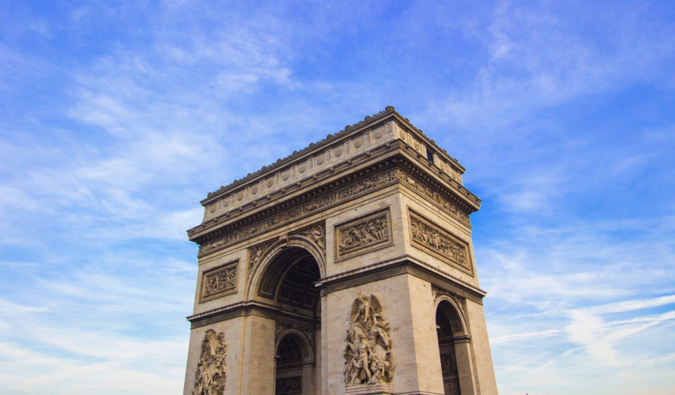
The Arc de Triomphe against a bright blue sky in Paris, France

I love visiting Paris. I’ve been going there for over nine years and have yet to tire of the history, the charm, or the food (and wine!).

Over the years, I’ve taken a million different tours of this amazing city to learn more about what makes it tick. For four months earlier this year, I lived in Paris, and had the opportunity to check out even more walking tours.

And there were a lot to check out!

There are dozens upon dozens of companies covering all aspects of life in Paris, and it can be hard to make a sense of all those endless Viator and Tripadvisor listings. It’s obscene how many tour companies there are. (I mean I’ve tried so many tour companies and I STILL have more on my list to try (and some to retry).)

But, I still feel like I’ve done enough to warrant a post on some of the best walking tour companies in Paris, so, today, I want to share with you my top favorites:

1. New Europe Tours

The crowded steps of Sacre Coeur atop Montmartre in Paris, France
New Europe is one of the most popular free walking tour companies in all of Europe. Their main free tour takes you around the center of Paris and gives you a historical overview of the city. They also run a good (but paid) tour of Montmartre, and they have a really fun pub crawl as well if you’re looking to hit the bars with other travelers.

The basic tour will last around three hours and is free, though you’ll want to tip your guides. Some tours cost 15-35 EUR per person.

2. City Free Tour

The sun shining over the historic Pantheon in Paris, France
This free-tour company, like New Europe, offers a couple great general tours to help you get familiar with the City of Light, led by a local expert who can answer your questions. They also offer a few specialized tours so you can really focus on different neighborhoods. For example, the Montmartre tour does a great job of showing you just what life is like in this famous bohemian neighborhood, while the Latin Quarter tour highlights some of the most famous landmarks in town.

IS TRAVEL HACKING REALLY A SCAM?

0

Nomadic Matt in first class

Last month, I wrote an article on how to travel anywhere for $1,000. I wanted to show people how, by changing how you save and using a few budget techniques, you could make any trip happen for $1,000 (or less) from start to finish. While that is a lot of money to most people, it’s not an insurmountable amount of money to save with a few clever ninja techniques (it works out to only $2.74 per day).

In the article, I picked expensive destinations as examples because I didn’t want to be accused of copping out by picking cheap places. If I had, I imagined the Internet would rise up and say “Oh, sure, Matt! Anyone can travel to Thailand on a budget. That’s easy. What about (insert expensive destination)? This article is fake news!”

In picking expensive destinations, I used points and miles to help mitigate the costs of getting to each destination. Using points and miles for cheap and free flights and accommodation was a must. After all, it’s one thing to pay $700 for a flight if the destination only costs a few dollars a day. It’s another thing to pay that much when you’re going to Australia! You won’t get far with only $300 to spend in Australia!

But a different — and unexpected — backlash erupted. On the blog and social media, people kept commenting that points/miles are money, have a cost, aren’t easy to get, only work in the States, and that, basically, the whole article was BS. For example:

First, let me say you are all correct. From the outset, I should have factored in taxes and fees into the cost of the trips, and have since changed the expense chart to reflect that. It was silly of me to not include that from the outset. I apologize for the oversight.

But, second, I don’t think using points or miles is in anyway cheating or unfair. (I’d also like to say that while they were a big part of the article, many of the other tips helped lower costs just as much!)

To me, points and miles are free money. They have no cost to me. I don’t give up anything to get them. I think of them as the perk for being smart about my spending. Sure, I have to spend the points/miles in addition to money, and I know some of you view points and miles as having some value with an opportunity cost to them, etc.

But I don’t think of them that way.

They are just a thing I get when I spend money that I would have spent anyway.

Let me explain in more detail. A lot of people think points and miles are hard to get, that you have to do crazy stuff to get them, or you have to spend lots of money to get there:


I hear you and I see the logic but I disagree. You can earn a lot of points and miles per year with much less spending than described because there are pretty easy ways to earn multiple points/miles per dollar spent.

I’m a terrible travel hacker compared to my friends. I don’t do some of the crazy things they do to earn points and miles because I don’t have a lot of time, so I like to make it easy on myself. I don’t buy extra things, overspend, resell furniture or gift cards, or give up my Saturdays to go buy stuff in bulk and then sell it online for a profit.

I simply go about my life and spend wisely. I have chart for which cards I use for which expenses, so I always get the most miles per dollar spent. Here it is:

How I Optimize My Spending with My Travel Credit Cards
credit card chart for travel hacking
(Note: I also have all the co-branded airline cards but I rarely ever use those.)

Through all this, I earn a million or more miles per year. If it was really only 1 point/mile per dollar spent, then I would have to spend one million a year but that’s not the case. When I need to buy something, I do it online for bonus points through airline shopping portals (I recently got 6x American Airlines miles for my Macy’s shopping on top of my credit card points). Need something on Amazon? I buy a gift card from Office Depot for 5x points and then go through JetBlue for 3x more points. Buying a new computer? I’m off to get a new card to hit the minimum spending for the bonus. Got a few minutes? I answer some surveys for points.

I’m always earning multiple points per dollar spent. It’s rarely one to one. (Note: You can click here to see a more detailed breakdown of where I earn my million points/miles.)

I don’t view collecting points/miles as a cost because I don’t spend extra money to earn them. To me, something has a cost when I give up money to get it.

Sure, there are taxes and fees are included in the ticket that vary wildly among airlines (I’m looking at you, BA and Virgin), but it’s still cheaper than the price of a full ticket. And hotels don’t charge these fees, so the cost of them using points is literally zero. Also, some credit cards allow you to wipe charges off of them, making those expenses literally zero too.

If you want to travel more, points and miles have to be something you do (providing you live in a place where they are an option). Even if it takes you are year to accumulate them, they help you unlock your dreams by drastically reducing the cost of everything.

When I ask most people why they don’t travel hack, they just shrug their shoulders and go, “I don’t know. Seems hard, I guess.” I think people believe because travel hacking seems complicated, therefore it must be so. Actually, it is not.

In addition, travel hacking seems to run counter to everything we have learned about finance. We’re taught to think of money and credit in one way:

“Credit cards a bad. The companies are bad. Never pay a fee. Your score is sacred and doing things like this hurt it, and you’ll never get a loan.”

But that is just bullshit. It’s a myth perpetuated by….well, I don’t know who exactly, but people keep believing it.

You earn points and miles for everyday purchases you would have bought anyways and the perks outweigh the credit card fees. For example, with my $450 per year Chase card, I get:

  • $300 in airline credit
  • 3x points on travel and restaurants (so I can earn points faster)
  • Global Entry ($100 every five years)
  • Purchase protection so I can get refunded if things I buy are lost, damaged, or stolen
  • A priority pass for lounge access (about $100 a year)
  • Trip insurance

My $49-a-year IHG card gives me a free night at a category 1-5 property (around $200 a night) and my American Airlines card comes with free checked bags, saving me hundreds of dollars a year!

Additionally, my credit score has only gone up because of this as now I have more credit and less debt as well as a good payment history. (And, as my friend Gary says, “What good is a credit score if you don’t use it?”)

If you pay your bills off each month and are reasonable with your money, not collecting points and miles is saying no to free money. It’s saying, “I don’t want to be rewarded for my good spending habits.”

Free is the best word in travel.

When you don’t travel hack, the only person you are hurting is yourself. You aren’t hurting the banks or the airlines. They are in on the game.

In my view, travel hacking is something to be embraced. It reduces the cost of travel. You can do this in a lot of countries around the world! Even if takes you a year to earn a free flight, why not take the flight? One free flight is better than no free flights.

Anything that saves money and reduces the cost of travel is something every traveler should do.

Saying no to travel hacking is saying yes to spending more money on travel — and why would you ever want to do that?

12 THINGS EVERY PERSON WHO WANTS TO TRAVEL WITH THEIR DOG SHOULD KNOW

0

This is a guest post from Candy Pilar Godoy, who blogs about pet travel at Boogie The Pug. She travels the world with her pug, Boogie, and her tiny chihuahua, Marcelo. She’s here to tell you how you can do the same with your dog!

Many people assume that it’s supremely difficult — if not impossible — to travel with dogs. So most assume that they’ll need to fork over a truckload of cash to cover the dog-sitting costs of leaving their pooches behind while they travel.

However, I learned that, with research and a little extra planning, you can take your furry friends along with you on most travel adventures — and it’s not as difficult as you might think.

According to the 2017–2018 National Pet Owners Survey, 68% of US households own a pet. That’s 89 million dogs, an increase of 56% since 1988.

And of that number, about 37% of pet owners actually travel with their pets every year, up from just 19% a decade ago. The International Pet and Animal Transportation Association reported that, worldwide, more than four million live animals are transported on planes every year.

The travel industry has had to adapt to this growing demand, and today, traveling with your dog is easier than ever.

As someone who is extremely passionate about traveling AND dogs, I wanted to share what I’ve learned on the road about this emerging trend.

1. Don’t assume it’s a no

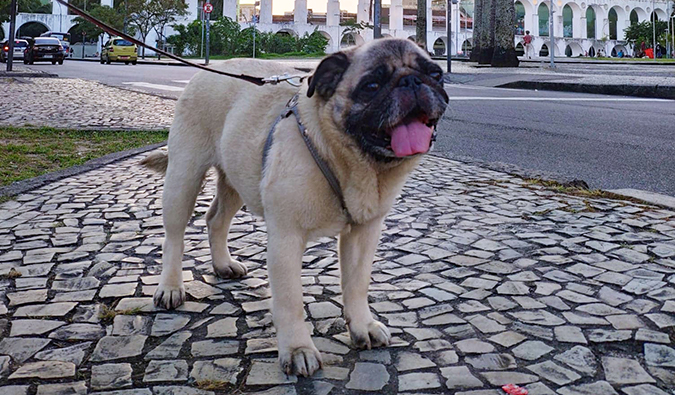
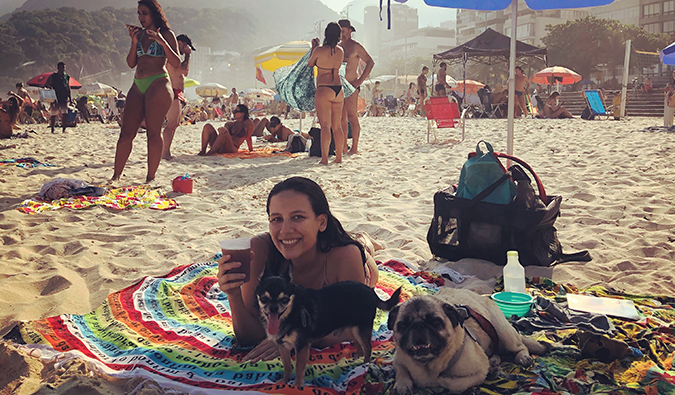
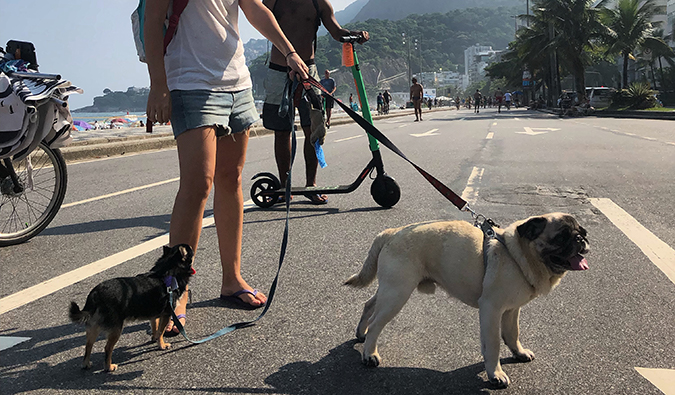
Boogie the pug in Rio de Janeiro
Travel with animals increases every year, and it’s taken establishments time to catch up, meaning lots of places don’t have dog policies in place just yet (or their policies have yet to be thoroughly fleshed out). I’ve heard plenty of stories of restaurants and hotels whose websites and/or social media have listed themselves as dog friendly, when in reality they’re not. It happens.

When in doubt, always ask. Never assume that dogs are or are not allowed. It’s great to look for a “No Pets Allowed” sign or a “Pet Friendly” notice, but whether a place has one or not, it’s always best to double-check. A quick email or phone call can save you a lot of time, confusion, and frustration. For example, I’ve been pleasantly surprised to learn that dogs are welcome in most shopping malls in Rio de Janeiro. Who knew?

2. Make copies of pet-related documents

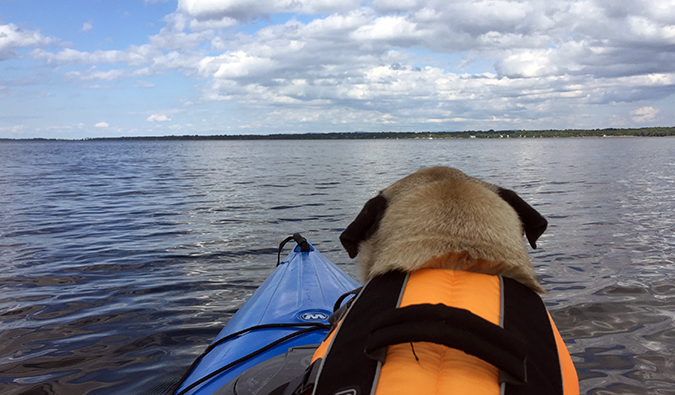
Boogie the pug kayaking in Vermont
If you’re planning to cross borders or travel internationally, you’ll need your dog’s health records on hand (sort of like us humans and our passports). These are necessary to prove that your dog is healthy and vaccinated. Officials ask to see them, and depending on who you deal with, they’ll either keep the originals or make a copy. Additionally, if you need to visit a new vet abroad, you’ll be able to provide them with your furry friend’s medical history.

For these reasons, I like to keep multiple copies of my dogs’ medical records and vet information on us at all times. This includes both a virtual copy on my phone and printed copies in my day bag.

3. Use dog-friendly apps

Boogie the pug in Philadelphia
There are plenty of apps that can help when on the road with your pup. It’s become a lot easier than when I used to travel the world sans iPhone. My favorites include:

  • All Trails – This has the largest collection of trail maps (over 50,000). Browse photos and reviews, and filter your search by dog-friendly trails so you know which hikes to hit with your dog.
  • Bring Fido – The Yelp of the dog world. Bring Fido helps you locate nearby hotels, attractions, and restaurants that welcome pets.
  • Pet First Aid by American Red Cross – This app helps you locate the nearest emergency animal hospital, and provides step-by-step instructions for common pet emergencies.

4. Skip hotel fees

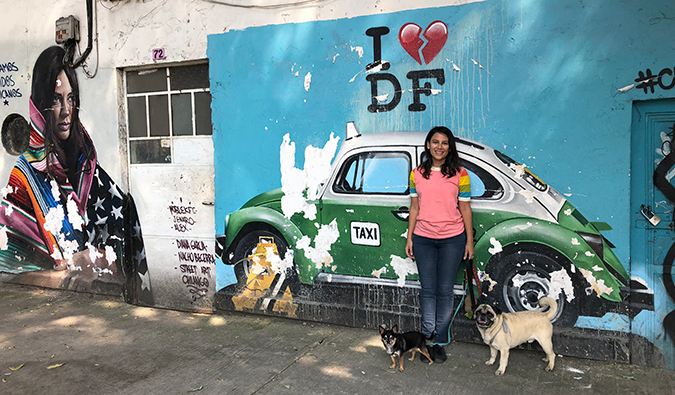
Boogie the pug and Marcelo the chi in Mexico City
Many hotels charge additional fees to accommodate your pet. These can range from a one-time fee of $50–$250 to a daily charge of $10–$50 on average. These extra costs add up, increasing the price of your trip and putting pressure on your budget. If you book a hotel with a $50/night pet fee for a week, that’s an additional $350!

There are some hotel chains, however, that welcome your pets without asking for any extra cash — no additional fees, no deposits, and no one-time charges. Consider one of these hotels when you’re booking your next trip. My favorite pet-friendly hotels with no extra fees include:

  • Kimpton – With no additional fees or deposits, Kimpton Hotels rank high in terms of pet-friendliness. Plus, there’s no size or weight limit, and no limit on the number of pets allowed.
  • Red Roof Inn – This upscale economy chain has over 580 locations in the US, and additional locations in Brazil and Japan. They allow all family pets weighing 80 lbs. or less.
  • Motel 6 – Motel 6 hotels are a great option for anyone on a US road trip, with over 1,400 locations across the United States and Canada. They welcome all well-behaved pets, with a maximum allowance of two pets per room.

Can’t find a good hotel in the area? Try airbnb.com. They have an easy search function that filters for pet-friendly homes. We often use Airbnb when traveling internationally.

Pro tip: Before booking with any hotel, ask these questions to ensure that your stay is comfortable.

5. Take a pet carrier

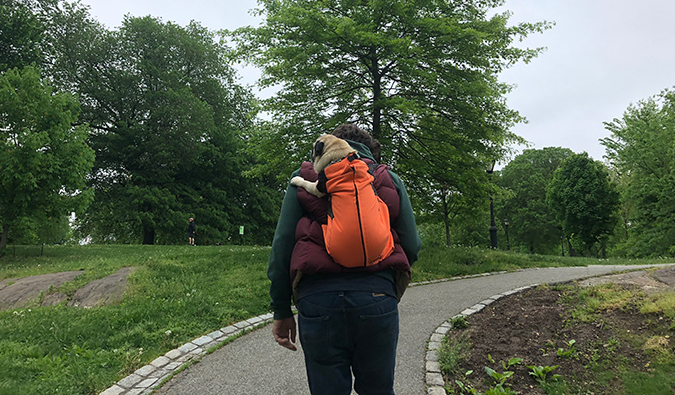
Boogie the pug in a backpack
There are many options on the market when it comes to pet carriers. My favorites include the k9 Sport Sack, a dog carrier backpack that fits dogs of up to 40 lbs. (psst — use the promo code BOOGIE for 10% off). It comes in multiple colors and can be personalized with patches. I also use The Roodie, a pet-carrier hoodie that holds dogs weighing up to 15 lbs.

6. Be respectful of the people you meet

a dog playing in a water sprinkler in Berlin
No matter where you go with your dog, be honest and considerate with those around you. Some people love animals, while others can be terrified of even a tiny puppy. Be polite and know your dog’s limits.

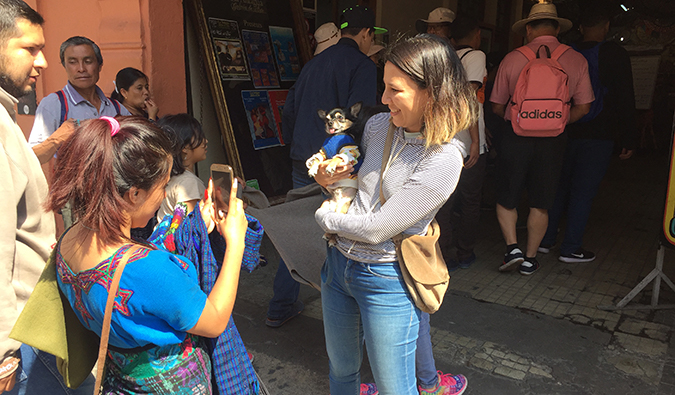
Remember that human relationships with dogs vary incredibly across cultures. For example, in Guatemala, we saw more street dogs than pets. People were often surprised to learn that our dogs travel on planes, and even more taken aback to learn that they sleep in our bed. Try to be aware of these cultural differences, and be sensitive to the human-canine boundaries to which people are accustomed.

Moreover, if your pet tends to be unfriendly with humans (or other dogs), make that very clear to anyone approaching. You don’t want to end up in a situation that could have been avoided with a clear warning. After all, dogs are animals — as owners we are the ones responsible for them.

7. Triple-check airline pet policies

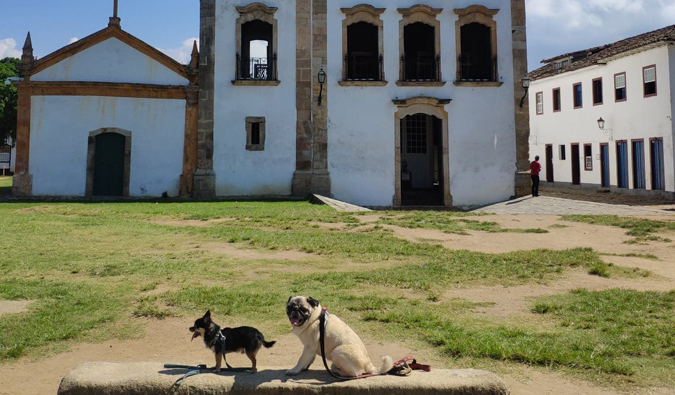
Boogie the pug and Marcelo the chi in Paraty, Brazil
When flying, especially internationally, we always double-check, if not triple-check, airline pet policies. Policies are constantly in flux, and rules are always changing. You want to make extra certain that you and your dog are both welcome on that flight. I usually check the airline’s website, give them a call, and send an email confirmation when I’m bringing my dogs on a flight.

Policies and prices for flying with your pet also vary according to a few factors. They usually depend on the airline, the country you’re traveling to, and the size and breed of your pet. There’s also the option of air travel in the cabin, in cargo, and in baggage. (Want to know the difference between these three?

Some of my favorite dog-friendly airlines include American Airlines, Delta Airlines, Air France, and JetBlue.

8. Countries differ

Boogie the pug and Marcelo the chi at the beach
When it comes to crossing borders, countries differ in their rules and regulations for allowing your pup entry. Some only ask for a rabies vaccine and paperwork from your vet, while others require a pet quarantine and high fees. There’s also a list of banned breeds for whom some countries won’t allow entry at all.

The hardest countries to enter tend to be islands, like Australia, Japan, Fiji, and Iceland. The easiest are countries in the European Union (if your pup has an EU passport!). Research the rules of your destination countrythoroughly and far enough in advance to ensure that you can meet all the requirements.

9. Make dog friends

Boogie the pug and Marcelo the chi
As I said earlier, dogs are social animals. When you’re out walking or spending time at the local park, befriend other dogs and their owners. They’ll let you in on their favorite hangouts, the best dog-friendly restaurants in the area, and which vets they trust. Dog owners know best, and they’re a great resource to have. Here are the best ways to find a local dog community online or IRL:

  • Go on a walk – Grab your pup and head out for a walk around the neighborhood. Stop to sniff a butt or two, and talk to dog people. Speaking to local dog owners is the best way to get the lowdown on the area, and all of the dog-friendly places around town.
  • Instagram – These days, dogs everywhere have their own Instagram profiles. Look up hashtags, like #dogsof and enter in your location. You’ll find dogs all over the world. Find some local pups and send them a message asking for tips.
  • Visit a dog park – Dog parks are a great place to exercise and socialize. Many major cities have them. If there aren’t any official dog parks in your area, ask local dog owners or people online about unofficial places where your dogs can romp around.
  • Find an online community – Online platforms host a myriad of groups based on things like breed, location, dog size, and activity level. I recommend searching Facebook and Meetup.com. Many online communities host meetups and social gatherings that you and your pup can join. They’re also a great place to ask questions.
  • Go to a pet store – Local pet shops are great resources for information. Many post flyers for local dog services, or information on nearby dog-related activities for you and your four-legged friend.

10. Pack the essentials

Boogie the pug and Marcelo the chi at the beach
As much as you’d like to just grab your dog and go, there are a few things you’ll definitely need to bring along. Poop bags, a leash and harness, and ID tags are just a few. Pack your pup’s essentials in case you can’t find them on the road (not every location has a good pet store!).

Here’s a checklist of things you might need. It includes things like:

  • Dog food and water
  • Collapsible bowls
  • Toys
  • A bed
  • Flea and tick medicine
  • Medical records and travel documents

Also, make sure your dog is microchipped and always up to date on standard vaccinations.

11. Teach your dog manners

Marcelo the chihuahua in Guatemala
Before you hit the road, it’s best if your dog knows a thing or two. Basic commands, like “sit” and “stay,” will make managing a dog while traveling easier. A well-trained dog can be left behind in a hotel room or rental to rest for a few hours while you have a nice dinner or visit a museum.

Plus, you’re more likely to get a “yes” to your requests if people see that your dog is well behaved. No one wants to be around a barking or rowdy dog who won’t listen!

Work on obedience and manners, and make sure your pup always puts their best paw forward.

If you need help, working with a certified trainer is best. There are also many resources online to help ensure that your dog is obedient and ready to venture out into the world. I recommend the AllThingsPups training tips — they have a YouTube channel, Instagram account, and podcast.

12. Say hello!

Boogie the pug getting lots of attention in Guatemala
Seeing a dog always puts a smile on a stranger’s face. Be polite to people you encounter with your pup. Kindness goes a long way.

On a recent flight, a friendly exchange with a dog-loving airline worker led to my pups and me getting a whole row to ourselves. Extra legroom and seat space are always welcome!

I’ve also gotten free treats, lots of useful tips, and other upgrades all because of a smile, some amicable banter, and of course, my friendly pups.

***
Travels with my dogs are more colorful and locally focused, and force me to explore parts of my destination that I would have never experienced had I been dogless. My dogs help me meet more people, see more places, and live in and cherish the present. There’s no better way to appreciate a new place than with a dog!

Candy Pilar Godoy has visited almost 40 countries across six continents, and speaks three languages. She often travels with her dogs, and writes about pet travel on her blog Boogiethepug.com. Candy currently lives in Rio de Janeiro with her two dogs, Boogie and Marcelo, and cat Kitty. Follow them on Twitter, Facebook and Instagram.

P.S. – I just released a new book! It’s called “Ten Years a Nomad” and it’s about my ten years backpacking the world and the lessons I learned from it. It features tons of stories I’ve never told on this blog and is a book that delves into the why of travel!