Sacred to over a billion Buddhists, Hindus and Jains, enigmatic Mount Kailash is quite possibly the world’s holiest mountain. Pilgrims from across Asia trek across the spectacular high-altitude landscape of remote Western Tibet to pay homage and walk around the sacred mountain. It is one of the world’s great overland trips and, despite the altitude, is surprisingly accessible.
Mount Kailash bathed in light at sunrise
Kailash (Kang Rinpoche, or ‘Precious Snow Mountain’ in Tibetan) gets much of its power from its striking physical location, a lone peak detached from the main Himalayan range in Tibet’s Kangdise mountains. The curiously four-sided mountain rises sheer from the surrounding plain, with its four faces facing the cardinal directions. Springing from its foothills are the sources of four of Asia’s greatest rivers – the Indus, Sutlej, Brahmaputra (Yarlung Tsangpo) and Karnali (which flows into the Ganges).
For Tibetans this is where the Tantric magician Milarepa vanquished his Bön (Tibetian folk religion) rival Naro Bönchung in an epic battle of sorcery, confirming the dominancy of Buddhism over the existing Bön religion. For Hindus, Kailash is the abode of Shiva and his consort Parvati. Both Buddhists and Hindus view Kailash as the mythical Mount Meru, the central axis of the universe. Such is the sanctity of the 6474m peak that to this day it remains unclimbed.
Buddhist pilgrims walking the kora around Mt. Kailash
Walking the Pilgrimage Circuit
The three-day clockwise walk around Mt Kailash is one of Asia’s classic treks. It isn’t particularly strenuous but it does take you to high altitudes, starting at 4670m and peaking at 5650m at the Drölma-La pass, so you need to be well acclimatised and physically fit. Days are not long (the first and third days are essentially half days) and it’s possible to hire local yaks or porters to carry your gear. You can either camp en route or overnight in simple pilgrim accommodation at the monasteries of Drira-puk and Zutul-puk. You’ll walk with Tibetan nomads, Indian tourists and Bön pilgrims (who make the walk anti-clockwise), passing three monasteries and dozens of sacred sites with rocks carved with stone mantras en route.
Epic hikes around the world
Hike some of the most epic trails around the world, from steep climbs through Zion National Park to sweeping, scenic vistas along the Hong Kong Trail.
Hike some of the most epic trails around the world, from steep climbs through Zion National Park to sweeping, scenic vistas along the Hong Kong Trail.
Such is the spiritual power of Kailash that a single circuit – or kora – of the mountain is said by some to erase the sins of a lifetime. At one spot known as Shiva-tsal visitors leave a memento of themselves on the mountain – often an item of clothing or a lock of hair – as a symbol of the old life they are leaving behind. Hard-core pilgrims aim for 108 circuits, some inching their way around the mountain like caterpillars, doing full body prostrations. A journey around Kailash is as much a spiritual as physical journey.
The most popular time to walk the mountain is during the Saga Dawa festival which usually begins in May and ends in June, when thousands of pilgrims (and many tourists) descend on the mountain to celebrate Buddha’s enlightenment. A large prayer pole is raised with great fanfare at Tarboche at Kailash’s southwestern corner, after which everybody starts off on their trek. Check on the political situation if planning a trip for the festival, as the region is sometimes closed to foreigners at this time, in fear of pro-Tibetan demonstrations.
Tibetan pilgrims working their way around Mt Kailash doing full body prostrations
How to get to Mount Kailash
The best way is to take a flight or train to Lhasa from China or Kathmandu, spend a couple of days acclimatising there and then start the four-day drive out to the mountain in far Western Tibet. On the way you can stop off at the Tibetan town of Shigatse and towering ancient monastery of Sakya, and even detour to the stunning north face of Everest Base Camp (add on two days). In recent years the roads to western Tibet have been paved and hotels upgraded so it’s now a relatively comfortable and scenically stunning drive.
On the way back from western Tibet you can opt to get dropped at the Nepal border at Rasuwagadhi, a days’ drive from Kathmandu, after descending through the dramatic Alpine-style Kyirong Valley, dropping from the high Tibetan plateau to the edge of the Indian subcontinent. All in, you should budget for a 17- to 21-day road trip, depending on your itinerary.
A pilgrim makes prayer
Several agencies in Kathmandu offer overland tours from Kathmandu direct to Kailash but note that the altitude gain is potentially dangerous on these trips; it’s safer to spend a couple of days in Lhasa seeing its great monastic sights. Acclimatisation is particularly important in Western Tibet, since there’s almost nowhere below 4500m.
What to see in the area around Kailash
Lying at the foot of Mt Kailash is Lake Manasarovar (Mapham Yum-tso in Tibetan), a stunning high-altitude lake that Tibetans and Hindus consider sacred. Pilgrims walk around the lake in four days but it’s now possible to drive around it, stopping (and preferably staying overnight) en route at the charming lakeshore monasteries of Seralung, Gossul, Trugo and Chiu. The views of the immense cobalt waters framed by the snow-capped peaks of Kailash and Gurlha Mandata (7728m) are truly astonishing.
A day’s drive from Kailash takes you to Thöling Monastery and the ruins of Guge, a 10th-century Buddhist kingdom that drew on nearby Kashmiri and Ladakhi styles to create some of the Himalaya’s most sublime Buddhist art. Exploring the murals, tunnels and hilltop citadel of the former Guge capital at Tsaparang ranks as one of Asia’s greatest (and least known) experiences. Figure on a three-day return trip from Kailash and try to visit the beautiful Silk Road-style cave murals of Dungkhar and Piyang en route.
Stunning Lake Manasarovar from the lakeshore Gossul Monastery (c) Bradley Mayhew
It’s tempting to make the long drive out to Mt Kailash with as few breaks as possible but it’s worth stopping en route at crag-top Drapsang Monastery, photogenic Dargyeling Monastery and important Tradun Monastery (just outside Drongba), all of which lie between Lhatse and Mt Kailash.
Permits to Tibet
All foreign tourists to Tibet need to arrange a tour (vehicle, driver and guide) through a local Tibetan agency in order to get a Tibet Tourism Bureau permit to enter Tibet. You need to pick this up in China or Kathmandu before arriving in Tibet. Your agency will need up to a month to secure this and additional permits for western Tibet. You will also need a valid China visa.
With the passing of Prince in April 2016, music lost one of its most enigmatic talents. There was only one Prince Rogers Nelson and his death at age 57 created a huge void in the lives of his many fans. One very small consolation is that Prince didn’t simply change the course of popular music, he also left behind a rich legacy both in his native Minneapolis and also across the United States.
Prince was both a musical icon and a movie star
So it’s time to put on your favourite purple shirt and leather trousers (and a raspberry beret, if you want to go all in) as we bring you the ultimate sightseers guide to Prince, in Minneapolis and beyond.
The house that Prince built
Paisley Park, Minneapolis
The ultimate pilgrimage point for the self-respecting Prince fan, this is very literally the house that Prince built: a sprawling $10 million recording complex in suburban Minneapolis that opened its doors in 1987. Here he recorded some of his most iconic records: Sign O’ The Times, Diamonds and Pearls and, of course, the 1989 Batman soundtrack. It contains a recording studio and two rehearsal spaces that double as live venues.
Prince saw Paisley Park as his answer to Elvis’s Graceland. Since his death it has been converted into a museum and shrine, and stepping through its corridors you can sense his presence. Each April, marking the anniversary of the singer’s death, Paisley Park hosts an annual Prince ‘Celebration’, including performances by musicians who played with him, talks and other events (visit the official website for ticket info).
The Capri Theater, Minneapolis
Located in north Minneapolis, the Capri Theater opened its doors for the first time in 1927. But it was not until 1979 that this historic venue carved its place in the rock annals, when Prince played his first solo show there. The Capri closed temporarily in early 2019 for refurbishment and renovation, but you can still stand outside beneath its atmospheric red signage. Close your eyes and imagine what it must have been like when music fans gathered 40 years ago, curious about the young local man shortly to make his first foray into rock ’n roll.
After featuring in the film Purple Rain, First Avenue club became synonymous with Prince
First Avenue, Minneapolis
Downtown Minneapolis venue First Avenue achieved rock immortality when Prince filmed several key sequences at the live-music club for his 1984 movie Purple Rain. Overnight it became an iconic rock club and is intimately bound up in the Prince story. First Avenue was paid $100,000 for use of its space and shut for 25 days to accommodate filming. A silver star bearing Prince’s name is emblazoned on the wall outside, which, after his death, was painted gold. First Avenue continues to host live music events, with bands such as Parquet Courts, Snail Mail and This Is The Kit all passing through (tickets available via the official website).
The Purple Rain House, Minneapolis
The home in the movie Purple Rain of Prince’s alter-ego, The Kid. Only the exterior of the building features in the movie. Nonetheless it made such an impression on Prince that he subsequently bought it for himself, just a year before his death. You can take pictures outside, though, as it’s a private residence, be respectful of the current occupants.
This musical mural in Minneapolis is the perfect place to snap a selfie
Schmitt Music Mural, Minneapolis
Prince was beginning to create waves across the United States and further afield when, in the late Seventies, he posed for a photoshoot with legendary rock photographer Robert Whitman. As a backdrop, Whitman chose this enormous mural in downtown Minneapolis, painted onto the wall of the former headquarters of musical instrument manufacturers, Schmitt.
The company commissioned the music mural in the Seventies, which resembles a giant piece of sheet music, with the notes recreating the score from Ravel’s Gaspard de la Nuit. It endures today and, while you may not wield a camera with the wizardry of Whitman, the landmark is a perfect selfie spot.
The RP Funding Center, Florida
The video accompanying Prince’s huge 1983 hit, ‘Little Red Corvette’, was filmed at this venue in Florida. The singer and his band shot it during rehearsals for their upcoming 1999 tour. Prince told director Bryan Greenberg to keep rolling as he strutted across the empty stage (watch carefully and you will notice there are no crowd shots). He spun across the boards and then delivered an incredible splits.
Prince was such a regular at the Dakota Jazz Club that he had his own table
Dakota Jazz Club, Minneapolis
Prince was a regular at this Minneapolis institution right up to his death. You can sit at his favourite table – where a placard reads ‘rest in peace’. The venue hosts live shows by touring jazz bands.
Electric Fetus, Minneapolis
Prince was, of course, a huge music fan and a regular at this Minneapolis record store. On Record Store Day 2016 he swung by and purchased six CDs including Stevie Wonder’s Talking Book, Joni Mitchell’s Hejira and Santana’s Santana IV.
Prince performing at the Rio in Las Vegas
Las Vegas Rio, Las Vegas
Prince’s final years were characterised by a burst of activity, as if he sensed he had only a finite amount of time left. In November 2006 he rocked up at the Rio Las Vegas hotel for a six-month residency at the complex’s 1000-person capacity live venue. Each night he would perform for up to three hours, playing from an ‘in the round’ (island) stage and wielding a bright orange stratocaster. The venue is still open and hosts regular live performances.
Minnesota River
Another one for Purple Rain fanatics. In a key scene in the film The Kid tells Apollonia, his love interest, to purify herself in the ‘crystal clear waters’ of Lake Minnetonka (approximately 15 miles southwest of Minneapolis). He reveals soon afterwards that they aren’t actually at Lake Minnetonka at all, but the banks of the Minnesota River.
Google has announced a feature in Google Maps that uses augmented reality, which will hopefully make exploring a new city easier for travellers.
Exploring a new city on foot is a great way to take in the sights and sounds of a new place, but it can be hard to know exactly which direction to go at times. Google Maps is a huge help but it can be tricky on occasion to know which way it is sending you initially or what side of the street you’re on if you haven’t yet got your bearings. The welcome news is that a new feature, Live View, uses global localisation and augmented reality to show you exactly which way to walk using arrows and directions placed in the real world.
The new AR feature shows you where to go using arrows. Image: Google Maps
How it works is that you search for a nearby location you want to walk to, or tap on it on the map, then tap on the blue directions button near the bottom of the screen. You then choose walking directions near the top of the screen, hit ‘Live View’ near the bottom of the screen, and you’ll be guided through using the feature. Live View has been tested with Google’s Local Guides and Pixel community over the past few months and is now expanding to Android and iOS devices that support ARCore and ARKit.
You can also use Google Maps to see all of your flight and hotel reservations in one place, find restaurants tailored to your tastes with Your Match, see how long the wait is and even book a reservation without ever leaving the app. If you’ve chosen to turn your Location History setting on, you can now use the updated version of Timeline to see all of the places you went to in a country or a city, so that you can share tips with friends or recall your favourites for your own reference.
The updated version of Timeline shows you all of the places you went to in a country. Image: Google Maps
More information about devices that support the new augmented reality feature is available here, and to see how global localization can improve navigation, please see here.
American Airlines has announced a list of new routes for its 2020 summer fight schedule, including the airline’s first flight to Africa.
Detail of Hassan II Mosque in Casablanca.
Next year, the airline will launch a service to Morocco, making it the first time the company runs a service to Africa. The flight will connect Philadelphia and Casablanca beginning on 4 June, 2020. It will make American the only US carrier with a non-stop flight to Casablanca, which will fly three times per week on a Boeing 757.
New tramway along Boulevard Mohammed V.
The airline also notes that Royal Air Maroc – Morocco’s national airline – will join the Oneworld airline alliance in January, which will allow for further connections to destinations like Marrakesh, Lagos and Accra. Other members of Oneworld include British Airways, Qantas, Qatar, Finnair and more.
Twilight view of the Hassan II Mosque, whose 200-metre minaret is the world’s tallest.
While the first flight to Africa is certainly grabbing attention, there are a number of other new flight routes coming in 2020. On 7 May, new flights will begin between Chicago and Krakow as well as Budapest. Chicago will also be connected with Prague beginning on 8 May. A flight between Dallas-Fort Worth and Tel Aviv will begin on 9 September.
Travellers planning an itinerary for their holiday in the UK need look no further than Lonely Planet’s Ultimate United Kingdom Travelist. The new book ranks the top 500 unmissable experiences and hidden gems across Great Britain, Northern Ireland and the Channel Islands – and we can reveal the top 10 here:
Counting Sheep at the Edinburgh Fringe Festival.
1. See the greatest shows on earth at the Edinburgh Festival Fringe
Edinburgh – Walking down the Royal Mile, set against the brooding backdrop of Edinburgh Castle and a congregation of medieval rooftops, it isn’t the knife-throwing unicyclist that first stops you in your tracks. Neither is it the a cappella choir rehearsing in the shadows of St Giles’ Cathedral, nor the gussied-up collective of artists including bare-chested Korean drummers, a karaoke version of Macbeth, a soap-bubble circus and a group of preening Thai ladyboys. Even the camera-ready crowds lining up to take photos aren’t surprised by them. Instead, it is the zombified drag queen, pulling balloons from between her buttocks, that brings the street to a standstill.
At such times, there’s no shame in being baffled by the world’s largest arts festival. Quite simply, the Fringe floods the city with art and nowhere beats it for spectacle or scale. Strangeness, too. Come August in Edinburgh, everything seems brighter, barmier and more colourful. To negotiate such a minefield of creative freedom, it’s best to tackle the Fringe over several days, dipping in and out of shows aided by word-of-mouth reviews and tips picked up in the pub. There is theatre, comedy, dance, circus, cabaret, opera, music and spoken word, and whatever the time of day, an acrobat, trapeze artist, contortionist or tried-and-tested bagpiping busker will be pleased to entertain you. Plan ahead too much and you’ll miss the freedom of spontaneity, but come ill-prepared and you may find the hot tickets already sold out.
2. Take a world tour of treasures at the British Museum
London – Some museums are travel destinations in themselves. The British Museum – the first-ever public national museum – is the envy of the world, with good reason in some cases, considering the many treasures obtained under questionable circumstances in colonial times. Yet this miraculous museum started life as a humble cabinet of curiosities, assembled by 18th-century physician and hot-chocolate inventor, Sir Hans Sloane. As a condition of bequeathing his treasures to the nation, he ordered that they be open for free to ‘all studious and curious persons’, a tradition that persists to this day.
Early on, the collection was dominated by natural history, books and drawings, but the kleptomaniac zeal of the colonial period saw it stuffed with gifted, borrowed and purloined treasures from across the globe, from mummified Pharaohs to the Parthenon Marbles, alongside the greatest treasures unearthed in the British Isles. Putting disputes over ownership to one side, visitors today are transported on a whirlwind world tour of human creativity. If human beings have made it, somewhere in the world, there’s a chance you’ll find an example among the display cases. One side effect of this globetrotting collection is that the museum speaks to the culture of almost everyone who walks in the door.
There’s far too much to take in on one trip; if you only have a day, make a beeline for the Egyptian treasures, the Parthenon Marbles and quirky British antiquities such as the Sutton Hoo helmet and the Lewis chessmen.
3. Step ogre-sized strides over hexagonal stones at the Giant’s Causeway
Northern Ireland – The descent down from the cliffs to the strange rocks of the Giant’s Causeway feels at once timeless – the scene has remained the same for countless centuries – and unrepeatable: the moody skies, the light and the temperament of the sea are constantly changing. Equally exhilarating when cloaked in fairytale mist as when bathed in bright sunshine or whipped by howling winds, uneven stacks of hexagonal basalt columns stand in neat clusters along the water’s edge, emerging from the shore like tightly packed tower blocks in a city skyline. The low rumble of the ocean builds into a roar as white-tipped water creeps up and crashes over the rocks, lapping the stones as it retreats. Northern Ireland’s only Unesco World Heritage site is shrouded in a sense of magic, myth and natural wonder.
Legend has it that Irish giant Finn McCool built a causeway across the sea as a way to reach his rivals in Scotland. One day, the Scottish giant Benandonner followed Finn back to Ireland, but he was tricked by Finn and retreated home to Scotland, ripping up the causeway behind him. Giants aside, scientists put the formation of the rocks down to volcanic activity some 60 million years ago. As the lava flow cooled and hardened it contracted, creating a honeycomb pattern.
After clambering over the pillars on the shore, check out the Organ, a rock formation resembling organ pipes, and the Chimney Stacks headland, which looks like industrial chimneys on the edge of the ocean. A clifftop path leads to the Amphitheatre viewpoint and down the Shepherd’s Steps to the shore; there’s also a minibus that runs to the rocks from the visitor centre, where you can learn more about the causeway’s history, geology and legends.
The Roman Baths in Bath. Image by
4. Experience how the Romans bathed in Bath
Southwest England – If there’s one thing the Romans liked better than anything – except perhaps straight roads, good sanitation and gladiatorial gore – it was a nice hot bath. And 2000 years ago, when Britain was under Roman rule, they built a sumptuous bath complex at a site known as Aquae Sulis (present-day Bath), taking advantage of the area’s geothermal hot springs, which warm the underground water to 46°C (115°F).
Though now swallowed up by the modern city of Bath, most of the structure is still standing – including bathing pools, changing rooms, the original hypocaust heating system and the central Great Bath, lined with lead and filled with 5.2ft of steaming, geothermally heated water. In fact, it’s one of the best-preserved Roman bathhouses in the world, and gives a fascinating glimpse into their everyday lives (and fastidious ablution habits). The only disappointment is that it’s no longer permitted for people to take a dip here – but you can get pretty close to a bona fide Roman bathing experience at the Thermae Bath Spa nearby, complete with its postcard-worthy panoramic rooftop pool.
5. Retrace the Romans’ footsteps along Hadrian’s Wall
Northeast England – Hot on the heels of Bath’s namesake thermal baths is another mighty Roman legacy – an enormous defensive wall stretching 73 miles across Britain. This phenomenal feat of engineering was built under Roman emperor Hadrian between AD 122 and 128 to keep out Scottish Picts. Rising to a height of up to 15ft, with a width of almost 10ft, it took 15,000 men six years to construct it from local whinstone (dolerite). Only 10% survives today, but what does makes an unforgettable impression.
Along the wall were 80 mile-castle forts, with observation turrets between them. Larger forts were built in the south, with 16 more lying astride the wall, which you can visit today. Staggering remains that serve as reminders of the Romans’ advancements include the hospital at Housesteads Fort, ventilated granaries and barracks, as well as flushable communal latrines.
Exploring sections of the wall is easy thanks to good rail and road access (including buses), but if you’re up for an adventure, you can complete the national Hadrian’s Wall Path walking trail along its length in about a week.
London’s famous pub, the Churchill Arms. Image by mikecphoto/Shutterstock
6. Make a British weekend of it with a Sunday pub roast
Fewer and fewer people in Britain start Sunday with a trip to church, but the roast lunch is still a lock. For visitors, it’s a must-do experience. It doesn’t matter whether you’re in a centuries-old, windowless pub in London or at a large country inn with tables sprawling over a lawn, you’ll be among friends and families laughing, drinking beer and tucking into plates of hot sliced roast beef or pork, Yorkshire pudding, roasted potatoes and assorted veggies, all slathered in gravy. Warming, filling and indulgent, it’s comfort food par excellence. But more than that, it’s a reassuring experience, a weekly ritual where the nation stops time, staves off the start of the working week and lives in the moment. Grab a plate and take your fill.
The Tate Modern at dusk in London.
7. Discover a powerhouse of modern art at Tate Modern
London – London’s art galleries were once stuffy, nostalgic, Portland-stone institutions, heavy with history. But when Tate Modern opened in 2000, in the hollowed-out shell of the decommissioned Bankside Power Station, modern art finally got an address to be proud of. Now housing the Tate’s art collection from 1900 to the present day, the gallery has exploded beyond its original footprint, with new galleries inside the power station and the Blavatnik Building rising behind like a twisted ziggurat. Inside, you might see anything from permanently displayed Rothkos, Dalís and Picassos to visiting masterpieces by Monet, Matisse and Warhol, and eccentric installations from the likes of Ai Weiwei, Rachel Whiteread and Anish Kapoor. Before you leave, head to the top-floor viewing deck for stunning city views
Southwest England – Just what were ancient Britons playing at when they hauled these giant stones into place all those millennia ago? Stonehenge, on Salisbury Plain near Amesbury, is a monumental, undeniably mind-boggling achievement. Built in stages between around 4500 BC and 1500 BC, Stonehenge’s massive stones (some weighing 25 tonnes) were probably erected using a system of sledges, rollers, pivots and pulleys; some were transported here from the Preseli Hills in Wales, 140 miles away.
But despite decades of academic study, no one really has the foggiest why Stonehenge is there. Oriented around the solstices, it forms part of a larger sacred site, including barrows, burial mounds, earthworks and a ceremonial pathway, the Avenue. But what did this site mean to its builders? Is it a temple? A sacrificial centre? A place of healing? A memorial to the ancestors? An astronomical timepiece? The truth is, nobody knows. And standing in the shadow of the stones, feeling their power and presence, it’s impossible not to let your imagination run wild.
The UK’s Lake District.
9. Find poetry on the shores of Lake Windermere
Cumbria – England’s largest natural lake – 10.5 miles from Ambleside to Newby Bridge – is at the heart of the Lake District and its most popular destination. People come in search of the scenic splendour and bucolic experiences that inspired Wordsworth, Coleridge and the English Romantics.
You can visit Wordsworth’s house at Rydal Mount, or ride across the lake on a 19th-century steamer (sketchbook and pencil optional) just as the Victorians did. For more modern pursuits, the adventure centre at Brockhole, on the eastern side, has a zip wire running between 250-year-old oak trees.
Most activity is focused on the twin towns of Windermere (on a hill overlooking the lake) and busy Bowness-on-Windermere, which is home to the boat docks, a cluster of shops and the World of Beatrix Potter, which brings to life the most famous creations of the writer who dedicated her life to the preservation of the Lake District.
Far more evocative is Wray Castle, the mock-Gothic structure used by Potter’s family as a holiday home. It’s now empty but the lake views from the battlements are impressive; get there by boat from Bowness.
South Wales – There’s more to Wales than sheep, drizzly valleys and place names that are impossible to pronounce for outsiders. If you haven’t been to the Pembrokeshire Coast National Park in the country’s ‘wild west’, you are missing a trick. Wholly deserving of its number 10 Travelist slot, this ravishing stretch of cliff-flanked coves, thrashing seas, wildflower-freckled moors and hedge-lined tracks leading to one-pub villages still feels like a great escape. Life around here moves in the slow lane.
You’ve come for the beaches? Wise choice, you’re in for a treat. Tenby in the south offers a classic dose of ice-cream-licking, bucket-and-spade fun. But the further west you head, the wilder it gets, with the likes of crescent-shaped Barafundle Bay, reached on foot through the dunes, surf-hammered Freshwater, and tucked-away Marloes with its high sea cliffs, shipwreck and boats heading over to puffin island, Skomer. A terrific base for beach-hopping and coastal-hiking is St Davids. Britain’s smallest city is charm personified, with a whopping medieval cathedral, lanes staggering down to the sea, and a couple of highly stylish, architect-designed hotels, including art-slung former windmill Twr Y Felin and one-time Victorian convent Penrhiw.
Break up drives by striking out on the 186-mile Pembrokeshire Coast Path, which dips and rises over kissing gates and windy clifftops to smuggler’s coves, wooded hollows where brooks burble, and Neolithic burial chambers. To up the adventure, go coasteering with the pros at eco-lodge Preseli Venture. Or turn your focus inland to the lonely Preseli Hills, a windswept range of rocky outcrops, low-lying peaks capped with prehistoric standing stones, and moorland flecked with gorse and heather.
Want to start exploring and experiencing the best the UK has to offer? Buy the Ultimate United Kingdom Travelist.
Are you constantly searching the most amazing travel experiences in the UK? They’ll now be easier to find as Lonely Planet releases the Ultimate United Kingdom Travelist, our first ranking of the top 500 travel destinations and experiences across the UK. To help travellers who let their tastebuds lead the way, we’ve rounded up the 10 highest ranking foodie experiences from the list to whet your appetite.
London’s famous pub, the Churchill Arms.
6. Make a British weekend of it with a Sunday pub roast
Fewer and fewer people in Britain start Sunday with a trip to church, but the roast lunch is still a lock. For visitors, it’s a must-do experience. It doesn’t matter whether you’re in a centuries-old, windowless pub in London or at a large country inn with tables sprawling over a lawn, you’ll be among friends and families laughing, drinking beer and tucking into plates of hot sliced roast beef or pork, Yorkshire pudding, roasted potatoes and assorted veggies, all slathered in gravy. Warming, filling and indulgent, it’s comfort food par excellence. But more than that, it’s a reassuring experience, a weekly ritual where the nation stops time, staves off the start of the working week and lives in the moment. Grab a plate and take your fill.
A burger served at Borough Market.
16. Take a foodie foray through London’s Borough Market
London – Once a humble wholesale fruit and veg mart, Borough Market has become London’s foodie epicentre, blowing holes in Britain’s reputation for stodgy, stolid cuisine. The atmospheric location under the railway arches was created in the 1850s, but it wasn’t until the 1980s that the market made the leap to artisan epicureanism. Today, there’s nowhere better to browse for homegrown produce, exotic imports and rare breeds. Most visitors make a lunch of it, grazing on everything from Asian stir-fries and wild boar sausages to oysters and pungent cheeses, and sipping single-origin coffee or a cheeky Belgian Trappist ale. With the maze of stalls and phenomenal crowds, it pays to come early to get a head start on the lunching office workers from Wednesday to Friday, or the legions of tourists on Saturdays.
51. Mix champers and champions at Wimbledon
London – London’s sports calendar is fast-paced and frenetic, but Wimbledon drops things to a more genteel pace, the occasional racquet-throwing tantrum notwithstanding. Sure, there are grunts and the odd expletive, but how many other sporting events can be enjoyed over champagne and strawberries in the (fingers crossed) English sunshine? The British leg of the Grand Slam tournament shifted from June to July a few years back, ensuring the best chance of idyllic weather to accompany the season’s best summer fruit. The biggest challenge is getting tickets. Unless you are well connected, try the public ballot, held the August before the tournament. If that fails, tickets change hands for monster sums online, or you can camp through the night for a spot in ‘The Queue’ on the day.
Make sure to sample a full English breakfast. Image by etorres/Shutterstock
68. Start the day with a full English breakfast
London – The local British caff, with its Formica tables and laminated menus, is a window into a previous version of England – pre-globalisation, pre-digital, pre-colour-coded healthy food labelling. The canonical full English is fried bacon, fried eggs, fried tomato, fried mushrooms, buttered toast (possibly fried – can you see a pattern?), baked beans and sausages, served with a squirt of brown sauce and a mug of tea. Restaurants do posh versions but if the experience means more to you than the food, go for the greasy spoon.
71. Sample Britain’s sweetest crab fresh off the boat in Cromer
East Anglia – The bustling Norfolk resort of Cromer is intrinsically bound up with the sea. A snub-nosed pier juts from broad beaches bearing fishing boats hauled high from the waves. The crustaceans landed here are so synonymous with the port that they borrow its name: Cromer Crab isn’t just a local boast, it’s a fishing area. And it’s famously sweet-tasting. Hunt it down in the narrow lanes leading from the shore. At Davies Fish Shop, the crab is caught by its own dayboat, then boiled, cracked and dressed on-site – straight from sea to slab. Or head to the Royal National Lifeboat Institution’s Henry Blogg Museum for tales of daring rescues, then up to Rocket House, an airy cafe with a balcony almost overhanging the sea and a menu packed with Cromer crab.
London – Waterloo has prime claim to the London sunset, but Primrose Hill is more refined. The graceful green space climbing behind Regent’s Park has front row seats onto central London, a vantage point enjoyed over the years by locals ranging from Sylvia Plath to Jude Law. It’s perfect picnic territory (though the surrounding pastel-coloured townhouse rows offer great cafes and restaurants if you prefer), and, if you time it right, you might bump into one of Primrose Hill’s resident druids, part of a cult founded here in 1792.
87. Spice up your life with a balti in Birmingham
Midlands & The Marches – Invented by a Pakistani chef in 1970s Birmingham, the balti launched as an east-meets-west dish where Pakistani culinary tradition fused with western tastes. It caught on like wildfire. In what is hands-down the country’s curry capital, the balti blossomed into Birmingham’s very own endemic spice sensation. What makes this an only-in-Birmingham thing? The dish it is prepared in, for starters: a steel receptacle in which the balti is cooked and served to retain essential flavours, originally manufactured by just one city firm. True baltis also require vegetable oil rather than ghee, dry spices besides fresh ginger and garlic and meat on the bone, not off. Fire up your taste buds by hitting the restaurant of the chef who created the dish: Adil’s, in Birmingham’s famous Balti Triangle. Much imitated outside the city; rarely replicated.
Sample oysters at Whistable’s famous festival
92. Come out of your shell at Whitstable’s famous oyster festival
Southeast England – Slurped since the Romans ruled these parts, Whitstable’s meaty molluscs are one of the main reasons moneyed Londoners head to this old-world town on the north Kent coast. Local lore dictates that oysters are only eaten in months containing the letter ‘r’, so it comes as a surprise to some that the town’s famous oyster festival, one of the southeast’s top gastro events, takes place in the last week in July (actually the end of the oyster season). The festivities traditionally marked the beginning of the oyster-catchers’ summer hols but have morphed into a parade and maritime-themed event. One of the (stomach-turning) highlights is the oyster-eating competition, and the whole caboodle is infused with white Downland wine and lots of Kentish ale, both Whitstable-brewed and from nearby Farnham.
Visit the oldest inn in England. Image by Caron Badkin/Shutterstock
107. Make the pilgrimage for a pint at Ye Olde Trip to Jerusalem
Midlands & The Marches – Our list’s highest-positioned tavern, this whitewashed edifice built into the bottom of the outcrop crowned by Nottingham Castle claims to be England’s oldest inn. Established as a stop-off for Holy Land–bound pilgrims, and with Richard the Lionheart supposedly among the former clientele, the building is steeped in legend (ask about the fate that befell those attempting to clean their model galleon, now caked under layers of grime, or the pregnancy chair sat in by generations of women wanting a child). But Ye Olde Trip to Jerusalem’s coolest feature is the network of caves opening directly off the rear, some used as drinking rooms or cellars. Characterful as the interior is, take a drink to the front garden courtyard if weather allows: this opens up great views of the pub and castle above.
111. Quaff quality craft-ale on Bermondsey Beer Mile
London – Along a corridor of unassuming railway arches and industrial estates, sandwiched among scrap metal collectors and taxi repair garages, is the heart of London’s brewery district. Now clocking in at slightly longer than its namesake distance, the Bermondsey Beer Mile is home to about 10 taprooms, some quite no-frills, plus an ever-expanding collection of craft-beer bars and bottle shops, making it an ideal afternoon ramble for hopheads. At one stop, you can even rent equipment to brew your own.
Tintagel, UK. 5, August, 2019.
Tintagel Castle ahead of the opening of the new bridge due to open this week.
A dramatic new footbridge on the Cornish coast has reunited the two sides of historic Tintagel Castle – the legendary birthplace of King Arthur – for the first time in some 500 years. Ever since the land bridge that connected the 13th-century gatehouse on the mainland to the central fortifications on a rocky headland collapsed into the sea, the two have been separated by a 58m gorge.
The new footbridge at Tintagel Castle, Cornwall.
The new link, part of a larger five million pound English Heritage project on the surrounding plateau, will enable visitors to approach the castle along the same route as the original land bridge, taking them straight to the site of the feasting hall of Richard, the Earl of Cornwall.
Tintagel, UK. 5, August, 2019. Tintagel Castle ahead of the opening of the new bridge.
No longer will they have to navigate a twisting narrow path down some 148 steps into the gorge and up again, one that often became overcrowded during the summer months.
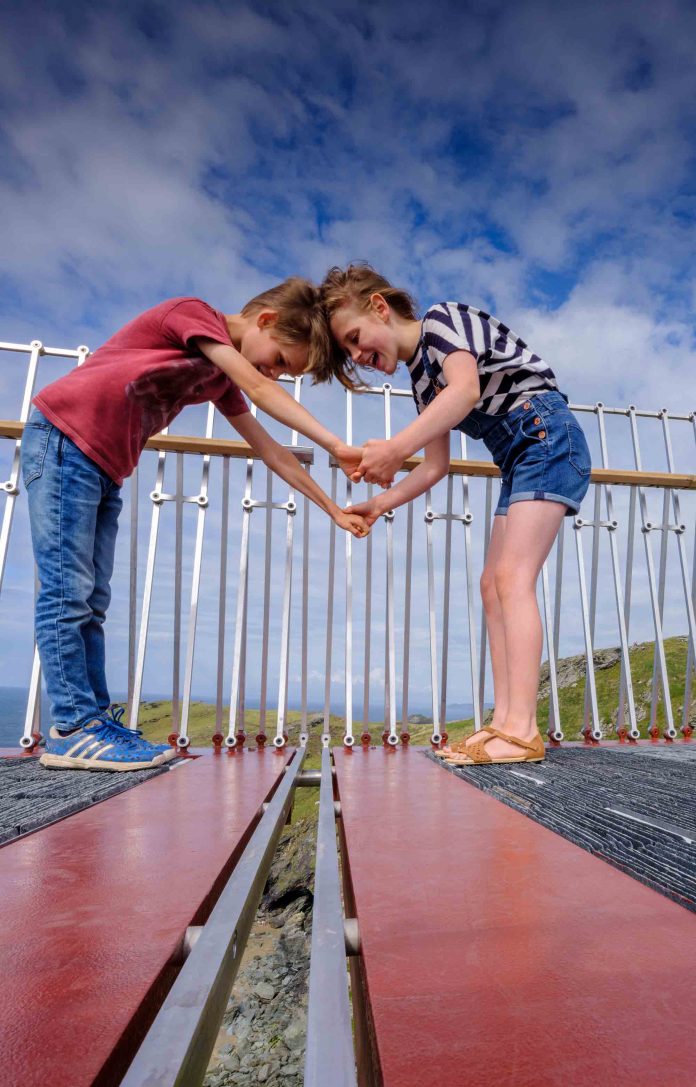
Children play on the new bridge at Tintagel.
The sleek new crossing is made up of two six-section cantilevers, which hang independently towards each other from either side of the rocky chasm. Incredibly, the two sides don’t actually meet, with a visible 4cm space between them (mind the gap). To emphasise the link’s modernity, electro-polished stainless steel has been used on the balustrades and diagonal support bars – from a distance, these elements almost disappear from view.
Visitors cross the new bridge at Tintagel Castle. Photo by: Jim Holden/Tintagel Castle
Unlike the many see-through glass walkways that have proliferated elsewhere in the world, the path across this bridge has been designed to mimic the one atop the original land bridge (it also helps to minimise vertigo). Some 40,000 locally-sourced slate tiles have been seemingly knitted together on end with subtle lines of quartz to recreate geological strata in the area.
Ney & Partners Civil Engineers and William Matthews Associates created the concept, which won a 2015 design contest held by Tintagel Castle. The castle was closed in October 2018 for the works, but re-opened to the public on Sunday 11 August.
The food hall trend is still going gangbusters worldwide, but while most restaurant collectives have a dish or two to appease plant-based eaters, vegan options don’t tend to be the focus of the whole shebang.
That looks set to change with Plant City, a food hall in Providence, Rhode Island, with five eateries, including full-service and quick-serve options, a burger joint, a coffee shop, and a juice bar – all of which are vegan. The most recent project from innovative plant-based chef Matthew Kenney opened in June, and so far, the reception has been overwhelmingly positive. “We served over 13,000 people in our first three days, and over 22,000 the first week,” says Kenney, the CEO and founder of Matthew Kenney Cuisine. “My expectations were far exceeded when we saw the outpouring of support.”
Plant City covers three floors, with a cellar-level communal space, coffee shops and a marketplace on the ground floor, and a pizza joint and a Latin-inspired spot on the second floor. Image by Go Providence
The project took about eight months to get off the ground, from conception to renovations to launch on 14 June. It features two unique concepts – New Burger, which serves plant-based American comfort food like burgers and shakes, and a retail marketplace, which carries offerings from small local businesses – alongside three established franchises. Pizza restaurant Double Zero has locations in New York and Venice Beach as well as on the second floor of Plant City, with three more outposts on the way this year. The Mexican-inspired Bar Verde, on the second floor as well, is an offshoot of the flagship in New York, and juice bar and café Make Out can also be found in Bogota, Colombia, and Los Angeles.
Everything at the marketplace is 100% vegan and cruelty-free. Image by Go Providence
As for the marketplace, that’s where you’ll find everything from small-batch nut cheeses and packaged goods to fresh-baked vegan goods like bread, pop tarts, croissants, and macarons. “There’s actually a lot happening within the plant-based scene when it comes to small artisanal goods and products in the area. Most of these businesses are small and their distribution is limited, but our marketplace has the ability to offer these things since it operates on a pretty small scale,” says Kenney. “We’re glad that we have the opportunity to showcase what local artisans are making, especially since most aren’t available in grocery store chains.”
Baked goods like sticky buns and pop tarts get the plant-based treatment. Image by Go Providence
Given health, environmental, and ethical concerns, plant-based diets as a whole are growing ever more appealing, with one prediction estimating that the global market value for vegan food will reach around US$24.3 billion by 2026. Kenney’s operation is getting in on the ground floor, touting a healthy, sustainable philosophy while supporting local businesses and gathering a diverse selection of plant-based dining options under one roof. “The concepts of food halls have also always inspired me,” Kenney says. “You’ve got all these different cuisines and influences and energies mingling in one place, and it creates a sense of excitement and curiosity and stimulation. To showcase our plant-based cuisine in this type of curated, multifaceted environment has really allowed us to be really creative and innovative throughout the process.”
It’s easy to be swept away by Fort Lauderdale’s white sand beaches and the timeless glitz of Las Olas Boulevard. But, beyond the staples that have made the South Florida city a vacation haven and proven Spring Break spectacle, a new hip, colorful and creative side is quickly emerging. And, just like a sunny day at the beach, it shouldn’t be missed.
Fort Lauderdale’s FATVillage is a colorful spectacle
FAT times in Flagler Village
Miami – Fort Lauderdale’s bustling southern neighbor – has Wynwood, a graffiti-clad, urban utopia loaded with apparel boutiques, rock bars and contemporary art galleries. In Fort Lauderdale, Flagler Village is well on its way to becoming the next Wynwood, if not distinctly cooler.
The booming neighborhood is located west of US-1 (locally known as Federal Highway), bordered by Sunrise Boulevard to the north and Northeast 4th Street to the south. While a number of craft breweries have laid ground in recent times – like Invasive Species, Flagler Village Brewery inside the Brass Tap, and American Icon Brewery Kitchen & Taproom – it’s an artsy buzz that keeps Flagler Village going around the clock, too.
At the industrial neighborhood’s core is the FATVillage Arts District (standing for Flagler.Arts.Technology), a warehouse-filled stretch of art galleries, Henry’s Sandwich Station, and the ever-bustling BREW Urban Café. By day, laptop warriors, well-behaved pups and locals own the Instagram-worthy BREW space, enjoying locally-roasted Wells Coffee and friendly company. At night, the space boasts live music, poetry readings and movie showings, among other weekly happenings.
To experience the best of Flagler Village and the FATVillage Arts District, there is an ArtWalk on the last Saturday of each month. For the ArtWalk, galleries and businesses open their unique spaces to the public, complemented by local artisans, live tunes, food trucks and cold beer vendors lining the streets.
David Bowie and Mick Jagger have a home in the artsy MASS District
The MASS district: Music and Arts South of Sunrise
A stone’s throw north of FATVillage, and still within the broader Flagler Village neighborhood, is the MASS District (standing for Music & Arts South of Sunrise).
Glitch Bar is a can’t-miss within this easy-to-stroll, creative cluster of shops, art galleries and food establishments. The bar-arcade spot has a large selection of totally free video games (Skeeball, pinball and Nintendo 64, among others), craft brews and signature cocktails (like the Player 1: Old Fashioned with bourbon, chocolate bitters, a Luxardo cherry and orange peel). If you’ve never played the Killer Queen team-driven video game, it’s definitely the main attraction here and is worth a try – you’ll probably end up wanting to play all night long.
Beyond Flagler Village’s primary, artsy hubs, there is much to explore in between. Additional highlights include Chops + Hops (an axe-throwing bar that opened last year), Circle House Coffee (owned and operated by former Miami Dolphins linebacker Stephen Tulloch) and 27 Bar & Lounge, which pays homage to celebrities in the ’27 Club’ (those who passed away at the age of 27, like Jimi Hendrix, Janis Joplin and Amy Winehouse) via themed cocktails and a cozy menu.
NYSW Jazz Lounge attracts some of the area’s top talent for intimate shows
Brews and music in Middle River
Outside of Flagler Village, pockets of creativity are popping up and thriving throughout the city. Among them, the area known as Middle River has become a bit of a hotspot with Tarpon River Brewing (from the owners of locally beloved, craft-beer haven Riverside Market), Grind Coffee Project and NYSW Jazz Lounge as its primary anchors. For memorable tunes, NYSW has live jazz music five nights a week, showcasing the area’s best talent in a cozy, unpretentious club atmosphere.
Invasive Species Brewing opened in Flagler Uptown in 2017
Getting there
South Florida’s sparkling inter-city rail system, Virgin Trains USA (formerly Brightline), connects West Palm Beach, Miami and Fort Lauderdale. Its Fort Lauderdale station is located centrally downtown and is a perfect starting point for a ride (or scooter!) to all the city has to offer.
For lodging with a flair, The Dalmar boasts a modern-meets-mid-century vibe and has 209 stylish guestrooms and 33 suites. Its 25th floor rooftop bar, Sparrow, opened in May and offers panoramic views of the Fort Lauderdale skyline, greenery galore and a massive, colorful mural from local artist Amauri Torezan. Its 6th floor infinity pool and deck are also a great option for a swim and soaking up the rays, especially when you don’t want to battle possible crowds at the beach.
Venture beyond Barcelona and its urban pleasures and you’ll find a region of forested hills, pristine beaches and medieval villages.
The dramatic peaks of the Pyrenees offer the perfect backdrop for skiing in winter and hiking in summer, and the vineyards and rustic taverns are a must for anyone interested in learning how Catalonia became one of Europe’s most celebrated regions for wine and gastronomy.
A view over the town and vineyards of Vilafranca del Penedès
Take a tour of a cava bodega
Cava, the Catalan answer to champagne, is perhaps the region’s best-known export, and the place to sample it is at the source – in one of the Modernista bodegas that dot the area known as the Penedès.
The village of Sant Sadurní d’Anoia is home to the two giants, Freixenet and Codorníu, both of which are easily reached by train from Barcelona. Freixenet has been around for a hundred years, and its tourist facilities include a little train you can ride around the vineyards, and a tasting room. The historic Codorníu bodega, meanwhile, is said to be where it all began, and is worth a visit for its spectacular Modernista building alone.
At nearby Vilafranca del Penedès is another eminent cava producer, Torres, and the town also has a wine museum, Vinseum, that makes for a diverting hour or two.
The Camí de Ronda
Explore the Costa Brava
The long, twisting coastline that runs up to the French border is blissfully unspoilt, thanks to the difficulty of reaching its towns by public transport. With a car, however, you can visit a series of tiny coves wrapped around golden beaches bordering crystalline water – some backed by small towns where you might find a place to linger over paella, others completely untouched.
The Camí de Ronda is a coastal path constructed for police patrols to watch out for smuggling at the end of the Civil War, and runs almost uninterruptedly for the entire length of the Costa Brava. These days it’s used as a hiking route, and even small sections of it can be incredibly rewarding – ask the tourist office for a map.
Montserrat monastery perched high up in the mountains
Make for the mountains
Though known as a mountain range, Collserola – which flanks Barcelona to the northwest – is really a string of hills providing some spectacular views across the city and out to sea.
Similarly good for a morning’s hike is the small mountain of Montserrat, considered the spiritual home of Catalonia for the Benedictine monastery that perches there. Take a cable car or cog-wheel train to get up there and enjoy the panoramic views.
Skiers, however, will want to head for the Pyrenees, which usually have a good smattering of snow in winter and cater for all budgets and abilities – from the family-friendly La Molina to the royalty-friendly Baqueira Beret. Glorious mountain towns provide plenty of accommodation and eating options if the resorts or the lively Puigcerdà don’t appeal – La Seu d’Urgell is especially lovely, a mostly medieval town with a Romanesque cathedral.
Inside the Monastery of Santa Maria de Poblet
Follow in the footsteps of Cistercian monks
Bafflingly under-visited by tourists, the town of Montblanc is one of Catalonia’s most picturesque, a labyrinth of winding streets, ringed by 13th-century walls. An easy train ride from Barcelona, it has a smattering of traditional family-run restaurants and hotels and makes a great base to visit the three monasteries of the region: Poblet, Santa Maria de Vallbona and the Monestir de Santes Creus. Collectively known as the ‘Cistercian Route’, these three extraordinary buildings give a real sense of what the monastic life was like centuries ago.
The Reial Monestir de Santa Maria de Poblet (generally known simply as ‘Poblet’), built as a palace and religious complex in the 12th century, is quite majestic. You can still visit the 14th-century palace, the church, chapel and cloister as a part of a guided tour. Similarly stunning is the Reial Monestir de Santes Creus, with an especially evocative Gothic cloister and chapterhouse. The most modest of the three is Reial Monestir de Santa Maria de Vallbona, a still-functioning convent (with only eight nuns) and a former favourite of queens – Queen Violant of Hungary is buried here.
For a sense of the variety that Catalonia has to offer, take a trip down the coast south from Barcelona. Just under an hour away is pretty, whitewashed Sitges, a sedate and upmarket place, which goes wild during carnival season thanks largely to its huge LGBTQ community. Carry on south from here and you will arrive at Tarragona, with its world-class collection of Roman remains, which include a perfectly preserved aqueduct, amphitheatre, circus and forum.
End your trip at the Ebre delta, a curious and peaceful region of rice paddies, lakes and flat paths (ideal for cycling), with an abundance of birdlife, including flamingos. Its cuisine, too, is unique – be sure to try dishes with the locally grown rice, and don’t pass up on the eel.
Wander the medieval heart of Girona
Girona deserves at least a couple of days all to itself. A splendid medieval town split into old and new (it’s all relative) by the river Onyar, its streets are considered so well preserved that it was used as a backdrop for Game of Thrones. At its heart is the lofty 14th-century cathedral, which commands a view across what was, until the pogrom of 1492, the city’s Jewish quarter. Vestiges of that time include the Banys Àrabs (actually a Jewish/Muslim bath-house) and the Museu d’Història dels Jueus, an outstanding museum devoted to the history of the Call (Jewish quarter).


 Mount Kailash bathed in light at sunrise
 Buddhist pilgrims walking the kora around Mt. Kailash
 Tibetan pilgrims working their way around Mt Kailash doing full body prostrations
 A pilgrim makes prayer
 Stunning Lake Manasarovar from the lakeshore Gossul Monastery (c) Bradley Mayhew