Home Blog Page 99

Welcome to the jungle: planning your Amazon adventure

0

The Amazon basin is a marvel of the world and the imagination, an ecosystem of unrivaled size and diversity, and a place of near mythical status among travelers. The Amazon River has more water than the next eight largest rivers combined, and is twice the area of India, and the basin spans eight countries.

A boat passes under the canopy of a large tree with a buttressed root
Explore the twisting waterways of the world’s longest river

It’s a life spring of the planet, the source of so much of the air, water and weather we all depend on. However, unreasonable travel expectations – like seeing jaguars around every bend – can be a recipe for disappointment. For all its size, the joys of the Amazon are mostly subtle: the ghostly roar of howler monkeys, the remarkable variety of plant life, the kindliness of riverside communities and the quiet but awesome power of the river itself. Here we focus on the accessing the Amazon in Brazil.

When to go

May to June is a great time to visit, being midway between the rainiest months (February to April) and the hottest driest ones (September to November). It’s also when the water level in the Amazon River is highest and the surrounding forest is flooded. The Amazon rises and falls by an amazing 12 to 15 meters annually, and few experiences are more sublime, or uniquely Amazonian, than gliding silently in a canoe through the flooded forest. That said, the dry season is attractive for its clear weather and opportunities for long hikes.

View of a jungle lodge lounge with some tables, a pool table, and walls made of bamboo
Stay in some atmospheric digs like the Anavilhanas Jungle Lodge

Amazon experiences

A common way to experience the Amazon is at a ‘jungle lodge’. Most lodges feature private rooms, family-style meals and daily excursions, but amenities such as en suite bathrooms and 24-hour electricity vary. Many lodges include a chance to sleep in the forest, whether just a night at an established camp or hiking for two or three days on a ‘survival tour’. Near Manaus, Amazon Antonio Jungle Tours and Amazon Gero Tours have good lodges and reasonable rates. Upscale options in the same area include Juma Lodge and Anavilhanas Lodge. And one of the best lodges in the entire Amazon is Uakari Lodge in Mamirauá Reserve.

Riverboats offer another way to see the Amazon – chugging along the river, stopping for excursions, sleeping on board. The boats vary in creature comforts, from hammocks to deluxe berths, and trips typically last five to 10 days. Reliable operators include Amazon Eco Adventures, Lo Peix and Amazon Brazil Jungle Tours.

A passenger riverboat cruises down the Amazon at sunrise
Amazon riverboats offer a close-up view of the river with a breeze

Tree climbing and sport fishing are also popular in the Amazon, and can be arranged as day trips or as part of a lodge or boat tour. For tree climbing, try Tropical Tree Climbing or Amazon Tree Climbing; for sport fishing, try Maia Expeditions, all in Manaus.

There are a handful of activities virtually every visitor to the Amazon does. The most memorable are long hikes or canoe trips to enjoy and learn about the forest, and hopefully spot some wildlife. You may also visit the home of a local family, spend a night in the jungle, and do fun stuff like piranha fishing and caiman spotting. Always confirm what activities are included in a tour before booking.

How long to visit

For most people, a week is a good amount of time to enjoy and experience the Amazon. Accounting for two to three days of travel and transfers, that leaves four to five days for excursions and activities. If you’ve got more than a week, consider splitting your time in different areas of the Amazon rather than spending it all in one place.

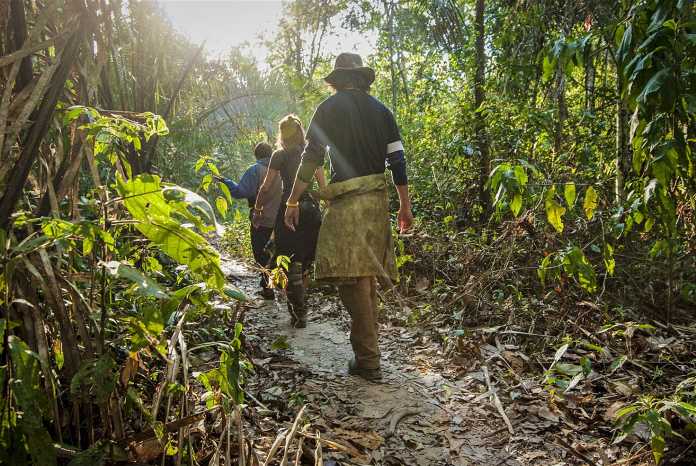
Take a hike through one of the lushest, most important jungles on the planet

Where to go

Manaus is the region’s largest city, and the quickest and easiest route into the jungle. You’ll find many good tour operators here, from budget to upscale. The flip side is that tours tend to be more crowded, and the surrounding area is less pristine.

If you’re willing to add a leg your journey, there are some outstanding options in other areas. One of the best is Mamirauá Reserve, located 675km upriver from Manaus, outside the small city of Tefé. There’s just one lodge there (Uakari Lodge), and visits can be pricey, but between the comfortable lodging, highly skilled guides and the reserve’s stunning richness, you can hardly do better.

A view of a white-sand beach with the Amazon jungle in the background
Alter do Chao was originally a trasnport hub for the latex industry, but many visit for its picturesque beaches

About 600 km downriver from Manaus, the small town of Alter do Chão is the jumping-off point for boats trips along the Rio Tapajós (a major tributary of the Amazon), including fascinating visits with local rubber-tapper communities. Alter do Chão itself is famous for its white sand beach and bohemian air. Mae Natureza or Areia Branca Ecotour offer recommended tours.

Getting there

Manaus is serviced by direct flights from all over Brazil, and even Miami. You can also get there by boat from anywhere on the Amazon, including Belém and Porto Velho, but be prepared for a long trip (two to five days).

You can reach Tefé and Alter do Chão by air or by boat. For Tefé, most flights and boats connect through Manaus. For Alter do Chão, catch a plane or boat from Manaus or Belém to the city of Santarém, and take a bus or taxi from there (35km). Speedboats are available between Manaus and Tefé, and are faster than an ordinary boat but cheaper than a plane.

A man sits in a small fishing boat looking at the port in Tefe
People arrive through one of the many ports along the riverside in the city of Tefe

Flying is, of course, much quicker than taking a boat, and sometimes not much more expensive. Then again, long distance boat travel is an experience unto itself: chugging along for days at a time, sleeping in hammocks, and whiling away the hours with other passengers. You won’t see much in terms of wildlife or scenery though, as the boat follows the huge main channel.

Morning Desert Safari Abu Dhabi Flat 20% Off

0

Overview

Morning with dune bashing.

Try out the morning desert safari in the Al Khatim desert, around an hour drive from Abu Dhabi, to have a blistering and beautiful view of the Shining desert. Have an amazing experience, as you hold on to your seats and go dune bashing in a 4×4.

After dune bashing, get a chance to see camels closely in a group on the farm. You can also do camel riding. The Al Khatim desert is blessed with the largest dunes, reaching hundreds of meters high than the surrounding plains. You can also do sand boarding, and have an endless thrilling and adventurous experience. You can also try quad-biking at an extra charge, available on site.

Get your camera ready in the desert camp, as you will get a picture to wear traditional Arabic dress. Prepare yourself for a hand interaction with the Falcon, and take a gallery full of pictures. Also at the campsite, you will get Arabic coffee, tea, dates, water, and soft-drinks for Refreshments.

The ticket includes:
– Desert safari for 1-hour.
– Arabic traditional dress for taking pictures.
– Hand interaction with the Falcon for taking pictures.
– Refreshments at the campsite.

Note: Pick-up will be between 8.00 a.m. – 8.30 a.m. from your location in Bur Dubai/Deira.
Minimum 3 persons are required to book this tour.
Camel ride and sand-boarding are charged extra.
Quad-biking is also available at an extra charge on site.

Meal

7

  • Refreshments at the campsite (Arabic coffee, tea, dates, water, and soft drinks)

Activit

    • Desert Safari
    • Camel Riding ( if selected
    • Sand Boarding
  • Dune Bashing

Other Inclusion

    • Dune Bashin
    • Camel Riding (if option selected
    • Sand Boardin
    • Desert photography opportunitie
    • Professional licensed safari guid
  • Hand interaction with the Falcon

Transport

7

  • Hotel pick-up and drop-off by 4×4

Things To Carr

    • Comfortable Footwea
    • Sunscree
    • Sunglasse
    • Cap / Ha
    • Closed Shoe
    • Water Bottl
    • Valid I
  • Camera

Advisor

    • Dune bashing can get bumpy. For safety purposes, we do not recommend children under aged 0-2, pregnant women or the elderly to take parting in this activit
    • Infant seats are not available for dune bashin
    • It is recommended that you do not eat 2-3 hours before the safari trip to avoid incurring motion sickness during the dune bashin
  • We would like to recommend you to wear comfortable clothes and closed shoes in your desert safari tour.

Tour Type

  • This is a group tour

Cancellation Policy

    • If cancellations are made 15 days before the start date of the trip, 25% of total tour cost will be charged as cancellation fees
    • If cancellations are made 7-15 days before the start date of the trip, 50% of total tour cost will be charged as cancellation fees
    • If cancellations are made within 0-7 days before the start date of the trip, 100% of total tour cost will be charged as cancellation fees.
  • In case of unforeseen weather conditions or government restrictions, certain activities may be cancelled and in such cases the operator will try his best to provide an alternate feasible activity. However no refund will be provided for the same.

Refund Policy

  • The applicable refund amount will be processed within 10 business days

Confirmation Policy

    • The customer receives a confirmation voucher via email within 24 hours of successful booking
    • In case the preferred slots are unavailable, an alternate schedule of the customer’s preference will be arranged and a new confirmation voucher will be sent via email.
  • Alternatively, the customer may choose to cancel their booking and a full refund will be processed.

       travlomama


The Taj Mahal is an ivory-white marble mausoleum on the south bank of the Yamuna river in the Indian city of Agra.

0

Taj Mahal

Top choice historic building in Agra

Poet Rabindranath Tagore described it as ‘a teardrop on the cheek of eternity’; Rudyard Kipling as ‘the embodiment of all things pure’; while its creator, Emperor Shah Jahan, said it made ‘the sun and the moon shed tears from their eyes’. Every year, tourists numbering more than twice the population of Agra pass through its gates to catch a once-in-a-lifetime glimpse of what is widely considered the most beautiful building in the world. Few leave disappointed.

The Taj was built by Shah Jahan as a memorial for his third wife, Mumtaz Mahal, who died giving birth to their 14th child in 1631. The death of Mumtaz left the emperor so heartbroken that his hair is said to have turned grey virtually overnight. Construction of the Taj began the following year; although the main building is thought to have been built in eight years, the whole complex was not completed until 1653. Not long after it was finished, Shah Jahan was overthrown by his son Aurangzeb and imprisoned in Agra Fort, where for the rest of his days he could only gaze out at his creation through a window. Following his death in 1666, Shah Jahan was buried here alongside his beloved Mumtaz.

In total, some 20,000 people from India and Central Asia worked on the building. Specialists were brought in from as far away as Europe to produce the exquisite marble screens and pietra dura (marble inlay work) made with thousands of semiprecious stones.

The Taj was designated a World Heritage Site in 1983 and looks nearly as immaculate today as when it was first constructed – though it underwent a huge restoration project in the early 20th century.

• Entry & Information

Note: the Taj is closed every Friday to anyone not attending prayers at the mosque.

The Taj was built by Shah Jahan as a memorial for his third wife, Mumtaz Mahal, who died giving birth to their 14th child in 1631. The death of Mumtaz left the emperor so heartbroken that his hair is said to have turned grey virtually overnight. Construction of the Taj began the following year; although the main building is thought to have been built in eight years, the whole complex was not completed until 1653. Not long after it was finished, Shah Jahan was overthrown by his son Aurangzeb and imprisoned in Agra Fort, where for the rest of his days he could only gaze out at his creation through a window. Following his death in 1666, Shah Jahan was buried here alongside his beloved Mumtaz.

In total, some 20,000 people from India and Central Asia worked on the building. Specialists were brought in from as far away as Europe to produce the exquisite marble screens and pietra dura (marble inlay work) made with thousands of semiprecious stones.

The Taj was designated a World Heritage Site in 1983 and looks nearly as immaculate today as when it was first constructed – though it underwent a huge restoration project in the early 20th century.

• Entry & Information

Note: the Taj is closed every Friday to anyone not attending prayers at the mosque.

The Taj can be accessed through the west and east gates. The south gate was closed to visitors in 2018 for security concerns but can be used to exit the Taj. The east gate generally has shorter queues. There are separate queues for men and women at both gates. If you are a foreigner, once you get your ticket, you can skip ahead of the lines of Indians waiting to get in – one perk of your pricey entry fee. It’s possible to buy your tickets online in advance at https://asi.payumoney.com (you’ll get a ₹50 discount for your troubles), but you won’t save much time as you still have to join the main security queue. A ticket that includes entrance to the mausoleum itself cost ₹200 extra.

Cameras and videos are permitted, but you can’t take photographs inside the mausoleum itself. Tripods are banned.

Remember to retrieve your free 500ml bottle of water and shoe covers (included in Taj ticket price). If you keep your ticket, you get small entry-fee discounts when visiting Agra Fort, Fatehpur Sikri, Akbar’s Tomb or the Itimad-ud-Daulah on the same day. Bags much bigger than a money pouch are not allowed inside; free bag storage is available. Any food or tobacco will be confiscated when you go through security, as will pens.

• Inside the Grounds

From both the east and west gates you first enter a monumental inner courtyard with an impressive 30m red-sandstone gateway on the south side.

The ornamental gardens are set out along classical Mughal charbagh (formal Persian garden) lines – a square quartered by watercourses, with an ornamental marble plinth at its centre. When the fountains are not flowing, the Taj is beautifully reflected in the water.

The Taj Mahal itself stands on a raised marble platform at the northern end of the ornamental gardens, with its back to the Yamuna River. Its raised position means that the backdrop is only sky – a masterstroke of design. Purely decorative 40m-high white minarets grace each corner of the platform. After more than three centuries they are not quite perpendicular, but they may have been designed to lean slightly outwards so that in the event of an earthquake they would fall away from the precious Taj. The red-sandstone mosque to the west is an important gathering place for Agra’s Muslims. The identical building to the east, the jawab, was built for symmetry.

The central Taj structure is made of semitranslucent white marble, carved with flowers and inlaid with thousands of semiprecious stones in beautiful patterns. A perfect exercise in symmetry, the four identical faces of the Taj feature impressive vaulted arches embellished with pietra dura scrollwork and quotations from the Quran in a style of calligraphy using inlaid jasper. The whole structure is topped off by four small domes surrounding the famous bulbous central dome.

Directly below the main dome is the Cenotaph of Mumtaz Mahal, an elaborate false tomb surrounded by an exquisite perforated marble screen inlaid with dozens of different types of semiprecious stones. Beside it, offsetting the symmetry of the Taj, is the Cenotaph of Shah Jahan, who was interred here with little ceremony by his usurping son Aurangzeb in 1666. Light is admitted into the central chamber by finely cut marble screens.

The real tombs of Mumtaz Mahal and Shah Jahan are in a basement room below the main chamber.


Welcome to Mumbai (Mumbai)

0

If Mumbai is your introduction to India, prepare yourself. The city isn’t a threatening place but its furious energy, limited (but improving) public transport and punishing pollution make it challenging for visitors. The heart of the city contains some of the grandest colonial-era architecture on the planet, but explore a little more and you’ll uncover unique bazaars, hidden temples, hipster enclaves and India’s premier restaurants and nightlife.

    Top experiences in (Mumbai)

Chhatrapati Shivaji Maharaj Terminus

Top choice historic building in Mumbai (Mumbai)

Imposing, exuberant and overflowing with people, this monumental train station is the city’s most extravagant Gothic building and an aphorism of colonial-era India. It’s a meringue of Victorian, Hindu and Islamic styles whipped into an imposing Dalí-esque structure of buttresses, domes, turrets, spires and stained glass. It’s also known as CSMT.

Some of the architectural detail is incredible, with dog-faced gargoyles adorning the magnificent central tower and peacock-filled windows above the central courtyard. Designed by Frederick Stevens, it was completed in 1887, 34 years after the first train in India left this site.

Despite being renamed again in 2017, after being changed to Chhatrapati Shivaji Terminus (CST) in 1998, it’s still better known locally as VT.

Sassoon Docks

No sense is left unaffected at Mumbai’s incredibly atmospheric fishing docks, dating to 1875, the oldest and largest wholesale fish market in Mumbai. A scene of intense and pungent activity begins around 5am, when colourfully clad Koli fisherfolk sort the catch unloaded from fishing trawlers at the quay, and carries on throughout the morning.

Gaggles of sari-sheathed women peel pink prawns as theft-determined crows swoop in and out. Fishmongers barrel though discarded piles of shells, drying bombil (fish used for Bombay duck) and discarded fish bits with massive carts of catch, all against a cinematic backdrop of wooden fishing boats. Piles of pomfret, blue crabs, rawas (white salmon), tambusa (Indian red snapper), tuna, cuttlefish and sting rays are hawked – 20 tonnes per day – often in heated exchanges of commerce and camaraderie. Some say photography is prohibited, others disagree (we had no issues shooting away and the whole thing is a photographer’s dream).

Related tour

Peshawri

Make this Northwest Frontier restaurant, outside the international airport, your first or last stop in Mumbai. It’s a carbon copy of Delhi’s famous Bukhara, with the same menu and decor. Folks flock here for the buttery dhal bukhara, a 24-hour simmered black dhal (₹945), but don’t miss kebabs. Try the Murgh Malai (marinated tandoor-grilled chicken) and raan (impossibly succulent slow-roasted lamb hock).

Despite the five-star surrounds (and prices) you’re encouraged to eat with your hands and the seating is low.

Iskcon Temple

Top choice hindu temple in Mumbai (Mumbai)

Iskcon Juhu plays a key part in the Hare Krishna story, as founder AC Bhaktivedanta Swami Prabhupada spent extended periods here (you can visit his modest living quarters-cum-museum in the adjacent building; 10.30am to 12.30pm and 5.30pm to 8.30pm). The temple compound comes alive during prayer time as the faithful whip themselves into a devotional frenzy of joy, with kirtan dancing accompanied by crashing hand symbols and drumbeats. Murals around the compound detail the Hare Krishna narrative. The Iskcon hotel here is also recommended, as is the thali-only restaurant (buffet meals ₹300 to ₹600). It’s a compelling place to visit for intense, celebratory worship in the sedate suburbs.


Top 10 beaches in Goa

0

A guide to the finest beaches in Goa. From the North to the South of the state, enjoy an incredible coastline throughout your Goa holidays.

India’s ‘sunshine state’ has long provided a haven for those in search of the sun, sand and sea. Boasting 105km of stunning coastline and an endless list of idyllic beach settings, there’s no surprise so many people flock to Goa for their beach holidays. The laid-back and picturesque state is all about relaxation, and in fact, the only stress you’re likely to encounter is in choosing which beach to visit during your holiday in Goa.

We’ve compiled the perfect list for those of you struggling to pick your perfect seaside location – presenting our top 10 beaches in Goa, all ready to be enjoyed on a sun-filled holiday.


North Goa

1. Morjim

Discovered in the far north of the state, Morjim presents one of the more wild expanses of sand for you to embrace during your Goa holidays. Backed by a smattering of inviting beach bars and shacks, the beach’s most famous characteristic is its role as a nesting ground for olive ridley sea turtles.


2. Baga

A little further south of Morjim sits Baga, showcasing an entirely different atmosphere to that of its neighbour. Isolation is swapped for infrastructure, resulting in a fantastically-vibrant atmosphere defined by an unbroken line of aromatic and welcoming beach shacks, all placed beside a long stretch of golden sand.


3. Candolim & Calangute

Among the most popular beaches for British tourists spending their holidays in Goa, Candolim and Calangute’s long strips of golden sand result in one of the state’s most inviting stretches of coastline. There’s a very friendly atmosphere resonating throughout the resorts, best discovered over a delicious Goan curry in one of the eye-catching beach shacks.


4. Sinquerim

Encapsulating the languid and relaxed ideology of Goa, stunning Sinquerim is a sedate but beautiful place to lay your beach towel. The beach itself is decorated with a small collection of beach shacks, dotted along a long curve of sand, backed by towering palm trees.


South Goa

5. Arossim

Arossim’s beautiful beach presents a long and wide stretch of golden sand, lapped at by clear blue water and backed by a dense forest of palms. Another of the beach’s highlights is its culinary offerings, with superb beach shacks such as ‘Zeebop’, located just to the south of the beach, serving up delicious and fresh seafood to hungry beach goers. Find out more about holidays in Arossim here.

6. Majorda

Located just north of Colva, Majorda offers 25km of soft golden sand and is famed as being one of the most picturesque beaches in the south of Goa. Along the coastline, you’ll find a small selection of beach shacks where you can try tasty Goan delicacies and enjoy a refreshing beer.

7. Benaulim & Varca

Located around 30km south of Goa’s capital, Panjim, Benaulim Beach offers holidaymakers not just a wonderful haven for rest and relaxation, but also plenty of things to do in and around the area. Its long stretch of soft white sand backed by verdant palm trees is a picturesque setting for keen beach goers, but if soaking up the sunshine on a sunlounger doesn’t sound like your cup of tea, you can get stuck into to water sports and dolphin watching.

8. Mobor

Tucked down into South Goa, Mobor is an alluring, laid-back hangout, perfect for tourists in search of holidays to Goa with a slow pace. It’s easy to embrace the notion of rejuvenation here, especially given the spectacular spit of soft white sand, while the rustic beach shacks will gladly welcome you and keep you fed and watered throughout your stay.


The beach outside The Leela

9. Cola

If you’re looking for that unprecedented sense of peace and quiet, amid the blissful and idyllic nature of one of Goa’s finest beaches, a holiday to Goa is incomplete without a visit to Cola Beach. The private beach is perhaps best known as the host of our Maharaja Night, where you can camp overnight in comfortable safari tents right on the sand.

10. Palolem

Often labelled as Goa’s finest beach, Palolem’s tag ensures it has a lot to live up to, and this breathtaking beach consistently delivers. A long curve of palm-fringed sand awaits those visiting Palolem, as well as some of the safest swimming areas in Goa. Though the beach isn’t as undeveloped and sedate as in previous years, there is still a charm and character here that can best be found in ramshackle beach huts serving tasty local grub.

Need a little more information about the beaches of Goa? Check out our Beach Guide on our website where you can also peruse the great range of accommodation we offer across Goa.

Have we missed out your favourite beach in Goa? Let us know by commenting below.

https://www.google.com/maps/d/viewer?mid=16NocgpyDPj8fwboGD_rxrW4J8xY&ll=15.624400708138543%2C74.06021119609375&z=10

Mauritius is an island Eden is a palm-fringed playground is tropical waterf

0

This popular ecotourism destination is a 26-hectare nature reserve on an island roughly 800m off the coast. It preserves very rare remnants of the coastal forests of Mauritius and provides a sanctuary for a range of endemic and endangered wildlife species. Visits are only possible as part of a guided tour, and these leave from Pointe Jérome, close to Le Preskîl. Highlights include Aldabra giant tortoises, ebony trees, wild orchids, and the endangered pink pigeon and other rare bird species.

Best in Travel 2019 Best Value visit now

0

1. Southern Nile Valley, Egypt

Egypt’s Southern Nile Valley is the flag-bearer for the country’s return to travel’s super league, and its near-incomparable historical itinerary represents a superb deal for travellers in 2019. For starters, world-class ancient sites hugging the Nile south from Luxor to Aswan are accessible for a few dollars. If you’re on a cruise, food and land transport will be included; otherwise it’s easy to make inexpensive arrangements for all but a handful of big-ticket temples and tombs, which are more than worth the admission price themselves. Factor in easy access from Europe and growing visitor numbers and it’s a great time for that dream Nile cruise or desert adventure.

2. Łódź, Poland

The ambitious post-industrial city of Łódź, the third-largest in Poland, is in a rapid state of transformation. It combines renovation of industrial spaces with bold architectural projects: former factories and other spaces are being transformed into cultural, shopping and entertainment areas. Łódź’s EC1 complex continues to take shape and already has a new planetarium, a huge new science and technology centre and a range of exhibition spaces. The Manufaktura shopping and entertainment area is home to the MS2 Museum of Art, a zip line and an artificial beach. And don’t miss the remarkable Fabryczna railway station, a work of art with trains.

3. Great Smoky Mountains National Park, USA

Although little celebrated outside the USA, the Great Smoky Mountains National Park is no secret, as 10 million annual visitors will attest. This park, which straddles the North Carolina and Tennessee border, is free to enter, which means accessing the view from Clingmans Dome or exploring the atmospheric remains of Cades Cove won’t cost you anything more than getting there. It also offers some of the best hiking east of the Mississippi. The park has recovered from the 2016 wildfires and access to the iconic Chimney Tops Trail is almost fully restored, so this is a great time to enjoy a wallet-friendly national park adventure.

4. Maldives

Independent travel is growing in the Maldives as word gets out about a network of inexpensive places to stay on the islands. OK, we’re not talking Southeast Asia cheap, but an increasing number of inhabited, non-resort islands have their own locally run guesthouses, bypassing the expensive resort scene and bringing visitors close to what can be the otherwise elusive Maldivian culture. Costs are typically around US$90 per night and meals, diving and other activities can be arranged. Popular islands for independent travellers include Maafushi, Rasdhoo, Thoddoo and Dhigurah, but there are many more, contributing to a growing independent travel scene across the atolls.

5. Houston, USA

Although trips into orbit remain prohibitively expensive, the city from where the moon landings were guided is a great-value place to celebrate the 50th anniversary of the giant leap for mankind. An excellent place to start is Houston’s Museum District, which has 19 museums within walking distance: 10 of them are always free and the others offer special free days. The up-and-coming EaDo (East Downtown) district is home to an open-air gallery of murals, and a self-guided tour can take you around this colourful part of town. Houston’s diversity inspires its cuisine and great eating needn’t mean top-end fine dining. Chinatown, located on Houston’s west side, is home to the James Beard Award-nominated Mala Sichuan and Crawfish & Noodles.

6. Argentina

In the past few years, costs for travellers to Argentina have crept up, but the country’s efforts to encourage visitors can offer some significant savings. Overseas visitors who pay for their lodging with an international credit card will receive a refund on the 21% rate of Value Added Tax, plus there are savings on visa fees for certain nationalities. The solar eclipse crossing the north of the country is another incentive to visit in 2019, along with Argentina’s marvellous mix of world-beating wine, awesome mountain and lake scenery and its crackling-with-life capital Buenos Aires.


7. Bangladesh

Bangladesh creates astonishingly few ripples given everything it has to offer. The world’s eighth most populated country is home to diverse, exciting cities, Asia’s longest beach (and an emerging surf scene) at Cox’s Bazar, and the mangroves and wild tigers of Sundarbans National Park. Bangladesh has always been an inexpensive destination for travellers, and Unesco World Heritage sites are waiting to be discovered, such as the open-air museum that is the historic city of Bagerhat, where the Ganges and Brahmaputra rivers meet, and the atmospheric Buddhist ruins at Paharpur. Visitors remain a rarity almost everywhere else, giving Bangladesh an ‘out there’ feeling that’s harder to find in many neighbouring countries.

8. Albania

Albania has been Europe’s final frontier for a while. Here’s a pocket of great value hiding in plain sight, with some superb beaches, a unique history and none of the crowds of Montenegro to the north or Greece to the south. The country’s exciting food scene celebrates the fruits of its unique local flavours and offers seriously distinctive dining. Although its archaeological sights, such as Apollonia and Butrint, and its one-of-a-kind blend of Balkan, Mediterranean and Italian influences are no secrets, Albania remains a destination where you can hike amid beautiful mountain scenery, stay in tiny and timeless villages and explore the buzzy capital Tirana for far less than pretty much anywhere else in Europe.

9. Ecuador

Want to see the best of South America but short on time? Ecuador is the place for you. Here are green Andean landscapes, colourful colonial towns, Amazon rainforests and Pacific Ocean waves. As you might expect in a small country, buses are quick, plentiful and cheap: hardly anywhere is more than half a day’s journey away. Ecuador is home to one of South America’s best beach scenes, in the towns north of the city of Guayaquil. Though they’re changing fast, the likes of Canoa and Mompiche are still places where you can find a beachside place to crash for a few dollars a night.

10. Slovenia

This pocket of Europe in miniature is a great value bet for anyone who’s after the continent’s highlights but is short on time or funds. In a single day you can tour a Venetian-tinged seaside town, cross Alpine passes and dine by the river in the heart of Ljubljana. But why rush? This is a land of outdoor activities available for much less than you’ll pay in other Alpine countries. It is a place of world-class restaurants and wineries, and undiscovered small towns. Getting around is easy and cheap, and many road and rail journeys are spectacular. Summer brings crowds to lakes Bled and, to a lesser extent, Bohinj, but it’s easy to leave them behind.

Travel fads come and go, and they’re fun, for a while. Cronut- and freakshake-hunting was, at one point, deemed an essential city trip activity for Instagrammable-snack devotees, while barnyard yoga seemed to make perfect sense for flexible nature lovers – where better to hone your cow pose?

Some trends, however, emerge slowly and have the potential to stick around for the long haul. So what’s on the horizon this year? Here are the trends to watch in 2019 that just might change the way we travel for good.

Múlafossur Waterfall, Faroe Islands on a sunny day.
The Faroe Islands make a great option for off-the-beaten-path adventures

Getting off the touristed path

The ‘don’t be a tourist, be a traveller’ sentiment is jaded. We all have an impact on the places we visit, whether we go it alone or rely on a tour group. Avoiding crowds and nabbing low-season deals is nothing new for experienced globetrotters, but with the rise of ‘overtourism’, steering clear of the masses and choosing your destinations wisely is more important than ever. It can have surprising benefits, too.

Take part in the trend for getting off the touristed path.

A virtual reality headset in a rocky landscape
Transport yourself to other worlds with new technologies

Augmented attractions

Like it or loathe it, virtual reality tech is gathering pace. With ever-improving headsets, apps and 360-degree content, it’s already taking armchair travel to the next level – transporting anyone with a wifi connection to Antarctica, Aruba or even Mars – but what effect will these new technologies have for those who still want to see the world, IRL (in real life)?

A woman wanders through Tbilisi, Georgia
Learn about the lineage you never knew you had with a DNA test kit 

My DNA and me

We live in the information age. Never before have we had so much knowledge at our fingertips – but besides having a few distant cousins on Facebook, how much do you know about your genealogy? Ancestry exploration has been given a new lease of life with the dawn of do-it-yourself DNA kits. You might be born and bred in your home nation, but your DNA may well reveal where you really come from. Naturally, curious travellers are using unexpected results as an excuse to book a trip.

Find out more about the trend for understanding your ancestry.

A scenic road on the Isle of Skye at sunset
The Scottish Highlands are a surprising – and scenic – option for EV road trips

Road trips go electric

The EV (electric vehicle) revolution is just around the corner, with charging stations cropping up in the most unlikely places. Whether you’re considering taking the leap with your next set of wheels, or willing to experiment with a rental, your next road trip could not only be better for the environment, but also show you a totally different side to your destination.

Get on track with the e-vehicle trend.

The Milky Way above a forest silhouette
Seek out the spaces that provide impeccable night-time views

Dark skies

When did you last take a good look at the night sky? What could you see? For many of us around the world, light pollution spoils the view. Sure, we can spot the moon – the Big Dipper if we’re lucky. But opportunities for true constellation admiration are few and far between. Fortunately, designated dark-sky spaces are on the increase, granting stargazers better access to spellbinding panoramas.

Welcome to Lamu Archipelago

0

Few would dispute the Lamu archipelago forms the most evocative destination on the Kenyan coast. It’s the best of several travelling worlds: medieval stone towns of narrow streets, charming architecture, tropical-island paradise, delicious local cuisine and star-heavy nights that are pregnant with the smell of spice and possibility. Choose your calling: bustling Lamu Town, a pungent, lively Unesco site; Shela Beach, an idyllic spot that attracts the majority of Lamu’s visitors; Manda Island and its resorts; little-visited Paté Island with its traditional villages and beguiling ruins; or remote Kiwayu Island, an adventure destination often reached by dhow.


Welcome to North America

0

Culture

Iconic cities that need no introduction are just the icing on this culture-laden cake. Yes, you have the Museum of Modern Art in New York and the Smithsonian in Washington DC but the buzz of music, art and film finds its way down into everyday life, with citizens as often creating as much as consuming. A historical melting pot of cultures and identities, North America features some of the world’s most multicultural art. From Toronto’s film festival to Mexico City’s thriving music scene, North America is a veritable smorgasbord of enlightening experiences just waiting to be uncovered.

Landscapes

Even the most hardcore North American urban and suburbanites are forced to stop and gawp when confronted with the sheer natural beauty that is their homeland. From red-rock deserts to lush tropical rainforests, North America has the rare claim of covering every climatic zone, and its deepest gorge in Mexico’s Copper Canyon and Mt McKinley in Alaska exceed geographical extremes. Whether you’re relaxing on a virtually undiscovered beach, racing down the slopes of the Great White North or scaling the iconic crags of the Grand Canyon – North America is certain to take your breath away.

Adventure

In this land, adventure is king. Venture on a Canadian wilderness trek, buckle up for the legendary road trip along Route 66 or explore ancient rites at mysterious Maya and Aztec ruins. Whatever your travel dreams, North America offers a kaleidoscope of cultures, cuisines, landscapes, history and adventures that are bound to fulfill.

Food

On one evening across North America, thick barbecue ribs and smoked brisket come piping hot at a Texas roadhouse, while talented chefs blend organic produce with Asian accents at award-winning West Coast restaurants. Locals get their fix of simple street tacos in Mexico, and a continent away, golden fries disappear under a steaming pile of gravy and cheese curds in a plate of poutine. Fresh lobster served off a Maine pier, oysters and champagne in a Vancouver wine bar, beer and pizza at a Midwestern pub – these are just a few ways to dine à la Americana.

Italy’s coolest city: why Naples is the place to be right now

0

With its strong community spirit, unsanitised street culture and crumbling architecture, the gritty southern-Italian city of Naples attracts those who want to see a raw and untamed side of Italy.

In the 20th century, trailblazing cultural icons such as Hemingway, Pablo Neruda and Andy Warhol were seduced by Naples. Today, trendsetting young artists and writers are drawn here too, some enticed by the vital and uncompromising portrayals of the city in Elena Ferrante’s My Brilliant Friend and Roberto Saviano’s Gomorrah.

Young people hanging out and chatting in the street in Naples' historic centre
Hanging out in the historical centre of Naples © Yulia Grigoryeva

Buzzing bars and impromptu gigs for those in the know

What makes Naples’ nightlife cool is not a slew of hipster bars furnished with pallet furniture and bare light bulbs, but the very absence of these kind of places. At night Neapolitans spill out onto the streets and cluster around the galley bars and cafes of Piazza Bellini. On the west side, students gather at Caffè Dell’Epoca for the famous €2 Aperol spritz, then head on to the buzzing Afro-beats nightclub Teranga. Those in search of cocktails and live music find it in sophisticated bars on the east side of the square, such as Nea, which is an art gallery by day, and leafy Intra Moenia, which doubles as a publishing house.

Elsewhere, impromptu gigs erupt in the Spanish Quarter’s bassos (tiny ground-floor apartments) and experimental DJ sets draw crowds to Spazio Intolab – an abandoned wool factory near the station. However, insiders know that each night of the week lends itself to hanging out on the street outside a different bar. On Wednesday the cavernous Buco Pertuso hosts up-and-coming bands and cheap drinks; on Thursday Francesco Sepe keeps his family Antica Cantina Sepe open late for his now infamous ‘Aperisepe’ evenings, serving €1.50 wine and his mamma’s aubergine parmigiana; on Friday outside Spiedo D’Oro, well-loved owner Enzo hosts small ramshackle live-music gigs.

Well-heeled Neapolitans head out for their pre-dinner aperitivo in the smarter area of Chiaia, near the seaside. The narrow streets, known as baretti, are punctuated with cocktail bars such as Antiquario and Chandelier, where Negronis are accompanied by a banquet of charcuterie and cold salads.

The side of an apartment building is decorated with two huge murals, one of the footballer Maradona's face and the other of a boy's face, both with red face paint on their cheeks
A giant mural depicting the footballer Diego Maradona by the artist Jorit Agoch © Marco Cantile

Subversive street art and cutting-edge galleries

Nestled between amorous scrawl, graffiti tags and protest manifestos, street art by local and international artists adorns the fragmented stockades of the city. Naples’ mayor has even pledged his support, writing on his Facebook page that street art fits with the ‘city’s social and political revolutionary drive’. A Banksy – the only one in Italy – can be spotted in Piazza dei Girolamini in the historic centre: a Madonna figure stencilled onto the wall in blue-grey tones, with a gun above her head in the place of a halo.

Local duo Cyop & Kaf have created more than 220 murals on shopfronts, shutters, and street corners in the Spanish Quarter. Painted flatly in blocks of colour, the murals show surreal, dreamlike and often disturbing characters that reference local folklore and subvert oppressive forces such as the local mafia. On the outskirts of the city, Jorit Agoch has painted a huge portrait of footballer Maradona – an earthly deity for Neapolitans – on the southern facade of a 10-storey social housing block. On the opposite end of the block is the largest ever depiction of Che Guevara’s face.

The city’s cultural cachet, and an abundance of cheap studio space, is drawing Neapolitan artists back to their once neglected hometown. Artist and curator Raffaela Naldi Rossano runs ‘Sibilla Cabinet’, an ecofeminist (a movement that combines feminist and ecological concerns) and critical-theory bookshop in her own artist-run gallery space. She invites artists and writers to the city to participate in her Residency 80121 program, encouraging a conversation to evolve on what it means to inhabit Naples because, as she explains, ‘nothing is ever certain here’. Local artists such as the Fake Gallery collective and &nd Project Napoli host a continuum of shows, openings and events in DIY venues. Most recently, the city’s rising-star status was confirmed by the arrival of the prestigious Thomas Dane Gallery from London. Like Naldi Rossano, Dane invites international artists to stay in Naples and exhibit in his gallery, adding to the city’s growing artistic buzz.

The interior of Materia Mediterranea's shop, with clothing on a rail and art and ceramics on tables and shelves
Materia Mediterranea boutique

Vintage pioneers and atmospheric boutiques

The very idea of ‘vintage’ clothing emerged here in WWII when resourceful Neapolitans collected allied army uniforms to repurpose and sell on the black market. Per Voi Giovani, a tiny modernist-inspired gem of a shop behind Naples’ station, has been selling vintage clothing to artists and musicians since the 1960s. Rows of colour-coordinated shirts, jumpers and trousers are packed into its brass shelving. More vintage shops line Via Mezzocannone, the narrow student street which runs between the city’s two universities – Il Federico II and L’Orientale. Halfway down on the right is Retrophilia, a light and airy boutique selling a carefully curated collection of women’s clothes.

Filmmaker Pier Paolo Pasolini admired Naples’ ability to avoid succumbing to mass consumerism, and a plethora of small independent boutiques still thrive here today. One unassuming courtyard hides both the quirky Ospedale delle Bambole (Dolls’ Hospital) workshop and the stylish Materia Mediterranea boutique, which sells art, ceramics and jewellery handcrafted by local artisans. Affordable antique gold and coral jewellery is sold in the historic wood-panelled Leonardo Gaita on Via Toledo, and the row of tiny old-fashioned burrows on Via San Biagio Librai. Bespoke men’s tailors such as Mariano Rubinacci, Camiceria Piccolo and umbrella-artisans Talarico have been kitting out fashion-conscious dandies from all over Europe for a century.

The entrance hall of Casa D'Anna, decorated with paintings and period furniture The sumptuously decorated interior at Casa D’Anna © Casa D’Anna

A warm welcome at locally owned apartments and B&Bs

There are plenty of exciting places to stay in Naples, and the best finds are as much about people that host you as the location, design and comfort. The Church is an apartment in Palazzo Marigliano, one of the most famous aristocratic palazzos in the historic centre. The vast light rooms house reclaimed and repurposed furniture made by your hosts, a group of friends who take great joy in making a welcoming environment and providing a delicious breakfast on the terrace, which overlooks the terracotta rooftops of the old town.