Home Blog Page 91

How to road-trip Canada on a budget

0

Canada is big and beautiful, but climate, distance and the high cost of domestic travel make it a hard country to get to know. Having the freedom to throw your stuff in the trunk and set off as you please makes self-driving a tempting way to explore this frequently spectacular country.

Icefields Parkway in Alberta, Canada © Witold Skrypczak / Lonely Planet Images Icefields Parkway in Alberta, Canada

The Trans-Canada Highway is one of the world’s longest roads, spanning 8030km from St John’s, Newfoundland, to Victoria, British Columbia. The route spans all ten provinces and flirts with the Atlantic and Pacific oceans at its limits. It crosses four islands, passes through tundra, boreal forests, national parks and prairies, glaciers, a few thousand lakes and twists beneath the shadows of vast peaks. But you need more than wanderlust to hit the road; you need a car, a plan and what’s that about winter tires? Never fear, this practical guide will see you zooming across Canada in no time.

Renting wheels

This is the easiest way to get on the road, but one-way penalties can exceed hundreds of dollars and rentals between some locations are prohibited. Experiment with your route – returning your vehicle where you collected it will save you money. Most rates don’t include comprehensive insurance, which the agency will coax you to purchase for an additional daily fee. Many credit cards and travel insurance policies do cover rental car insurance. Clarifying the fine print with all parties could save money and bring peace of mind. Remember to confirm the number of miles included, especially with RV rentals. If you’re flexible, you could get lucky with a relocation, where you pay a drastically reduced rate to deliver a vehicle between depots, sometimes with free fuel. Relocation contracts for private vehicles can also be found.

Toronto is the perfect cosmopolitan stop on a cross-country trip © d3sign / Moment / Getty Toronto is the perfect cosmopolitan stop on a cross-country trip © d3sign / Moment / Getty

More information: renting and relocation

  • www.kayak.com/cars – compares rates
  • www.torontodriveaway.com – private vehicle relocations from east to west
  • www.canadream.com – RV relocations (under the Hot Deals tab)
  • https://www.travelomama.com

Buying a used car

Long-term visitors on a working holiday might want to investigate buying (and reselling) a used vehicle. Mandatory insurance should be your first concern – it’s expensive. In Ontario, ownership is not transferable until the purchaser’s insurance has been issued. In British Columbia, Saskatchewan and Manitoba, car insurance is operated by the government. In all other provinces and territories, you’re on your own.

Rates vary by location, driving history, vehicle age and type. You can purchase a vehicle without a Canadian license, but you need to have a fixed address for insurance and registration. Regardless of your driving experience back home, you’ll be considered a ‘new driver’, which will elevate your premium and make you ineligible to insure vehicles 15 years or older. Banks have the best premiums for new drivers – private insurers are reluctant to take on the liability. Be sure to clarify the cancellation penalties if you plan on selling after a few months, as policies are sold on a yearly term.

More information: researching insurance

  • www.tdinsurance.com – cheapest premiums for new drivers
  • www.rbcinsurance.com – comparison rates for new drivers

A tour around Cape Breton is an iconic Canadian road trip © Barrett & MacKay / All Canada Photos / Getty A tour around Cape Breton is an iconic Canadian road trip

Where to buy your vehicle will be dictated by your circumstances and where you plan to travel. Ontario has a huge market for used cars. It may seem like looking for a limo in a lemon tree, but bargains can be found. The Catch-22 is that Toronto has the highest insurance premiums (provinces to the east have the lowest) and if you buy here, you must insure here.

Tips and tricks for buying a vehicle

Trusting your seller is important. A good dealership will ‘do it all for you’, but their prices include commission and vehicles may not be what they seem. Many dealers offer ‘as-is’ vehicles, which usually do not include safety certification – avoid these tempting ‘bargains’. They may appear to be priced well and look great, but without certification, cannot be driven from the lot. It is the buyer’s responsibility to tow and certify the vehicle elsewhere, at unknown expense, or have the dealer certify the vehicle for an elevated fee. Such vehicles may also harbour undisclosed mechanical problems. When buying privately, try to get the seller to include the vehicle certification in the price. Find out if the vehicle has a maintenance history with a reliable mechanic.

It is mandatory for dealers (but not private sellers) to disclose if a vehicle has any outstanding liens (unpaid debts) against it. Legally, once such a vehicle is resold, the onus on repaying these debts transfers to you, the buyer. Reputable dealers and trustworthy private sellers should provide a Used Vehicle Information Package (UVIP) outlining the car’s ownership, accident and finance history. If they don’t, ask for one. You can obtain a UVIP yourself from the Licensing Offices of the Ministry of Transportation for $20.

Chateau Frontenac in Quebec City © David Chapman / Design Pics / Getty Chateau Frontenac in Quebec City 

Searching online for the terms ‘one owner’ and ‘service history’ might uncover those harder-to-find, well-loved cars, put up for sale by honest owners. Exercise caution whichever route you take. It is possible to buy a reliable vehicle for around CAD$3000, all in. You should be able to sell it when you’re done and recoup a chunk of your investment.

Post-2000 Toyotas and Hondas are generally fuel efficient, inexpensive to maintain and have good resale potential. Volkswagens and Volvos are noteworthy, but parts are more expensive. Cheap SUVs seem perfect for cross-Canada treks, but may harbor costly problems with the chassis and suspension.

More information: buying a used car

  • www.ebayclassifieds.com – free classifieds site
  • www.autotrader.ca – largest paid classifieds site
  • www.edmunds.com – used and new car reviews
  • www.gasbuddy.com – lists gas prices and calculates estimated fuel costs

Winter weather driving

Driving through a winter road in British Columbia © Christopher Kimmel / Getty Driving through a winter road in British Columbia

Canada’s roads are salted in the winter – check your prospective vehicle thoroughly for signs of the demon rust. Most older vehicles need their timing-belt replaced every so often – failure to do so can destroy the engine. Confirm with the seller when this was done. Check the brakes and tire tread. Are winter tires included? Do you need them? Are gear changes smooth? When considering price, remember you have to pay tax on the sale, which can be as high as 13%.

Registering your vehicle in Canada

Once you’ve found your chariot, everything you need to know about registering your vehicle in Canada is below:

  • Alberta – www.servicealberta.gov.ab.ca
  • British Columbia – www.icbc.com
  • Manitoba – www.mpi.mb.ca
  • New Brunswick – www.gnb.ca
  • Newfoundland & Labrador – www.gs.gov.nl.ca
  • Nova Scotia – www.gov.ns.ca
  • Ontario – www.mto.gov.on.ca
  • Prince Edward Island – www.gov.pe.ca
  • Québec – www.saaq.gouv.qc.ca
  • Saskatchewan – www.sgi.sk.ca

Finally, save yourself some heartache by registering for the Canadian Automobile Association’s roadside assistance (www.caa.ca).

If you’re keen to get intimate with Canada from coast to coast, a little research and proper planning will reveal the best means of getting around. Make comparisons, do the math and be sure to explore your options before setting out – it doesn’t need to cost the earth.

Planning your dream route

So you’ve got wheels, now what? Be inspired by one of our favorite journeys around Canada:


The best places to see tigers in the wild

0

With as few as 3890 tigers left in the wild, the thrill of spotting one of these rare and elusive predators in their natural habitat is simply unmatched. It’s also a much more sustainable alternative to visiting a captive tiger attraction, many of which have come under fire for animal mistreatment.

The modern world hasn’t been kind to tigers. Three of the nine tiger subspecies became extinct within the last century, and the remaining six are endangered, some critically, with ongoing threats to survival ranging from habitat loss to illegal poaching. But there is some good news, with wild Bengal and Siberian tiger numbers both increasing in recent years, and continually improving tourism infrastructure in key tiger habitats offering visitors a good shot at spotting one with minimal impact on the animals. To mark International Tiger Day (29 July), here’s a guide to the places where you might be lucky enough to see tigers in the wild.

Tourists in a 4WD watching a Bengal tiger approach them. The tiger is seen from the rear. Best places to spot tigers in the wild A Bengal tiger on the prowl in India

Madhya Pradesh, India

Home to 70 per cent of the world’s wild tigers (with its population of Bengal tigers numbering 2226 during the last census in 2014), India offers the world’s best tiger-spotting opportunities. Of its 50 tiger reserves, Madhya Pradesh – known as India’s ‘Tiger State’ – is home to some of the country’s most accessible and best-managed reserves including Kanha, which is widely thought to be the setting of Rudyard Kipling’s classic The Jungle Book. Ranthambhore National Park in Rajasthan and Corbett Tiger Reserve in Uttarakhand also offer particularly good chances of sightings.

  • How safaris work: With the exception of Satpura in Madhya Pradesh, which is the only reserve offering walking safaris, safaris are conducted in Maruti Suzuki Gypsies which can be booked for morning, afternoon, and sometimes night drives with a local guide. Aim for at least four drives for the best chance of spotting a tiger.
  • What else is there to see: Other wildlife you’re most likely to spot include deer – particularly sambar, spotted and swamp deer – raptors (owls and eagles), gaur, langurs, macaques, and if you’re lucky, maybe even a sloth bear or a jungle cat.
  • When to go: Most tiger reserves close during the July–September monsoon season. While tigers can be spotted year-round, the hot, pre-monsoon months of April and May tend to offer the best sightings (typically at waterholes).
  • Make it happen: The remoteness of reserves makes organised tours an attractive option. PureQuest Adventures offers a 13-day ‘Jungle Book Adventure’ taking in Satpura, Pench and Kanha Tiger Reserves. If you’d prefer to stay in one spot, visit Forsyth Lodge in Satpura, which works with the local community to provide transfers to Bhopal’s airport, a four-hour drive away.

A Bengal tiger in a river in Bardia National Park Nepal’s tiger numbers are on the up – and Bardia is one of the best places to see one

Bardia National Park, Nepal

Thanks to concerted conservation efforts during the last decade, Nepal’s Bengal tiger numbers have almost doubled during that time frame, with more than 235 individuals roaming across five national parks. Chitwan might be the best known, but in the nation’s remote northwest, Bardia National Park is considered the best place to spot one of the 80-odd tigers that call it home.

  • How safaris work: All Bardia safari lodges offer walking and 4WD safaris. While you can cover more ground in a half-day driving safari, full-day walking safaris lend to more intimate wildlife viewings. With guides carrying only a bamboo pole for protection (tiger attacks are rare, but not unheard of) it’s a bigger thrill, too.
  • What else is there to see: Look out for Bardia’s 30-odd greater one-horned rhino, as well as otter, crocodiles, wild elephants, five species of deer, and more. At the very least you’ll meet Vikram the rhino, a victim of human-wildlife conflict living out his days in an enclosure near the park entrance.
  • When to go: Bardia is open year-round, but as with India, it’s generally easiest to spot tigers in the hot season when tigers (and rhino) can often be seen cooling off in the Girwa River.
  • Make it happen: Of the several dozen safari lodges in or near the village of Thakurdwara, near the park entrance, Bardia Ecolodge is a standout for its superb meals and fantastic local guide. For more comfort, consider the luxurious Karnali Lodge run by responsible tourism pioneer TigerTops. All good lodges can arrange transport from the local bus stop, or from Nepalganj, the closest airport.

A tiger lowering its head to the water A Bengal tiger drinks from a waterhole at Sundarban National Park

The Sundarbans, Bangladesh

Straddling India and Bangladesh, the Sundarbans is the world’s largest mangrove forest. Thought to be home to more than 110 Bengal tigers, the misty maze of tidal waterways and small islands is best visited from the Bangladeshi side, which offers deeper access, maximising your chances of spotting a tiger. Sightings, however, are rare.

  • How safaris work: Safaris consist of a multi-day boat tour from the southwestern city of Khulna, or nearby. You’ll eat and sleep onboard your main tour boat, but during the day you’ll break into smaller groups and track tigers, either on foot (accompanied by armed forest guards) or on smaller boats (along narrower river channels).
  • What else is there to see: The Sundarbans is home to a wealth of wildlife – you can expect to spot saltwater crocodiles, wild boar, langurs and many of the region’s 260 bird species.
  • When to go: The cooler season from October to March – when you may spot tigers sunning themselves on river banks – is the most comfortable time to visit, but you’re more likely to see them in the water during the hotter months of April and May.
  • Make it happen: UK-based Responsible Travel offers an eight-day tiger safari in the Sundarbans with a zoologist guide. Reputable Khulna-based operators include Bengal Tours and Guide Tours, both of which offer three-day tours.

A Siberian tiger in the snow. It is looking directly at the camera and might be coming right for us! Track pug marks in the snow in Russia for a chance of seeing a Siberian tiger

Durminskoye Reserve, Russia

Primarily found in eastern Russia and northern China, the Siberian or Amur tiger is the largest tiger species, and among the most endangered. Hunted to the brink of extinction by the 1940s, the subspecies was saved when Russia became the first country to grant full protection of tigers in 1965. With the current tiger population estimated to number around 540 individuals, however, the chance of spotting one is slim.


  • How safaris work: Most tours are based in Durminskoye Reserve, a 50,000-acre wildlife sanctuary three hours from Khabarovsk in southeastern Russia and the prime habitat for the last remaining Siberian tigers. Most tours run like citizen scientist projects, with guests spending their days tracking pug marks on snowmobiles and on foot, setting camera traps and reviewing the footage, making a valuable contribution to the protection of the species.
  • What else is there to see: Keep your eyes peeled for wolves, lynx, badgers, foxes and raptors. In the summer months, Asian black bears sometimes make an appearance.
  • When to go: The winter months (particularly between November and February) provide the best conditions for tracking tigers.
  • Make it happen: Natural World Safaris runs a seven-day tour in Durminskoye Reserve hosted by frontline Russian conservationist Alexander Batalov. Batalov runs Russia Tiger Tracking, Russia’s first ecolodge dedicated to tiger tracking, which also accepts independent bookings.

The most colorful destinations in the US

0

There’s something about colorful destinations that is good for the soul: they seem to come to life, to crackle with personality. Here’s our tour of the most colorful places in the US, destinations that are sure to bring a little rainbow whimsy to your travels.

A tractor in a field of red, purple, yellow and pink tulips, with a layer of fog and some coniferous trees in the background A tulip farm in Oregon

Wooden Shoe Tulip Farm, Oregon

Tulip farms are a perennial favorite for color enthusiasts – their happy blooms are big and bright, creating waves of color when planted together. Head to Wooden Shoe Tulip Farm in Woodburn, Oregon, one of the largest tulip farms in the Northwest, to witness acres of land exploding in color during the annual tulip festival, which lasts from the end of March to the beginning of May. The farm is home to dozens upon dozens of varieties, and if you find some you really love (and happen to live in the US), you can even take some bulbs home.

An aerial shot of the Grand Prismatic Spring at Yellowstone National Park, one of the most colorful destinations in the US. The vibrant blue spring is ringed with white, yellow and bright orange soil. Yellowstone National Park’s Grand Prismatic Spring from above

Grand Prismatic Springs, Yellowstone

This hot spring is one of the biggest in the world (spanning the width of a football field and stretching ten stories in depth), and undoubtedly one of its most colorful. Rainbow rings encircle the piping hot pool thanks to the presence of heat-happy microbes that grow in its waters. The center of the spring can reach 189° F (87° C), creating an environment where nothing can grow, hence the clear blue; as the water moves further towards the shore, it cools, creating rings of yellow, orange and red depending on the temperature.

The rounded corner of an art deco hotel, with pastel pinks and white paint and a palm tree under a blue sky Art Deco hotel facade in Miami

Art Deco district of South Beach, Miami

The Art Deco historic district of South Beach, Miami, is a pastel paradise: buildings in soft hues of yellow, purple, pink and blue give this part of Florida’s most vibrant city a glamorous, vintage feel. The district features over 900 historic buildings that will have you feeling like you’re on a beach vacation with Gatsby himself. If you’re a big architecture fan, don’t miss the Art Deco Museum, where you can learn all about the origin of these buildings and the efforts that went into preserving them.

A long exposure of a waterfall tumbling into a blue pool, surrounded by a rocky shore and cliffs under a blue sky Havasu Falls in Arizona

Havasupai Falls, Arizona

Located within the Grand Canyon region, Havasupai’s bright turquoise waterfalls and pools are the stuff Western US vacation dreams are made of. This watery wonderland is on Havasupai Reservation and belongs to the Havasupai people (whose name means ‘people of the blue green water’). Permits issued by the tribe are required to visit, and they go on sale in February of each year. Getting one can be competitive, but the rewarding experience of wandering beneath these shimmering cascades makes the process worth it.

A rusted cast-iron balcony filled with vibrantly green plants in the French Quarter of New Orleans. The building is partly exposed red brick and partly painted a warm yellow. Balcony filled with plants in the French Quarter of New Orleans

French Quarter, New Orleans

New Orleans’ French Quarter is famous for being one of the best places to eat, drink and party in the country, but those making the pilgrimage to this amazing city would be remiss if they didn’t take the time to wander the French Quarter beyond Bourbon Street. Stroll along quieter streets lined with multicolor historic homes with floor to ceiling windows, bright floral window boxes and stately shutters.

A close-up of a field of yellow sunflowers A field of sunflowers in South Dakota

Sunflower fields in the Dakotas

Fun fact: North and South Dakota are the largest growers of sunflowers in the US, which means that sprawling sunflower fields turn the Dakota landscape a shining gold in the summertime. Highway 83 in North Dakota slices right through sunflower-growing country, while I-90 in South Dakota allows you ample opportunities to drink in the vast yellow fields; the latter highway also leads to Badlands National Park, known for its striped stone spires.

What I learned from backpacking in my 20s and 30s visit now

0

For some people, long-term travel is a once-in-a-lifetime experience. For others it’s a lifelong passion. I fall into the latter camp, and have bookended my 10 years or so of adventures thus far with two epic trips.

Before the second stint of globetrotting I had my doubts: would I ever recreate the joy of that first trip? Could I still handle life on the road? Here’s what I learned spending four months backpacking in my 20s and again in my 30s.

A woman stands on top of a volcano peak in trainers, black shorts and a pink sleeveless t-shirt with her arms outstretched. The Nicaraguan landscape spreads out far into the distance behind her and the blue sky is scattered with clouds. Feeling on top of the world in Nicaragua

Technology has transformed the way we travel for good

I knew something was awry last year when I rocked up to a hostel common room in Flores, Guatemala, plonked down my bags and was met with… no eye contact, no hellos, nada. Every one of my fellow travellers was glued to a laptop, phone or tablet. Smartphone zombies in commuter-clogged London are a common sight, but I wasn’t prepared for this.

On my first round-the-world trip in 2011, backpackers rarely travelled with expensive tech and were free from digital distraction, aside from the occasional hour spent video calling home and uploading photos at overpriced internet cafes. Serendipitous encounters happened on the regular and, without the shackles of Facebook, Twitter and Snapchat, people were – ironically – more social.

It’s not all doom and gloom, of course. What we might lose in organic conversation today, we gain in practical tools. Being able to book hostels, transport and experiences on the go made my recent Central America trip feel seamless, and mapping apps made it almost impossible to get lost. I am now dependent on Google for my navigational needs, despite having once traversed Kuala Lumpur quite happily, with nothing but a hand-drawn map.

This evolution will no doubt continue – the next life-changing travel app might be just around the corner – but I’ll always look back fondly on that period in my twenties, pre-ubiquitous free wifi, when sparking conversation with strangers was that bit easier.

A smiling woman in a striped t-shirt and black shorts pushes against a huge boulder as the sun spills into the top of the frame. Discover your own power in Fiji

Your body is the ultimate travel tool – use it

At 22 I had a list of body hang-ups as long as an unravelled hammock, but solo travel soon changed that. Countless hikes – up O’ahu’s Diamond Head, through Queensland’s ancient rainforests and around Thailand’s hilltop temples – made me see my sturdy thighs as strong, instead of something I wanted to shrink; my broad shoulders still looked wider than I’d have liked in a bikini, but they bore the weight of my backpack like nobody’s business.

I put my body through a lot and it served me well, so with every extra passport stamp came more confidence, gratitude and perspective. Over time I realised that without these limbs, lungs and love handles of mine I’d never have made it around the world alone. Travel has taught me that bodies are for celebrating, not berating.

At 30-something, these days I’m more concerned with the perils of ageing than aesthetics, such as sun damage and dodgy knees. Hotel beds wreak havoc on my crick-prone neck and being hungover in the heat is no longer bearable, yet I do it all anyway, because life is short and – I hope I’m still young enough to say this – YOLO.

A beautiful cove is filled with speedboats and tourists in Thailand The beach in Maya Bay, Thailand, is awash with visitors

Travel is a privilege – proceed with care

Overtourism existed long before the word started hitting the headlines in 2018. I saw it for myself in Maya Bay, the idyllic Thai setting for The Beach, which closed indefinitely to tourists last year. Seven years before the closure, my heart sank as our speed boat jostled for space in the overcrowded cove – the shoreline was cluttered with people. I joined the throng, waiting patiently to take a picture that would give the illusion of a secluded paradise, all while harbouring a growing sense of guilt. It’s easy to resent others for getting in your way when abroad, until you realise you’re no different.

Thankfully, responsible travel is on the rise. Reusable water bottles are now a common sight on the road, elephant rides have fallen out of favour as their negative impact on the animal’s health has been exposed, and sustainable hotels are increasingly sought after. For my latest big trip I chose lesser-visited destinations, took fewer flights and made sure money I spent was going back to local communities. But I know that next time I’ll need to do even more to offset the impact of my travels. As the climate change movement progresses, the way we see the world is going to change dramatically.

Photo of a woman from behind wearing flip flops, trousers and a tank top as she walks on a dusty path through lush tropical gardens in Guatemala Exploring the natural beauty of Guatemala

A bigger budget doesn’t always mean better experiences

I’m lucky enough to count staying in an overwater villa in the Maldives, enjoying a private plunge pool in the Caribbean and eating lobster in Mauritius amongst my travel experiences. I’ve also slept in grimy 20-bed dorms, eaten tuna out of a can for lunch for days on end and washed my pants in hostel sinks (sorry roomies) all in the name of saving precious pennies – and I wouldn’t change that for anything.

These days I’m still budget-conscious, but with a better financial safety net than 22-year-old me ever had. The option to splash out once in a while is liberating, but experiencing both sides of the coin has taught me that a tight budget doesn’t mean you have to miss out, and luxury won’t always lead to the best memories.

A woman is sitting on a pale stone wall with her back to the camera. She's looking towards a mountain that overshadows a large town in the middle foreground. Sparky facing her fears head on in Guatemala

Escaping your comfort zone should be a lifelong ambition

The prospect of solo travel in my early twenties was daunting, but I did it anyway. Sky-diving was emphatically not on my to-do list, but after a (drunken) pact, I still threw myself out of a plane. On that first trip I put trust in strangers and flung myself into unpredictable situations with a gusto and naivety that only carefree youngsters can; I leaned in to the thrill of saying yes more and reaped the benefits. Yet the older you get, the harder it can be to ignore the ‘what ifs’ in the back of your mind. It’s easier to settle into routine and cling to creature comforts, which is why, even after countless travel experiences, taking risks only gets harder for me.

I let fear get the better of me while learning to surf in Nicaragua. I’m no water baby, and the strong Pacific waves were alarmingly large. As I entered the ocean a huge wave loomed up ahead and, in a panic, I couldn’t decide whether to lift the board or push it beneath the surface to clear it… too late. My board rushed up to my face and – smack! I flipped backwards, the tide dragging me to the shore in a tangle of safety cord and bloody foam. My mistake? Not embracing the challenge with the enthusiasm of my younger self. I learned that hesitation can hurt – a lot – and the only way to increase confidence in the face of the unknown is to square up to what scares you more often.

Kid-Friendly Hotels in Bali for a Fun Vacation

0

Bali has been popular forever as a romantic destination but this land of pristine blue waters and white sands is now slowly catching the attention of family-vacationers too. From beautiful beaches to lush green rice terraces, tourists are discovering more and more of Bali and, it is now safe to say that herein lies a destination that offers something for everyone.

If you are planning to head to Bali with your folks anytime soon, here are some of the top family-friendly hotels in Bali that are willing to go the extra mile to cater to adults as well as kids.

Grand Hyatt, Bali

grand-hyatt-bali

This luxury family hotel in Nusa Dua has 636 rooms and suites and a expansive property of 42 acres filled with tropical gardens, lagoons and a palm-lined white sand beach. Needless to say, the property offers great views of the ocean. To top that, there are five swimming pools, a wellness centre, tennis courts, bars and restaurants.

The little ones have plenty of reasons to rejoice too. The River Pool with water slides is a hit with kids of all ages, while the Kids Club sees children between the ages of 3-12 years having a vacation of their lifetime. Kids can opt to swim, build sandcastles, play in the parks and playground or try their hand at arts and crafts. The hotel also provides babysitting services, so you can leave your kids in reliable care and take some time off for yourself. Take a class in Balinese dancing or play beach soccer within the hotel’s premises. There is a lot of fun to be had here as an entire family!

Location: Kawasan Wisata Nusa Dua BTDC, Bali, 80363, Indonesia

Tariff: Rs. 8,525 onwards*

Westin Resort

433 plush rooms with a breathtaking view of the Indian Ocean make this hotel in Nusa Dua a highly sought after property because of its ambiance and family-friendly deals. Apart from babysitting services, the hotel has a Kids Club, swimming pools and a playground by the beach that your kids are going to fall in love with.

Fetch yourself a drink from one of the bars as your children spend their day enjoying the joy rides and the 12-meter waterslide in the swimming pool. That’s not all—kids can also try their hand at kite making, and end their days with movie nights that are organized especially for them.

Book yourself in the Family Suite and feel at home as you stay together in a 2 bedroom suite with a separate living area. This one comes equipped with board games and a DVD player too. There’s also a Funday Family Brunch at the Italian restaurant Prego that most of the families seem to love; while the parents enjoy the exotic brunch spread, the children can pick from a kid’s menu, and enjoy outdoor activities while they munch on their favourite finger foods!

Location: Kawasan Pariwisata Nusa Dua No.Lot N-3

Tariff: Rs. 13,309 onwards*


Ayana Bali

ayana-bali

The location and the ambience of this property makes it a huge hit with adults as well as kids. Ayana Bali is a clifftop resort that overlooks the Jimbaran Bay. This is the same hotel that hosts the Rock Bar, one of the world’s best rooftop bars as per the Telegraph.

Adults are spoilt for choice with access to 17 bars and restaurants and 11 gorgeous swimming pools. There are also spas, tennis courts, a golf course and a wellness centre. For the kids, this vacation promises to be a memorable one thanks to the Kids Club that features trampolines, a hockey table, kid’s billiards, table tennis, and even a PlayStation! There are multiple fun activities like ceramics painting, tree-planting, crafts and traditional games to keep them occupied and thoroughly entertained.

Wish to spend the day together? Hop over to one of the kid-friendly pools complete with water slides!

Location: Karang Mas Estate, Jalan Karang Mas Sejahtera, Jimbaran, Bali 80364, Indonesia

Tariff: Rs.22,736 onwards*

Ritz Carlton Bali

Located within close proximity to the airport, Nusa Dua Beach and Garuda Wisnu Kencana Cultural Park, Ritz Carlton Bali offers 313 villas and suites to guests who’re looking for a luxurious indulgence on their vacation to Bali. Some of the villas can host up to 6 adults together, and the guestrooms can be childproofed on request!

While the property offers wellness and grooming facilities along with dining and other entertainment options to the adults, the kids are in for a treat with the special programs designed especially for them. Ritz Carlton Bali offers an extensive “Ritz Kids” activity program which includes involvement in their sea turtle preservation program, a night safari (which involves a tent being set up in your room for the kids) and even a merman program! No wonder this property makes it to the list of the best family accommodations in Bali.

Location: Jalan Raya Nusa Dua Lot #3 Sawangan, Bali, 80363, Indonesia

Tariff: Rs. onwards*

Elephant Safari Park & Lodge

elephant-safari

Fancy spending a vacation with elephants? Guests who’ve stayed with Elephant Safari Park & Lodge claim that they make the best vacation buddies! This one-of-a-kind luxurious property in Bali offers a vacation with Sumatran elephants, safari rides, elephant chauffeur service, a show arena, a museum, a gift shop, and a botanical garden.

If you are a family that loves going on adventures together, this is the best spot that caters to the young and the old alike. Out of all the experiences that the resort offers, a safari comes highly recommended, especially for the kids!

This hotel also houses a modern gym and spa, along with both indoor and outdoor dining options. The rooms are styled in typical Balinese fashion, and even have elephant pick up platforms! If you’re looking at luxury with a twist, Elephant Safari Park & Lodge is your best bet.

Location: Jalan Elephant Park Taro Desa Taro Kaja, Tegalalang, Bali, 80561, Indonesia

Tariff: Rs. 9,378 onwards*


Holi Festival in india

0

Perhaps the world’s most colourful festival – you’ve probably seen pictures of people covered in all shades of fluorescent powder – this nationwide party celebrates the arrival of spring and the triumph of good over evil. The action is particularly intense around Mathura and Vrindavan, the birthplace and spiritual home of Krishna.


Romanian Local Life: Food, People & Cultural Tours

0

The local life in Romania will impress you: a rich multicultural heritage, delicious, healthy and homegrown food, handcrafts long forgotten and a simple way of life in small local communities. This is responsible tourism at its best!

Overview Get acquainted with Bucharest’s cultural sights and culinary delights on a half-day walking tour of the Romanian capital. This tour combines sightseeing with eating and is, therefore, ideal for both history buffs and food lovers. Tick off all of Bucharest’s top sights—including Revolution Square and Lipscani, Bucharest’s historical center—and feast on a 3-course meal of Romanian classics. Don’t risk having a bad meal as this tour guarantees fine food and excellent historical commentary. Dinner and a drink are included. Half-day food and history tour of Bucharest ideal for food lovers and history buffs Tick off top sights like Revolution Square and Lipscani Avoid taking the wrong turn or missing top attractions with your guide Sample authentic Romanian food with a 3-course meal of culinary classics Small-group tour limited to only 12 people

Seven great day trips from Athens

0

A world-class city, Athens is crammed with attractions and entertainment that can fill weeks of any visitor’s time. But a number of other outstanding destinations are located within easy reach – whether you travel by boat, public transport or with your own wheels. From ancient ruins to island beaches, these day trips from Athens are well worth considering.

Colourful fishing boats in the harbour at Aegina; beyond are palm trees and a Greek Orthodox church with a domed orange roof. The picturesque island of Aegina gets packed with Athenians on summer weekends

Escape the city heat on Aegina

A trip to Aegina is the quickest way to find yourself on an island if you’re staying in Athens. The Saronic Gulf island boasts a perfect combination of important ancient ruins, attractive sandy beaches, charming neoclassical architecture and local delicacies like the internationally renowned local pistachio variety. Outside the picturesque Aegina Town, the Temple of Aphaia, which is among the country’s top ancient sites, and the villages of Agia Marina and Perdika are also worth a visit. The huge Orthodox church of Agios Nektarios is a popular pilgrimage destination among both Greek and foreign visitors. Avoid the summer weekends if you can, as the island gets packed with Athenians escaping the city heat.

Getting there: Take the ferry (1 hour 15 minutes) or the hydrofoil (40 minutes) from the harbour of Piraeus. There’s no need to book in advance as departures are frequent.

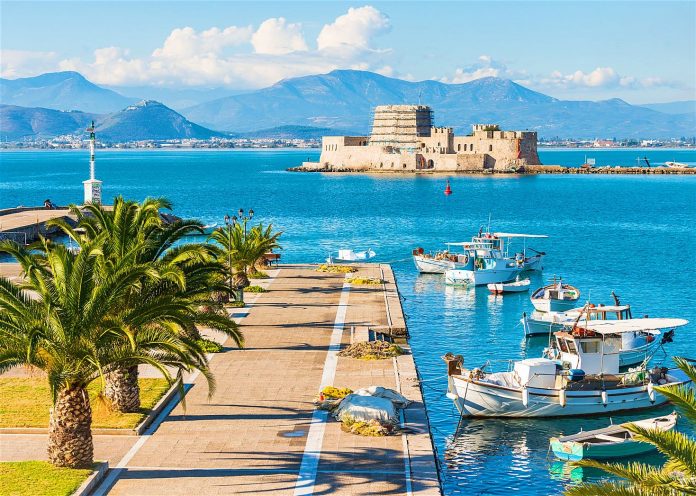
A paved jetty lined with palm trees, with boats next to it in the harbour; beyond is a fortress on an islet, with mountains on the coastline further away still. The town of Nafplio on Argolis peninsula boasts fortresses like Bourtzi, an islet in the harbour

Explore pretty Nafplio and the ancient Argolis region

One of the longest-inhabited regions in Greece, the Argolis peninsula also has the country’s highest concentration of major ancient sites, like the mythical fortress of Agamemnon at Mycenae or the spectacular Theatre of Epidavros, still in use every summer weekend. Nafplio, the first capital of modern Greece, is one of the prettiest towns in the country, with splendid Venetian and neoclassical architecture and fortresses like the hilltop Palamidi (a famous 999-step climb) or Bourtzi (a small fortified islet in the harbour). Plenty of elegant boutique hotels, tasteful shops and small restaurants hidden in narrow alleys make Nafplio a hugely popular destination for a day hop or a longer stay. Further south is the posh resort of Porto Heli, where Greek and international jetsetters own luxurious villas and mansions. The region also has some agreeable sandy beaches and numerous local wineries, many open to the public.

Getting there: Take the intercity bus (KTEL) from Athens terminal station (Kifisou 100). You can check the timetable and book online.

The well preserved remains of an ancient stone theatre on a mountainside; there is a lovely view down into a green valley below, surrounded by further mountain peaks. The ancient theatre at Delphi commands a stunning view

Visit the Navel of the World at Delphi

Myths, history and spectacular mountains meet at Delphi – just as in Greek mythology the two eagles released by Zeus met there, determining the Navel (or centre) of the World. The Sanctuary of Apollo, built in the 7th century BC, was a revered ancient oracle and home to Pythia, the priestess who mumbled her notoriously ambiguous answers on important or everyday matters to visitors from every walk of life. A stadium high on the hill, an ancient theatre and Tholos (a circular temple, probably the most photographed landmark of the site) together with a small but significant museum, keep attracting the modern-day crowds. The idyllic clifftop village on the slopes of Mt Parnassos, overlooking the endless olive groves that surround the sanctuary, is buzzing with taverns and souvenir shops catering to day trippers.

Getting there: Take the intercity bus (KTEL) from Athens terminal station (Kifisou 100). Check the timetable and buy tickets online.

Fishing boats in the harbour at Hydra, with the town's houses huddled on a hillside behind them. The tranquil island of Hydra is ideal for long walks as it’s completely car-free

Go for long strolls on stunning Hydra

Gorgeous Hydra is a rocky island with a rich history and spectacular, well-preserved stone mansions that once belonged to great naval families and captains of the Greek Revolution. The town is built on the hillside around a stunning harbour; it has a tranquil allure like no other Greek island as it’s completely car-free. Numerous small museums, art galleries and boutique hotels, together with the ever-present yachts docked in the harbour, contribute to its classy aura and more than make up for the lack of beaches.

Getting there: Hydrofoils from the harbour of Piraeus take from 1 hour 40 minutes to 2 hours. Buy tickets online.

A lamppost decorated with a wicker hanging basket of flowers next to a seaside bench, in Halkida on Evia island. The town of Halkida on Evia island is perfect for a relaxing break, with clean beaches and fresh seafood

Taste Greek small-town life in Halkida

Built on the channel that separates the island of Evia from the mainland, and famous for the six-hourly change in the direction of the water’s flow, Halkida can’t claim the title of tourist magnet by any means. Nevertheless, it’s a pleasant seaside town worth visiting if only for a relaxing break from a hectic city-sightseeing itinerary and for a taste of Greek small-town life. There are also plenty of good, clean beaches nearby, as well as countless seaside restaurants where you’ll enjoy extremely fresh seafood, with far more variety than you’ll see in Athens.

Getting there: Halkida is an hour’s drive from Athens via the main motorway to Thessaloniki. It’s also accessible by intercity bus (KTEL) from Athens terminal station (Kifisou 100; buy tickets online) or by train from Athens central station (tickets can be booked online).

One of the best day trips from Athens is to the ruins of the temple of Poseidon at Cape Sounion, which are lovely at sunset as seen here: the columns of the temple are bathed in dying sunlight and we see silhouettes of islands in the distance in the sea. Cape Sounion with its ruins of the temple of Poseidon is famous for glorious sunsets

Enjoy a Sounion sunset and visit the Marathon battlefield

You can easily spend a whole day at either of these close-by destinations but if your schedule is tight, they both make perfect half-day trips. Cape Sounion, at the southernmost tip of Attica, is where the splendid Temple of Poseidon is located – this is one of the best spots around Athens to savour a gorgeous sunset. It can be combined with lunch or dinner at one of the many fish taverns in the nearby working-class town of Lavrio. Northeast of Athens, Marathon is the site of one of the greatest battles in history and the place where the modern Athens Marathon commences, following the steps of Pheidippides, the legendary ancient courier who first ran the glorious route. The archaeological museum, the tomb of Athenians fallen in the battle, and the lake with its dam are the main attractions of the area.

7 magical destinations for anybody fascinated by witches

0

Witches and witchcraft have been both hated or revered throughout human history; loved as skilled healers or feminist icons, feared as handmaidens of the devil and practicioners of mysterious dark arts. As a result, witch lore pops up all over the world and sometimes in surprising modern day incarnations. Here are 7 destinations with a rich witchy history or a thriving tradition of mystic healing.

Catemaco, Mexico

A flaming seven pointed star is in the background. Two men stand in the foreground, with one man raising a sword in the middle of the frame. Wizard Hector Betaza, raises a sword during a black mass as part of the annual International Congress of Witches in Catemaco (c) Ronaldo Schemidt/AFP/Getty

Alongside Catemaco’s beautiful waterfalls and untouched beaches, the main tourist attraction is their long history of sorcery, mainly practiced by male brujos. Black and white magic are on offer throughout the year, although debate rages among locals about who is a con artist and who is an earnest practitioner of shamanic beliefs.

The exact origin of those rituals have largely stumped anthropologists but the general consensus is they’re a mix of pre-Hispanic beliefs that are now mixed up with Catholicism. Even the mayor is a brujo and heads up the annual Ritos, Ceremonias y Artesanías Mágica, a three-day event that starts on the first Friday of March with a ‘black mass’ near the town’s lake, attracting tourists and purveyors of fortunes, spells and potions.

Harz Mountains, Northern Germany

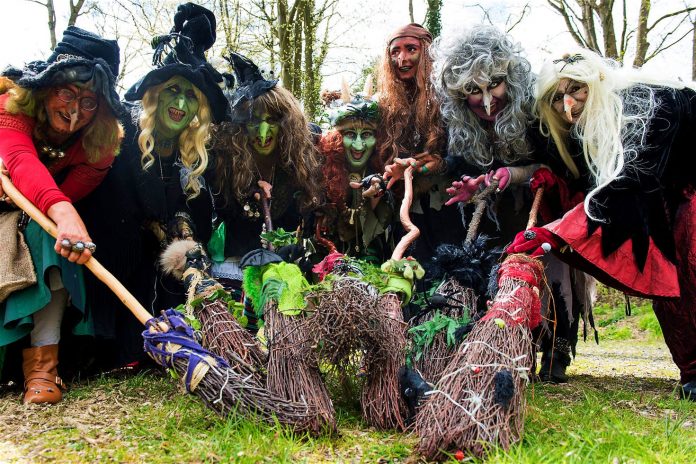
Seven women dressed in wigs and big hats, covered in face paint and fake noses and warts. They each hold a broom which they’re pointing towards the camera. Women dressed as witches practicing for Walpurgis night (c) Swen Pförtner/picture alliance via Getty

The Brocken, the highest peak of the Harz mountain range has long been associated with witchcraft and legends, with some sources associating it with sacrifices to the ancient Saxon god Woden (Odin of Norse legend). The peak was also said to be the meeting point for witches on Walpurgisnacht or Hexennacht, the night of 30 April. The legend was immortalised in Goethe’s ‘Faust’ and in recent years Walpurgisnacht has made a resurgence to embrace its pagan roots, turning away from being a Christian festival to protect against witches to instead be a chance to dress up and dance with them instead.

Variations are held in various parts of Eastern Europe and Scandinavia but it remains a quintessential German tradition and Harz Mountains is the epicentre. As well as festivities on the Brocken itself, the nearby towns of Thale, Wernigerode and Goslar go all out, including a thrilling ‘storming of the city hall by witches’. The Hexentanzplatz (meaning ‘dancefloor of the witch’) is home to creepy sculptures of witches and devils all year around and, for the more botanically-inclined witch, the hiking trails are extremely popular all year round.

New Orleans, USA

A framed picture stands in the middle of an altar with a photo of a woman with long fingernails in a white turban, clothes and earrings holding a crystal ball. Strings of beads surround it, along with coins, gum packets, pens and a heart-shaped box. Voodoo altar at New Orleans Historic Voodoo Museum (c) Kris Davidson/Lonely Planet

Forget Salem with its broomstick memorabilia, New Orleans is the real home of magic in the USA, thanks to its rich history of Voodoo. The city’s unique mix of West African spirits and Roman Catholic saints has survived since the 1700s in thanks in part to the enduring legend of Marie Laveau, a famous healer and voodoo priestess. So popular is her legacy, you can only visit her final resting place by guided tour as people still wish to mark an ‘X’ on her tomb in the hope she’ll grant their wish.

The modern practice of Voodoo is fairly limited in the city today but you can dig deeper into the history thanks to the Historic Voodoo Museum in the French Quarter or with one of the many tours. For more neo-Pagan vibes, you can pop into Hex for readings, crystals, herbs and more, with plenty of formulas inspired by West African traditions and Laveau herself.

Siquijor, Philippines

Roots, twigs and tree barks soaked in liquid are the essential ingredients in Siquijor potions (c) John S Lander/LightRocket via Getty

Dubbed the ‘Island of Witches’ by Spanish colonisers in the 1600s, Siquijor still maintains a strong tradition of local healers (mananambal) and hexers (mambabarang). The mananambal throw a huge Healing Festival the week prior to Easter, the culmination of seven weeks of gathering natural ingredients every Friday during Lent. The result is the ever-popular love potions or healing herbs, while rituals and readings are also on offer.

A 400-year-old Balete tree is also a supposedly enchanted place. The oldest and biggest of its kind in the province, it’s also home to a spring that comes directly up from its tangled roots. Once said to be the home to rituals and supernatural creatures, these days, you are more likely to encounter souvenir sellers.

Blå Jungfrun Island, Sweden

A stony beach after sunset with a sliver of pink in the sky. On the left background is an old timber hut with one bare tree next to it. Blå Jungfrun is said to be the real-time counterpart of Blåkulla (c) Gustaf Emanuelsson / Folio

According to legend, this is the real-life location of Blåkulla, an island where witches convened with the devil and was once accessible only by flight. For many years, offerings were left on the shores of the island in the hope of appeasing the strange creatures that might live there. Now a national park, it’s home to an intriguing stone labyrinth and archaeologists have recently found evidence of prehistoric altars and rituals in some of its caves.

While visitors are now welcome on this uninhabited island, it maintains an air of foreboding for many. Everyone must be off the island before nightfall and stick to the paths while there. It’s also forbidden to take any of the stones from the island, an act which is also said to bring you bad luck. Stones are regularly posted back by remorseful tourists so don’t say you weren’t warned.

Pendle Hill, Lancashire, UK

England’s most famous witch trial took place around Pendle in the 17th century and is a fascinating story of two matriarchal households, the Demdike and Chattox families, effectively destroying each other with accusations of witchcraft. Many historians now believe the heads of these families probably advertised themselves as practicing witches and the trade may have been a common one in the area known as ‘witching country’.

A stone wall at the foreground of the image framing grass and the sun peeking out from behind cloud cover with a hill in shadow in the background. Pendle Hill is in the middle of England’s ‘witching country’ (c) Lukasz Puch/Getty

On the trial’s 400th anniversary in 2012, an 82 kilometre footpath named the Lancashire Witches Walk was unveiled, leading from Barrowford to Lancaster Castle where the accused men and women were tried. Recent discoveries in the area have included a so-called ‘witch’s cottage’ complete with mummified cat found bricked up in the walls and historians are still searching for Malkin Tower, the home of the alleged Demdike coven.

Lima, Peru

Shamanism has long and deep roots in Peru and is thought to have emerged in tandem with the culture of building magnificent temples all around the country. Traditionally, the shamans would use natural hallucinogens to speak to the the spirit world and gods and now there are tour companies that offer to connect you with a shaman and a safe space for you to experience this for yourself.

Tourists can get a glimpse into the shamanic traditions courtesy of Lima’s Mercado de las Brujas (the Witches’ Market) underneath the Gamarra Station. Here sellers offer all sorts of traditional folk cures for what may ail you, including a variety of unusual uses for snake fat, frog innards and llama fetus.


The US’ 10 best historic homes to visit with your family this summer

0

You can read an author’s entire body of work, study a president’s legacy, or celebrate the achievements of a civil rights hero, but nothing gives you a true understanding of a famous figure like a visit to the place she or he lived. Their home is their sanctuary for creating their art, developing and carrying out their righteous mission, or simply experiencing life in a setting that influenced them. Here are a few historic homes that deliver a thorough education and, if you’re open to it, inspiration.

The white facade of the Truman House surrounded by orange leaves; historic homes The house on the Harry S. Truman National Historic Site captures the life and times of the 33rd president / Courtesy of City of Independence Department of Parks, Recreation and Tourism

Harry S. Truman National Historic Site: Independence, Missouri

From 1919, the year he married Bess Wallace, until his death in 1972, President Harry S. Truman lived in a simple Victorian home in, fittingly enough, Independence, Missouri. (During his eight-year residency on Pennsylvania Avenue, it was known as the ‘Summer White House’)

A wander through this home delivers an intimate look at the life of the World War I veteran and 33rd American President. Like most presidential homes and memorials, this one is part of the National Parks Service and tours by park rangers happen regularly. The home is so loaded with period details, family heirlooms, personal objects and memorabilia that a guided tour is well worth it.

Susan B. Anthony House: Rochester, New York

One of the cornerstones of American democracy – a woman’s right to vote – took root at a modest, pre-Civil War brick house in Rochester, New York, which is located about 90 minutes from Niagara Falls. Pioneering activist Susan B. Anthony turned her house into the headquarters of the suffrage movement, and when she wasn’t campaigning across the country, she was organizing from the parlor here, often with anti-slavery activist Frederick Douglass and fellow women’s rights activist Elizabeth Cady Stanton.

Check out the third-floor attic, where she penned many political documents, and the second floor features a collection of memorabilia that tell the story of the suffrage movement.

John Fitzgerald Kennedy National Historic Site: Brookline, Massachusetts

America’s 35th president was born and raised just outside of Boston, in the ritzy suburb of Brookline, and to this day, the unassuming home where he spent the first three years of his life stands as a monument. It’s a museum-like destination showcasing Kennedy family mementos and photographs.

The exterior of the Morris-Jumel Mansion under a blue sky; historic homes Through its history, the Morris-Jumel Mansion saw the likes of Washington, Jefferson, Hamilton and many others

Morris-Jumel Mansion: New York, New York

George Washington, Thomas Jefferson and Alexander Hamilton are just a few of the notables who dined in the Morris-Jumel Mansion, a country retreat built in 1765 on an elevated perch overlooking Manhattan in what is now the Sugar Hill neighborhood of Harlem. It was commissioned by Roger Morris, a colonel in the British Army, and his wife Mary. But in 1776 it was seized by the Continental Army and transformed into General Washington’s HQ.

About 35 years later, it was purchased by wealthy businessman Stephen Jumel who pulled out all the stops to refurbish it. Known to be the oldest house in Manhattan, its period details have been carefully maintained, much to the joy of locals over time. (Duke Ellington once deemed it ‘the jewel in the crown of Sugar Hill.’)

Edgar Allan Poe House & Museum: Baltimore, Maryland

The city of Baltimore pays tribute to its longtime resident Edgar Allan Poe in many ways, such as naming its football team the Ravens, in honor of his famous poem. A visit to Charm City can be a Poe-filled pilgrimage, what with Enoch Pratt Free Library’s original manuscripts and his grave at Westminster Hall and Burial Ground.

Of course, the best way to learn about the American icon and his celebrated work is to visit the Edgar Allan Poe House and Museum, a modest building where he lived for much of the 1930s with his teenage cousin/bride, Virginia, and her mother. His workroom sits at the top of a narrow and fittingly creaky staircase while the rest of the house, which became a National Historic Landmark in 1962, has exhibits on his life in Baltimore, his family and the poems and stories he penned.

Paintings inside the Emily Dickinson Museum; historic homes The contemplative home where Emily Dickinson penned her poems

Emily Dickinson Museum: Amherst, Massachusetts

The tranquil woodsy landscape of Amherst Massachusetts, about 95 miles west of Boston, is the setting where Emily Dickinson penned her contemplative, radical verse. The Emily Dickinson Museum is set in two historic properties – the Evergreens, her brother and sister-in-law’s house, and the Homestead, a two-and-a-half-story brick house, where the famously reclusive Dickinson was born and spent most of her Victorian-era life writing countless poems, only ten of which were published – allegedly without her knowing – during her lifetime.

Wander the Homestead for a look at her parlors, library, kitchen and maid’s quarters and check out ‘my Voice is alive,’ an interpretive exhibit about her early work.

Louis Armstrong House: Queens, New York

The brick house on 103rd Street in the working-class neighborhood of Corona, Queens, doesn’t look like much from the outside, but inside is a time capsule that tells the story of one of America’s most iconic musicians. Louis Armstrong, who grew up poor in New Orleans, lived out his retirement years with his wife, Lucille, in this gorgeously appointed home, which today stands as a tribute to the legend.

The charming kitchen, the opulent bathroom and bedroom, the handsome wood-paneled office featuring original recording equipment, and the inviting living room, packed with souvenirs that Satchmo collected on his global travels, have all been maintained with attention to detail.

An exterior of the George Eastman Museum, with orange leaves surrounding The founder of the Eastman Kodak Company, George Eastman lived on 10.5 acres in Rochester, New York

Eastman Museum: Rochester, New York

Photography museums and galleries proliferate the planet, but the oldest in the world is in Rochester, New York at the estate of George Eastman, founder of the Eastman Kodak Company. A National Historic Landmark since 1966, the Eastman Museum is set on 10.5 picturesque acres and contains works from more than 14,000 photographers, including celebrated contemporary artists like Andy Warhol and Cindy Sherman, the world’s largest collection of daguerreotypes, and vintage prints from luminaries like Ansel Adams.